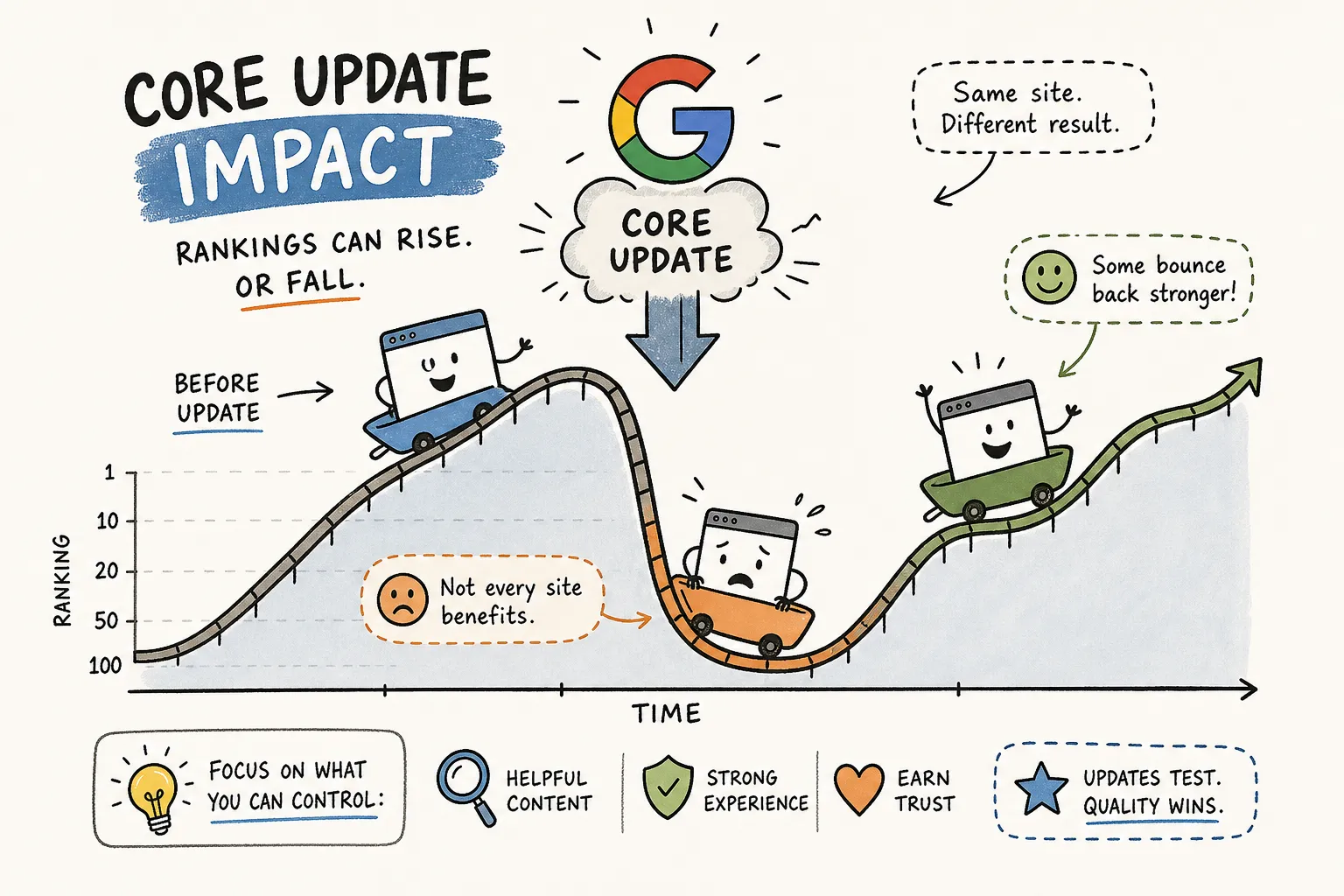
You open Google Analytics on a Monday morning and organic traffic has collapsed. Pages that held steady for months have dropped off the first page. Revenue is down, but Search Console shows no manual actions, no security issues, no crawl errors, just a clean interface and a very ugly chart. That is what a Google core update impact looks like in real life, and it happens to thousands of sites every time Google rolls one out.
If you are asking how Google core updates affect your website rankings, you are probably already staring at a drop and wondering whether to panic or wait. The answer is neither: you diagnose first, then act. Google releases several broad core updates per year, and at AISEO Round Table we track every one of them closely because our community is made up of exactly the kinds of sites that feel these shifts hardest, bloggers, freelancers, affiliate marketers, and small business owners. According to the Google Search Status Dashboard, the March 2026 Core Update wrapped up on April 8 and the May 2026 Core Update completed on June 2. If your traffic dropped anywhere near those windows, you need a clear-headed diagnosis before you touch a single page.
This guide walks you through confirming the cause, reading the data correctly, understanding what Google actually measures, and following a prioritized recovery plan. No speculation, no vague advice about “creating better content.”
What Google core updates are and how they work
Google makes thousands of algorithm changes every year. Most are small, targeted adjustments that affect specific ranking factors or spam patterns. Broad core updates are different: they re-evaluate how Google’s systems assess content quality across the entire web. When a core update rolls out, Google is not reacting to a specific piece of broken code or a particular spam tactic. It is recalibrating which pages best satisfy user queries across virtually every topic and industry.
Google announces these updates on the Google Search Central blog and via the Search Status Dashboard. Rollouts typically run one to three weeks, and the recent pattern has been roughly 12 to 18 days per update. That timeline matters because the data you see during an active rollout is noisy. Google explicitly advises against drawing conclusions from day-to-day fluctuations while an update is still deploying. Wait until the rollout finishes, then analyze.
As Google’s own webmaster guidance explains, a core update does not mean Google found something wrong with your site. It means Google re-evaluated the competitive landscape and other pages now compare more favorably for certain queries. Your content did not necessarily get worse; the bar got re-measured. That distinction changes everything about how you approach a recovery.
How do Google core updates affect my website rankings?
The short answer: core updates change which pages Google considers the best match for a given query, across the entire web, all at once. Your rankings shift when pages that previously outranked you drop, or when pages that previously ranked below you rise. The effect can be dramatic even if nothing about your site changed.
In practice, Google core update impact shows up in three patterns. First, a broad drop across many pages in one topic area suggests a topical authority or E-E-A-T issue. Second, a drop concentrated on specific page types, reviews, how-to guides, or comparison pages, points to intent alignment or content depth problems. Third, a scattered drop across unrelated pages often signals site-wide quality signals like thin content spread across too many URLs. Identifying which pattern applies to your site shapes every subsequent decision.
How to confirm a core update actually hit your site
Before changing anything, confirm the cause. A traffic drop that looks like a core update can also come from a technical issue, a manual action, seasonality, or a different targeted update like a spam or helpful content update. Misidentifying the cause means applying the wrong fix.
Start by cross-referencing your traffic drop date with the official Google update timeline on the Search Status Dashboard. If your traffic fell sharply within a few days of a known update’s start date, that is your first signal. If the drop happened well outside any known update window, investigate technical causes first, crawl errors, indexing issues, or a broken redirect chain, before assuming a core update is responsible.
From there, open Google Search Console and run a date comparison in the Performance report. Set the first range to the week before the update started and the second range to the week after it finished. This is the comparison method Google recommends because it isolates the update’s effect from background noise. Review clicks, impressions, average position, and top queries side by side. Focus on which specific pages and queries dropped the most, not just overall totals.
Third-party volatility tools like Semrush Sensor and Sistrix are useful as supporting evidence. If those tools showed high volatility scores during the same window, that confirms Google was broadly reshuffling rankings, which rules out isolated technical causes on your end. That said, broad market volatility does not prove your specific site was affected. The GSC data is what actually confirms impact on your property.
The quality signals behind ranking drops and gains
Understanding what Google is measuring helps you stop guessing. Core updates are primarily a re-evaluation of content quality and relevance, and the clearest framework Google has published for this is E-E-A-T: Experience, Expertise, Authoritativeness, and Trustworthiness. Of the four, Google frames Trust as the most central signal, with the others feeding into it.
In practical terms, E-E-A-T shows up through signals Google can observe: author credentials on the page, first-hand experience demonstrated in the writing, editorial transparency, clear sourcing, and whether the site maintains a focused, consistent topic area. Sites that publish well outside their established niche often dilute their perceived authority. If your affiliate review blog started covering general health advice, core updates tend to surface that kind of topical spread as a quality concern.
Content depth and search intent alignment are the other major failure modes in core update ranking drops. Pages that decline are often technically answering the query but not genuinely satisfying the user. Google is comparing your page against what is currently outranking you, not against what ranked when you first published. Shallow coverage, generic information without unique perspective, and outdated intent alignment are the patterns that show up consistently in post-update ranking losses tracked by analysts like Glenn Gabe and Marie Haynes.
User experience factors reinforce these quality signals. When users land on a page and return to search results quickly, that behavioral pattern strengthens a poor quality assessment. Slow Core Web Vitals, intrusive ad layouts, and unclear content structure are not standalone ranking factors, but they make weak content look weaker when Google compares it against cleaner, faster competitors during a core update cycle.
How to audit your site after a ranking drop
Start with the GSC data you already pulled. Export the pages and queries with the largest position drops, then sort by traffic impact. A page that dropped from position 6 to position 9 is far less urgent than one that fell from position 3 to position 18. Group the affected pages by content type or topic cluster to spot patterns, did your product review pages drop? Your how-to guides? A specific topic area? Patterns reveal more than individual page problems.
Content comparison checks
For each priority URL, search the main query and study the pages currently outranking you. Ask specific questions: Is their content more comprehensive? Do they show clearer author credentials or first-hand experience? Is the format, depth, or structure better suited to how people are actually searching? This is not about copying what competitors built, it is about identifying where your content is genuinely weaker in ways Google can measure, then closing those gaps with real substance.
Technical checks
Run a basic technical check on your affected pages: Core Web Vitals scores, mobile usability, internal link depth, and whether pages are being crawled and indexed efficiently. Core updates are not technical updates, but technical friction compounds quality issues. A well-researched page that loads slowly or has poor mobile layout compares less favorably against a competitor with equivalent content and a faster, cleaner experience. AISEO Round Table’s Step-by-Step SEO Audit Guide for Better Rankings, AISEO Round Table covers exactly this step, or you can start with Google’s Core Web Vitals documentation and mobile usability report in Search Console.
Your prioritized recovery plan: what to fix and when
Prioritize the highest-traffic pages that dropped the most. Those offer the best return on effort, and improving them first signals quality changes to Google across the most impactful part of your site.
The highest-return improvements involve rewriting thin content with genuine depth and first-hand perspective, adding author bylines and credentials where they are missing, and consolidating multiple pages that target the same intent into one stronger, more authoritative resource. One example of a change that does not work: adding two or three sentences to a thin post without addressing the actual depth gap. Surface-level edits are exactly what Google’s guidance warns against, and they rarely move rankings.
Other things to avoid during an active rollout: mass-deleting pages, blocking crawlers, or making sweeping site-wide technical changes before you have a clear diagnosis. Changes that genuinely help users are the ones that move rankings. Changes that only look like improvements on a checklist do not.
Frame recovery as a sustained process. According to recovery analyses from the SEO community (see the March 2026 Core Update ranking drops recovery plan) and consistent with Google’s own guidance on re-evaluation timelines, visible improvement typically takes three to six months for most sites, and harder-hit sites, particularly those in YMYL categories, often do not see meaningful recovery until a subsequent core update confirms the improvements. Build a simple weekly tracking log: check GSC every week for movement on your priority queries and pages. Progress looks like impressions rising before clicks catch up, and average position improving on target queries before traffic numbers reflect it.
Watch engagement metrics on rewritten pages as early signals too. Lower bounce rates and better time-on-page suggest your revisions are resonating before ranking changes are visible. Some gains from earlier core updates do not fully surface until the next core update cycle validates them. Consistent improvement over time is the actual recovery strategy.
How to stay ahead of the next algorithm change
Sites that weather core updates well are the ones that already have a monitoring routine before the update hits. A quick weekly check covers the essentials: scan the Google Search Status Dashboard for announced updates, review GSC Performance for sudden impression drops compared to the prior week, and check your rank tracker for movement on priority keywords. For a practical walkthrough, see the guide to Google core updates. The actual time required depends on your site’s size and toolset, but catching a drop within days of a rollout gives you a meaningful head start on diagnosis before traffic damage accumulates.
Now that you understand how Google core updates affect your website rankings, the recovery plan executed consistently over weeks is what separates sites that bounce back from those that stay suppressed through multiple update cycles. Algorithm changes are a permanent feature of SEO, not an occasional disruption. Building the monitoring habit now protects you the next time the same way this guide helped you with the last one.
Google Search Updates, Algorithms & SEO News | AI SEO Roundtable publishes breakdowns of major algorithm changes as they happen, along with actionable E-E-A-T guides (for example, Google Core Update December 2025) and a technical SEO checklist built for people running this process without agency support. If this article confirmed your site was hit and you are ready to work through the fixes, those are your next two stops. Many sites recover from core updates through focused in-house audits and consistent improvements, though some situations, particularly complex technical issues or competitive YMYL niches, may benefit from outside expertise. Either way, what you need most is honest data, a clear plan, and enough time to let Google see the work.