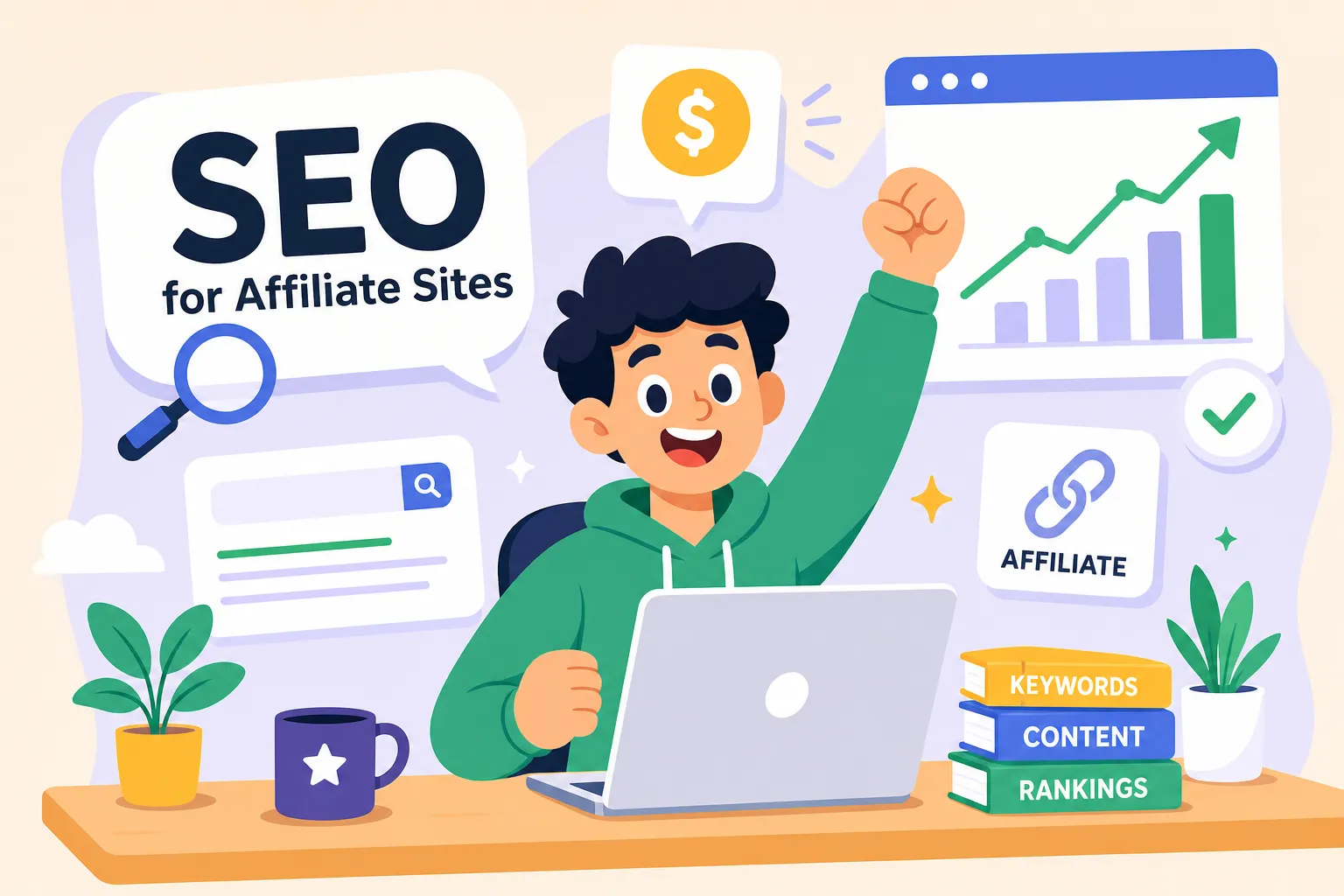
If you’ve been asking yourself how to do SEO for an affiliate marketing website and not getting clear answers, you’re in the right place. Many affiliate sites fail to rank in part because they target the wrong intent, they write content for people who are curious, not people who are ready to buy. That mismatch explains why plenty of well-written affiliate pages sit on page three of Google, earning nothing, while leaner pages above them collect commissions every day.
Affiliate SEO for a marketing website is a system with a clear sequence: find buyer-intent keywords, build content that converts, fix technical blockers, link your pages strategically, earn external authority, and track the results. Each step builds on the last, and skipping any one of them creates a gap that limits what the others can do.
Throughout this guide, you’ll find references to tool-specific tutorials and reviews published here at AISEO Round Table, including in-depth breakdowns of KWFinder and Mangools. If you want step-by-step guidance on any tool mentioned, those guides are available on this site. For now, here are the six steps that form a complete affiliate SEO plan.
1. How to do SEO for an affiliate marketing website: finding buyer-intent keywords
Why search intent beats search volume every time
Search intent is the difference between a visitor who reads your post and one who clicks your affiliate link. Consider a VPN niche: “how does a VPN work” is informational, the searcher wants to learn. “Best VPN for streaming” is commercial, they’re evaluating options. “NordVPN coupon” is transactional, they’ve already decided and want a deal. Only the last two generate affiliate revenue, and the transactional one typically converts at the highest rate.
Chasing volume without checking intent is the most common reason beginner affiliate sites stall out. A keyword with 10,000 monthly searches that attracts pure browsers will often be less valuable than a 400-search term that pulls in buyers at the final decision stage, though the actual difference comes down to your conversion metrics: affiliate CTR, conversion rate, and revenue per visitor. For deeper reading on classifying buyer intent, see Ahrefs’ guide to buyer-intent keywords.
The keyword modifiers that signal buying intent
Certain modifier families consistently attract purchase-ready traffic. Transactional modifiers, “buy,” “coupon,” “discount code,” “pricing”, sit at the top of the conversion hierarchy. Commercial modifiers, “best,” “review,” “vs,” “alternatives”, convert slightly lower but generate strong affiliate revenue across a much broader keyword set. Moz’s write-up on keyword intent is a helpful reference when you’re building your modifier lists and mapping intent to content types: Moz’s breakdown of keyword intent.
In a software niche, that pattern looks like this: “Jasper AI coupon” (transactional, very high conversion), “Jasper AI vs Copy.ai” (commercial comparison, high conversion), and “best AI writing tools” (commercial research, strong conversion at scale). All three earn commissions. The first earns the most per visitor. The third drives the most total clicks because it covers multiple affiliate links.
How to find low-competition affiliate keywords with KWFinder
KWFinder calculates keyword difficulty primarily from the backlink strength of pages already ranking in the top ten, a methodology the tool documents in its help center. For a newer affiliate site, that score works best as a comparative filter: use it to stack keywords against each other, not as a guarantee of ranking success. A low difficulty score matters most when the pages currently ranking also have thin content, weak backlink profiles, or a mismatch with the actual search intent.
AISEO Round Table’s KWFinder review and Mangools breakdown walk through the exact filtering process, including which difficulty thresholds and volume ranges make sense for newer sites. If you’re new to these tools, start there before building your keyword list. For a complete walkthrough on analyzing competitor keywords and turning those insights into a practical target list, see Master Competitor Keyword Analysis for SEO Success, AISEO Round Table.
2. Building affiliate content that ranks and converts
Choosing the right format: reviews, comparisons, and roundup lists
The format you choose should match where the searcher sits in the buying journey. Single-product reviews work best when someone is searching for a specific product and asking whether it’s worth buying, that intent is close to a purchase, and conversion rates reflect that. Comparison pages capture “A vs B” queries at the final decision stage. In our testing and analysis of affiliate content performance, comparison pages tend to generate more affiliate link clicks than single-product reviews because they reduce decision friction right when a reader is choosing between two options.
Best-of roundups target broader “best [category]” searches and typically drive more total outbound clicks because they feature multiple affiliate links. The conversion rate per visitor is slightly lower than reviews or comparisons, but the volume potential is often much higher. For most affiliate sites, a healthy content mix includes all three formats, each targeting a different stage of the buyer journey.
The on-page structure that earns rankings and clicks
An affiliate page that ranks needs a keyword-matched H1, a short verdict or recommendation in the opening paragraph, and a comparison table above the fold. Below that, detailed sections covering real features, honest drawbacks, and who the product is actually for will outperform templated content every time. A pros/cons block and a clear call-to-action before the conclusion round out the structure.
The detail that separates rankable affiliate content from thin pages Google continues to filter out is original, hands-on findings. If your review reads like it was assembled from a product marketing page, it won’t hold rankings. Real-use observations, specific limitations, and genuine opinions are what make a page worth ranking.
Schema markup that helps your pages stand out in SERPs
Use Product schema on single-product review pages, Review markup when the page contains a substantive original evaluation of that specific item, and FAQPage schema only when you have a real FAQ section with visible questions and answers. All three schemas should be implemented in JSON-LD, and the markup must match the visible page content exactly.
The practical rule: mark up only what is genuinely on the page. Google’s structured data documentation is explicit on this, schema is treated as a hint, not a free pass to rich results, and marking up content that doesn’t exist on the page can work against you. One clear, accurate schema type per page purpose is more effective than stacking multiple types hoping one sticks. For concrete examples and implementation notes on rich snippets for product pages, see Practical Ecommerce’s guide to using rich snippets for product pages.
3. Internal linking strategy that protects your money pages
Building a topic cluster around your affiliate niche
The hub-and-spoke model translates directly to affiliate sites. Informational guides, like “how does project management software work” or “project management tools for small teams”, act as spokes. The commercial page, like “best project management software”, is the hub. Internal links from your informational posts pass authority to the commercial pages and signal topical depth to Google.
This structure also means you don’t have to build external links to every affiliate page individually. A strong informational post that earns links from other sites passes a share of that authority to your money pages automatically. In practice, a topic cluster of five to ten informational spokes supporting one hub page gives Google enough topical signal to treat the hub as an authoritative result in your niche. For a full implementation guide on internal linking patterns and best practices, see our Complete Guide to Internal Linking in SEO, AISEO Round Table.
Anchor text rules for affiliate internal links
Use exact-match anchor text sparingly on monetized pages. When the page is clearly an affiliate review and the internal links all point to it with exact-match commercial anchors, it can look manipulative to Google. The practical standard is to link with phrases a real editor would write: partial-match phrases, natural descriptive text, or contextual references that make sense to a reader without knowing the target page’s keyword.
To make that concrete: “our full review of Jasper AI” or “which writing tool came out on top” are both natural anchors. “Best AI writing tool review” repeated across every internal link is not. Vary the phrasing the way you’d vary it in editorial copy, and you’ll stay well inside what Google considers normal linking behavior.
4. Technical SEO basics your affiliate site can’t skip
Indexation and crawlability: the first check to run
Three indexation problems appear repeatedly on affiliate sites: accidental noindex tags on commercial pages (sometimes left over from development or a plugin setting), robots.txt rules that block the wrong directories, and HTTP/HTTPS or www/non-www duplicate versions splitting crawl budget and link equity. All three are easy to miss and expensive to leave unfixed. If you’re unsure where to start fixing these, this post on common website technical SEO issues explains how to resolve many of them.
Run your most important affiliate URLs through Google Search Console’s URL Inspection tool. It shows whether the page is indexed, what Google last crawled, and whether any indexing issues were detected. Check this before assuming a ranking problem is a content or link problem.
Duplicate content from affiliate tracking parameters
When affiliate tracking parameters or session IDs are appended to your URLs, search engines can treat each variant as a separate page. That splits link equity, confuses crawlers about which version to rank, and wastes crawl budget on pages that shouldn’t exist in the index.
The fix has two parts. First, place a self-referencing canonical tag on your clean URL. Then add a canonical on each parameterized variant pointing back to that same clean URL. You can also configure URL parameter handling in Google Search Console to tell Google which parameters don’t change page content. For tracking values that are purely attribution-based and don’t affect what the user sees, that configuration keeps your preferred URL in control of the ranking.
Page speed essentials for affiliate review pages
Affiliate review pages are among the heaviest page types: product images, comparison tables, and third-party affiliate widgets all add load time. Oversized images and render-blocking JavaScript are the most common culprits, followed closely by too many external tracking tags firing simultaneously. Compress and resize images before uploading, defer non-critical JavaScript, and audit installed plugins for performance cost. Faster pages generally perform better for crawl efficiency and user engagement, Google’s Core Web Vitals guidance targets sub-3s load times as a practical benchmark, though page speed is one ranking factor among many, not a substitute for content quality.
5. Low-risk link building tactics for affiliate sites in 2026
Building linkable assets that fit affiliate content naturally
Affiliate sites have a natural advantage with certain types of link magnets: original product tests, comparison datasets, niche buying guides, and benchmark studies. These assets get cited by bloggers, journalists, and resource pages without aggressive outreach because they fill a real gap. Plan one linkable asset per major topic cluster rather than chasing links page by page. A thorough study comparing ten tools in your niche, with original data, will earn links over months and years after publication.
Outreach approaches that consistently earn links
Broken-link outreach works because it solves a real problem for the site owner. Find a dead resource on a relevant page, confirm the link is broken, and send a short note identifying the broken URL and offering your page as a replacement. Keep the message under 150 words, specific to their page, and easy to act on.
Resource-page pitches follow the same principle: short, specific, and audience-focused. Site owners who curate helpful resources for their readers are open to additions when the pitch is clearly relevant and clearly written for their audience, not for your metrics.
Unlinked brand mention reclamation is often the highest-conversion outreach type because the groundwork is already done. Find articles that mention your site or a product you cover without linking to it, then send a brief, friendly note pointing out that a link would help their readers find the resource more easily. Start with gratitude, make the request feel like a user-experience improvement, and keep it under 100 words. For outreach tactics and building broader authority beyond individual links, see Off-Page SEO: Master Backlinks, Outreach & Authority, AISEO Round Table.
6. Tracking SEO performance alongside affiliate commissions
Connecting Google Search Console data to your affiliate results
Google Search Console shows which queries drive clicks to your pages. Filter by commercial-intent queries, note which pages earn impressions and clicks from those terms, and cross-reference the results with your affiliate dashboard. The goal is to find two types of pages: those that rank well but convert poorly (a content or CTA problem worth fixing) and those that convert well but rank low (an opportunity to push harder with links or content updates).
The metrics that actually move affiliate revenue
Organic traffic alone doesn’t tell you whether your affiliate SEO is working. Start by looking at affiliate click-through rate, how many organic visitors actually click your affiliate links. From there, check the conversion rate on those clicks, and then pull revenue per visitor to see which pages are generating real income. Together, those three numbers show where value is being created and where it’s leaking.
A page with strong traffic but low affiliate CTR has a content or placement problem. A page with strong CTR but low conversion has a product or offer problem. Revenue per visitor tells you which pages to prioritize when you have limited time for updates.
Putting the full system to work
The six steps in this guide form a sequence, not a checklist you can complete in any order. Start with keyword research to make sure you’re targeting buyers, not browsers. Build content in the right format with the right structure. Fix technical issues that block indexation or dilute authority. Use internal linking to direct authority toward your money pages. Earn external links through assets and targeted outreach. Then track the gap between rankings and commissions so you know where to act next.
If you want to go deeper on the tools mentioned throughout this guide, AISEO Round Table’s reviews of KWFinder and Mangools cover the full workflow from keyword discovery to difficulty analysis, with filtering guidance built specifically for smaller affiliate sites. Both guides are available on this site.
Now you know how to do SEO for an affiliate marketing website, the full system, from intent-driven keyword research to affiliate marketing SEO strategies that build authority over time. Pick one step and implement it on your best-performing page this week. Each improvement makes the next one easier, and the sites that rank consistently are the ones that keep working the system, not the ones waiting for a shortcut that never comes.