July 4, 2026 — AI SEO Roundtable
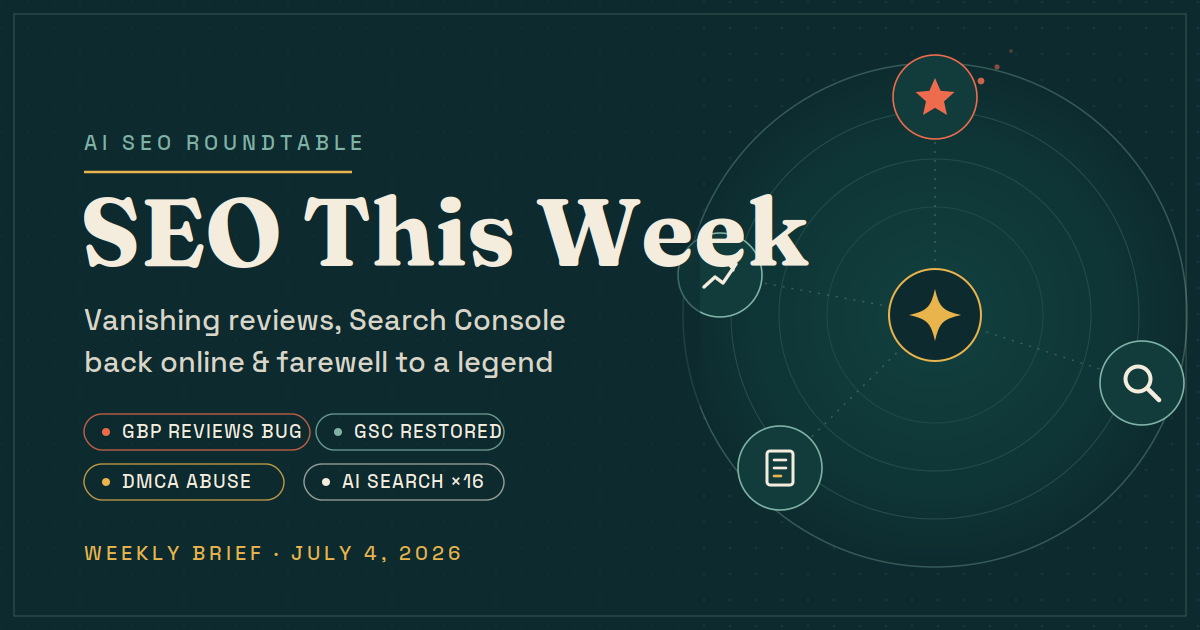
It’s been one of those weeks in search where the news cycle simply refused to slow down. Local SEOs are firefighting a Google Business Profile reviews crisis, technical SEOs finally got their indexing data back, and the entire industry paused to remember one of its founding fathers. Here’s everything you need to know and more importantly, what to do about it.
1. Google Business Profile Reviews Are Vanishing And Google Is Investigating
If you manage local listings and your review counts suddenly cratered this week, take a breath: it’s not just you, and it’s probably not a penalty.
Over the past several days, complaints have flooded the Google Business Profile forums from businesses across every industry reporting that reviews are disappearing from their listings. The scale varies wildly some businesses lost a handful, while others watched thousands of legitimate, organically earned reviews evaporate practically overnight. In some of the more dramatic reports, listings that had accumulated reviews over many years saw their counts collapse to a tiny fraction of what they were within a 24-hour window.
Google has now confirmed it is aware of the missing reviews issue and is actively working to resolve it, which strongly suggests this is a display or syncing bug rather than mass policy enforcement.
Why this keeps happening
If this feels like déjà vu, that’s because it is. Similar review-disappearance waves hit in October 2025 and again in February and March of this year. The pattern is becoming familiar: reviews vanish en masse, panic ensues, and most (but notably not all) reviews eventually return after Google’s systems re-verify them.
Part of the underlying story is regulatory. With the FTC in the US, the DSA in Europe, and the UK’s CMA all pressuring platforms to crack down on fake reviews, Google has been running increasingly aggressive AI-driven moderation of user-generated content. The collateral damage from those sweeps is real businesses losing real reviews.
What you should do right now
- Don’t panic-delete or rebuild anything. If this follows the pattern of previous incidents, most reviews are still stored in Google’s database and simply aren’t displaying.
- Document everything. Screenshot your current review counts and, if you use a review management tool, export your review history. Businesses that recovered reviews in past incidents were the ones with records.
- Report it through the Help Center. Use the Contact Us form, note the dates reviews disappeared, confirm you haven’t violated review policies, and reference that this is a widespread, acknowledged issue.
- Diversify your social proof. This is the third major review incident in nine months. If your entire reputation lives on one Google surface, you’re one bug away from losing it. Build presence on Trustpilot, Facebook, Yelp, and industry-specific platforms too.
2. The Search Console Page Indexing Report Is Finally Fixed
After more than three weeks of stale data, Google has repaired the page indexing report in Search Console and fresh data is flowing again.
For technical SEOs, this delay was more than an annoyance. The page indexing report is the primary diagnostic tool for understanding what Google has crawled, what it’s indexed, and what it’s excluded and flying blind for three weeks during an active spam update cycle (Google’s June 2026 spam update finished rolling out just last week) left a lot of teams unable to verify whether ranking movements were indexing problems or algorithmic ones.
Action item: Now that data is current, do a fresh indexing audit. Compare today’s indexed page counts against your pre-outage baseline, and pay special attention to any pages that dropped out during the June spam update window. If you see unexplained exclusions, this is the week to investigate them.
3. Remembering Bruce Clay, a Founding Father of SEO
The search industry lost one of its true pioneers this week. Bruce Clay widely regarded as one of the founding figures of search engine optimization as a discipline has passed away.
Clay’s fingerprints are all over the industry as we know it. He was teaching, codifying, and evangelizing SEO methodology back when most businesses didn’t know the acronym existed, and the frameworks he developed around siloing, on-page optimization, and ethical SEO practice shaped how generations of practitioners learned the craft. Many of the concepts he championed decades ago remain standard practice today.
For those of us now grappling with AI search, answer engines, and the biggest disruption the industry has ever faced, it’s worth remembering that Clay’s core philosophy build genuinely useful, well-structured content and make it easy for machines to understand is arguably more relevant in 2026 than ever. Rest in peace to a legend.
4. Google’s DMCA Problem Is Becoming a Negative SEO Weapon
A quieter but deeply concerning story continues to develop: the abuse of Google’s DMCA takedown system as a negative SEO tactic.
The DMCA process exists to protect copyright holders, and Google has long complied with legal removal requests. But over the past year, bad actors have discovered they can file fraudulent DMCA claims against content they don’t own and in far too many cases, Google removes the legitimate publisher’s original content from search results based on those bogus claims.
Think about what that means: a competitor or malicious actor can potentially get your original content deindexed by falsely claiming it infringes theirs. The system designed to protect creators is being turned against them.
Protecting yourself:
- Monitor Google Search Console for DMCA removal notices affecting your pages these appear in the removals and manual actions areas.
- Keep clear provenance records for your content: publication timestamps, drafts, CMS logs, and archived versions all help prove original ownership.
- If you’re hit with a fraudulent claim, file a counter-notice promptly. The process is tedious, but publishers who respond quickly have the best recovery odds.
This is a story worth watching. If abuse keeps scaling, expect pressure on Google to add verification friction to the takedown pipeline.
5. The AI Search Drumbeat Continues
No SEO roundup in 2026 is complete without the AI search angle, and this week delivered several notable threads:
Gemini’s AI agents and the rules of SEO. Google’s John Mueller weighed in on whether Gemini’s new AI agents fundamentally change SEO. The short version of the industry takeaway: the fundamentals of crawlable, well-structured, genuinely useful content still apply agents consume the web through many of the same pathways search crawlers do.
Agentic AI has a trap problem. In a related thread, Google warned that websites can expose AI agents to hidden traps as they navigate the open web a reminder that the agentic era brings new technical and security considerations for site owners on both sides of that interaction.
AI referral traffic is exploding. New industry data shows AI-driven traffic to websites has grown roughly 16x between 2024 and 2026. Whatever you call it GEO, AEO, AI search optimization visibility in AI answers is no longer a speculative side channel. It’s a measurable, growing acquisition source that deserves a line in your analytics dashboard and your strategy docs.
Structure determines citations. A recurring theme in this week’s expert commentary: original data helps content stand out, but structure is what determines whether AI systems actually cite it. Clear headings, extractable facts, well-marked-up entities the mechanical clarity of your content increasingly decides whether you get credited in AI answers.
The Takeaway
Three threads run through everything above. First, Google’s systems are increasingly automated and increasingly fallible the reviews bug, the indexing report outage, and the DMCA abuse problem all stem from automated pipelines operating at a scale where errors hit real businesses hard. Second, documentation is your insurance policy whether it’s review exports, indexing baselines, or content provenance, the businesses that recover fastest from platform problems are the ones with records. And third, the AI search transition is accelerating, but the practitioners who built this industry Bruce Clay chief among them left us a playbook whose core principles still hold: make genuinely useful content, structure it clearly, and earn your visibility.
See you at the next roundtable.