Google stopped ranking websites on matching words alone a long time ago. Today it ranks things people, brands, products, places, and concepts and how well it understands the thing behind your website has a direct effect on how visible you are. AI answer engines like ChatGPT, Perplexity, and Google’s AI Overviews have pushed this even further. They don’t return ten blue links; they compose answers about entities they recognize and trust.
Here’s the uncomfortable truth for most small websites: if machines can’t confidently answer “who is this, and what are they an authority on?”, you’ll struggle in classic search and stay invisible in AI answers. The good news is that fixing this doesn’t require a big budget. It requires clarity, consistency, and a handful of technical steps anyone can follow.
This guide explains entity SEO in plain language, shows you how Google and AI systems build their understanding of you, and walks you through a seven-step playbook you can start this week.
What Is Entity SEO?
Entity SEO is the practice of helping search engines and AI systems clearly identify, understand, and trust the “things” your website represents your brand, the people behind it, your products, and the topics you cover instead of relying only on keyword matching.
Where traditional on-page SEO asks, “Does this page contain the words people type into Google?”, entity SEO asks a deeper question: “Does Google actually know what this website is, who runs it, and which subjects it can be trusted on?”
What Exactly Counts as an “Entity”?
An entity is any single, well-defined thing or concept that can be uniquely identified. That includes:
- People: authors, founders, public figures (e.g., a named SEO consultant)
- Organizations: companies, publications, nonprofits, brands
- Places: cities, landmarks, business locations
- Products and creative works: software tools, books, courses
- Concepts: ideas like “keyword research,” “Core Web Vitals,” or “E-E-A-T”
The key property of an entity is that it exists independently of the words used to describe it. “Apple,” “AAPL,” and “the iPhone maker” are three different strings, but they all point to one entity: Apple Inc. Meanwhile, the identical string “apple” can also point to a completely different entity the fruit. Search engines resolve that ambiguity through context, and entity SEO is largely about making that resolution effortless when the entity in question is you.
Entities vs Keywords: Strings vs Things
Keywords haven’t become useless far from it. You still need solid keyword research to understand the language your audience actually uses. What has changed is what happens after someone types a query.
A keyword is a string of characters. An entity is the meaning behind the string. When Google sees the query “jaguar speed,” it doesn’t just look for pages containing both words; it decides whether the searcher means the animal or the car brand, then retrieves pages connected to the right entity. Your job in entity SEO is to make sure that when your brand name, your author names, and your core topics appear anywhere on the web, machines connect them to the correct, consistent entity every single time.
A simple way to remember the difference: keyword SEO gets you into the conversation; entity SEO gets you recognized in it.
Why Entity SEO Matters More Than Ever
Google Has Been Thinking in Entities for Over a Decade
Google launched the Knowledge Graph back in 2012 with the explicit goal of understanding “things, not strings.” Since then, nearly every major algorithm milestone Hummingbird (2013), RankBrain (2015), BERT (2019), and MUM (2021) has pushed the engine further toward interpreting meaning, context, and relationships rather than raw word matching. The Knowledge Graph now connects billions of entities through hundreds of billions of facts, and it quietly powers knowledge panels, “People Also Ask,” and much of what you see on a modern results page.
This shift also explains why E-E-A-T (Experience, Expertise, Authoritativeness, Trust) keeps showing up in every conversation about Google’s most important ranking factors. Experience, expertise, authority, and trust are not attributes of a page they’re attributes of an entity: an author, a brand, an organization. Google can only credit you with them if it knows who you are. If you want a deeper look at how these signals fit together, this plain-language breakdown of how Google ranks pages is a useful companion read.
AI Search Raised the Stakes
Classic SEO gave you a second chance: even if Google half-understood your site, you might still rank somewhere on page one. AI search is less forgiving. When ChatGPT, Perplexity, Gemini, or an AI Overview composes an answer, it names a small number of entities it recognizes and can corroborate and everyone else simply doesn’t exist in that answer.
The scale of this shift is hard to overstate. Google’s AI Overviews are already reshaping the results page, with AI-generated summaries overlapping more than half of traditional organic results. That’s why disciplines like generative engine optimization (GEO) have emerged, and why marketers now debate AEO vs GEO strategy the way they once debated on-page vs off-page.
Underneath all of those acronyms sits the same foundation: entities. Large language models learn about your brand from the text they were trained on and from the live pages they retrieve. If your identity is fuzzy, contradictory, or thinly documented across the web, no amount of prompt-friendly formatting will get you cited. If your entity is clear, consistent, and well-corroborated, you become the kind of source AI systems feel “safe” naming. That’s the real reason entity SEO has moved from an advanced tactic to a beginner essential.
How Google (and AI) Actually Identify Entities
Before the playbook, it helps to understand where machines get their information about you. Three mechanisms do most of the work.
The Knowledge Graph and Knowledge Panels
The Knowledge Graph is Google’s giant database of entities and the relationships between them this person founded this company, which makes this product, which belongs to this category. It’s assembled from sources like Wikipedia, Wikidata, licensed databases, Google Business Profiles, structured data on websites, and patterns extracted from the open web. When an entity is well-established, Google may display a knowledge panel for it. Getting a panel isn’t the goal of entity SEO by itself, but it’s a strong signal that Google has “resolved” your entity successfully.
Structured Data: Speaking Machine
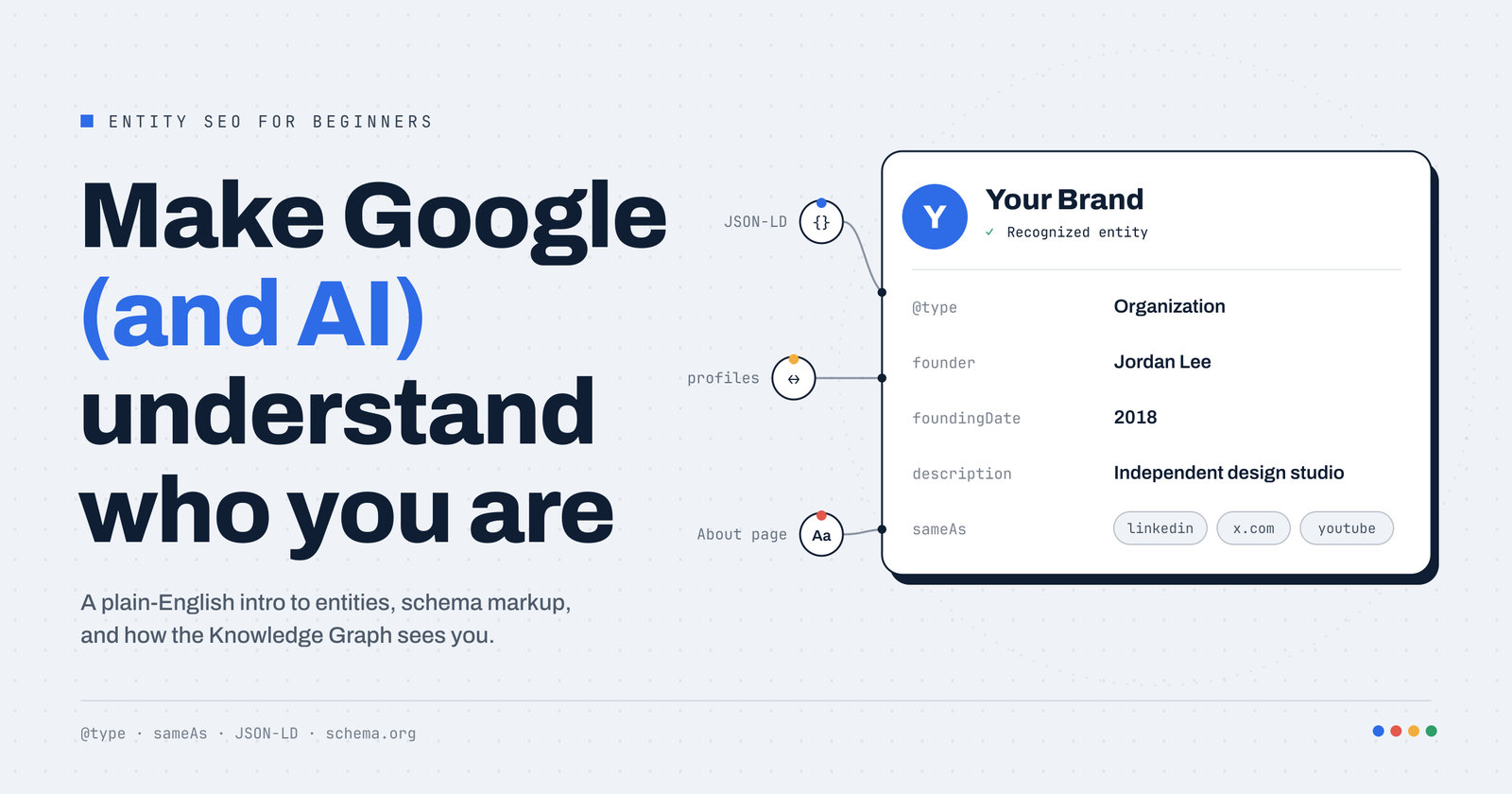
Schema markup (from schema.org) lets you make explicit, machine-readable statements on your own site: this website is published by Organization X, founded by Person Y, located here, and officially represented by these social profiles. Instead of forcing algorithms to infer who you are, you tell them directly. Structured data is also a core item on any modern technical SEO checklist, because it supports rich results in addition to entity understanding.
Context, Co-Occurrence, and Corroboration
Machines don’t take your word for it. They check whether independent sources describe you the same way. If your site says you’re “a WordPress security company,” but directories call you a “web design agency” and your LinkedIn says “digital marketing consultancy,” the entity becomes ambiguous and ambiguity dilutes trust. Conversely, when the same name, description, and topical associations appear consistently across your site, your profiles, industry publications, podcasts, and reviews, both search engines and language models converge on a confident, unified picture of who you are. Consistency isn’t cosmetic; it’s the raw material of entity recognition.
Entity SEO for Beginners: A 7-Step Playbook
You don’t need enterprise tools to do this well. Work through these steps in order.
Step 1: Define Your Primary Entity on Paper First
Before touching your website, write a two-sentence canonical definition of your entity: the exact name, what category of thing it is, who it serves, and what it’s known for. For example: “AISEO Round Table is an SEO publication founded by Syed Zakir Hussain that delivers practical search optimization strategies and tool guides for bloggers, marketers, and small business owners.”
Then list the related entities that orbit yours: founder and authors, core services or products, primary topics, and location if relevant. This document becomes your single source of truth. Every profile, bio, and schema field you create from now on should echo it same name, same framing, same facts.
Step 2: Build a Strong “Entity Home”
Your entity home is the one URL that definitively answers “who is this?” usually your About page or homepage. It should include your exact entity name, your canonical description, founder and team bios with credentials, contact details, and any proof points such as press mentions, certifications, or notable work. Both a human visitor and a crawler should be able to land on this single page and walk away knowing precisely who you are and why you’re credible. Thin, vague, or anonymous About pages are one of the most common entity weaknesses on small sites.
Step 3: Add Schema Markup (With sameAs Links)
Now translate your entity home into structured data:
- Organization (or LocalBusiness) schema for your brand, or Person schema if you’re building a personal brand including name, logo, description, and URL
- sameAs properties pointing to your official profiles: LinkedIn, X, YouTube, Facebook, Crunchbase, and your Wikidata item if you have one this is how you explicitly stitch your identities together
- Author markup on every article, connecting content to real people with their own bio pages
- Article and FAQPage schema where they genuinely fit
WordPress users don’t need to hand-code any of this. Plugins handle it well, and if you’re choosing one, this SEO plugin comparison of Yoast, Rank Math, and AIOSEO breaks down their schema capabilities side by side, while this step-by-step Rank Math SEO tutorial shows exactly where the schema settings live. Whatever you use, validate your markup with Google’s Rich Results Test before calling it done.
Step 4: Align Your Identity Everywhere on the Web
Audit every place your entity appears Google Business Profile, social accounts, directories, author bios on other sites, podcast guest pages and bring them all in line with the canonical definition from Step 1. Use the identical brand name (no creative variations), the same logo, the same short description, and, for local businesses, an exactly consistent name, address, and phone number. If your organization is genuinely notable, creating or improving a Wikidata entry adds a machine-readable anchor that both Google and AI systems draw from. Every aligned profile is another vote confirming that all these mentions refer to one single entity: you.
Step 5: Build Topical Authority With Entity-Rich Content
Entities aren’t just who you are they’re also what you’re an authority on. Search engines and LLMs associate your brand with the topics you cover deeply and repeatedly. That means organized topic clusters beat scattered one-off posts: a substantial pillar page on your core subject, supported by focused articles on its subtopics, all interlinked with clear, descriptive anchor text.
Within the content itself, write in a way that’s dense with correctly used entities. Name the tools, people, standards, and concepts relevant to your subject; define terms; answer the who/what/why questions directly. If you’re mapping out a cluster from scratch, this keyword research tutorial shows how to turn seed topics into a full content map. Over time, this depth is what teaches machines that your entity and your topic belong together which is precisely what gets sites included when you optimize for AI answers.
Step 6: Earn Corroborating Mentions and Backlinks
Self-declared identity only goes so far; third parties have to confirm it. Guest articles, podcast appearances, digital PR, industry directories, reviews, and expert roundups all create independent documents that describe your entity ideally using your canonical name and framing. Linked mentions carry the most weight, but even unlinked brand mentions contribute to entity understanding, because machines read the surrounding context either way. If outreach feels intimidating, start with these proven ways to earn backlinks organically most of them double as entity-building tactics.
Step 7: Monitor How Machines Describe You
Entity SEO isn’t set-and-forget. Once a month, run a quick audit: search your brand name in Google and see whether a knowledge panel or accurate site links appear; check branded query impressions in Search Console; and this is the new part ask ChatGPT, Perplexity, and Gemini, “Who is [your brand] and what do they do?” Note every error or omission, then fix it at the source: your entity home, your schema, or the inconsistent profile that’s feeding machines the wrong story. For a deeper framework on winning citations in conversational engines, see this guide to optimizing your site for ChatGPT and Perplexity answers.
Common Entity SEO Mistakes Beginners Make
A few pitfalls come up again and again:
- Treating schema as the whole job. Markup without corroboration is a claim without evidence. Schema tells machines what to verify; the rest of the web has to confirm it.
- Inconsistent naming. Rebranding shorthand, abbreviations, and mismatched descriptions across platforms fragment your entity into several weak ones.
- Anonymous websites. No About page, no named authors, no faces. Machines can’t extend E-E-A-T to an entity they can’t identify a weakness that becomes painfully visible when sites try to recover from a Google core update.
- Topic sprawl. Publishing thin posts across a dozen unrelated subjects prevents any strong entity-topic association from forming. Depth beats breadth.
- Keyword stuffing instead of entity coverage. Repeating your target phrase fifteen times signals nothing; naturally covering the related concepts, tools, and questions around it signals genuine expertise.
- Never checking the AI layer. If you’ve never asked an AI assistant about your own brand, you don’t know what story it’s telling and it may be wrong.
Conclusion
Entity SEO sounds technical, but at its core it’s an exercise in clarity and consistency: decide exactly who you are, say it the same way everywhere, prove it through deep content and independent mentions, and mark it up so machines can’t possibly miss it. Keywords still open the door entities are what make Google and AI remember you once you’ve walked through it.
The best part for beginners is that the highest-impact steps are also the simplest ones. This week, write your canonical entity definition, upgrade your About page, and add Organization or Person schema with sameAs links. Those three moves alone put you ahead of most small sites in the rankings you can see, and in the AI answers you can’t.
FAQs
What is entity SEO in simple terms?
Entity SEO means helping search engines and AI systems clearly understand who you are, what you do, and which topics you’re trustworthy on as a distinct “thing,” not just a collection of keywords. It combines a clear About page, consistent profiles across the web, schema markup, deep topical content, and third-party mentions that all tell the same story.
Is entity SEO the same as semantic SEO?
They overlap heavily. Semantic SEO is the broader practice of optimizing for meaning and context rather than exact-match strings. Entity SEO is the part of semantic SEO focused specifically on the defined “things” your brand, authors, products, and topics and on making sure machines identify them correctly. In practice, doing entity SEO well is the most concrete way to execute a semantic SEO strategy.
Do I need a Wikipedia page for entity SEO?
No. A Wikipedia page helps because it’s a trusted Knowledge Graph source, but Wikipedia has strict notability rules and most small businesses won’t qualify. You can build a strong entity without it through schema markup with sameAs links, a Wikidata item where appropriate, a complete Google Business Profile, consistent social and directory profiles, and consistent third-party mentions.
How long does entity SEO take to show results?
Expect a gradual build rather than an overnight jump. Schema and profile fixes can be recognized within weeks, while stronger effects better rankings for topic-cluster content, richer brand SERPs, accurate AI mentions, or a knowledge panel typically take several months of consistent publishing and mention-building. Entity trust compounds, which is exactly why starting early pays off.
Which schema types should a beginner start with?
Start with Organization (or LocalBusiness for a physical business, or Person for a personal brand) on your homepage or About page, complete with logo, description, and sameAs links to your official profiles. Then add Person/author markup to article bylines, and Article schema on your posts. FAQPage schema is a useful bonus on pages that genuinely answer questions. An SEO plugin can generate all of these without code.
Does entity SEO help me appear in ChatGPT, Perplexity, and AI Overviews?
Yes, it’s arguably the foundation of AI visibility. Answer engines mention entities they can recognize and corroborate across many sources. A clearly defined, consistently described, well-documented entity is far more likely to be named and cited than an ambiguous one, regardless of how well individual pages are optimized. Entity work is the layer underneath every AEO and GEO tactic.