
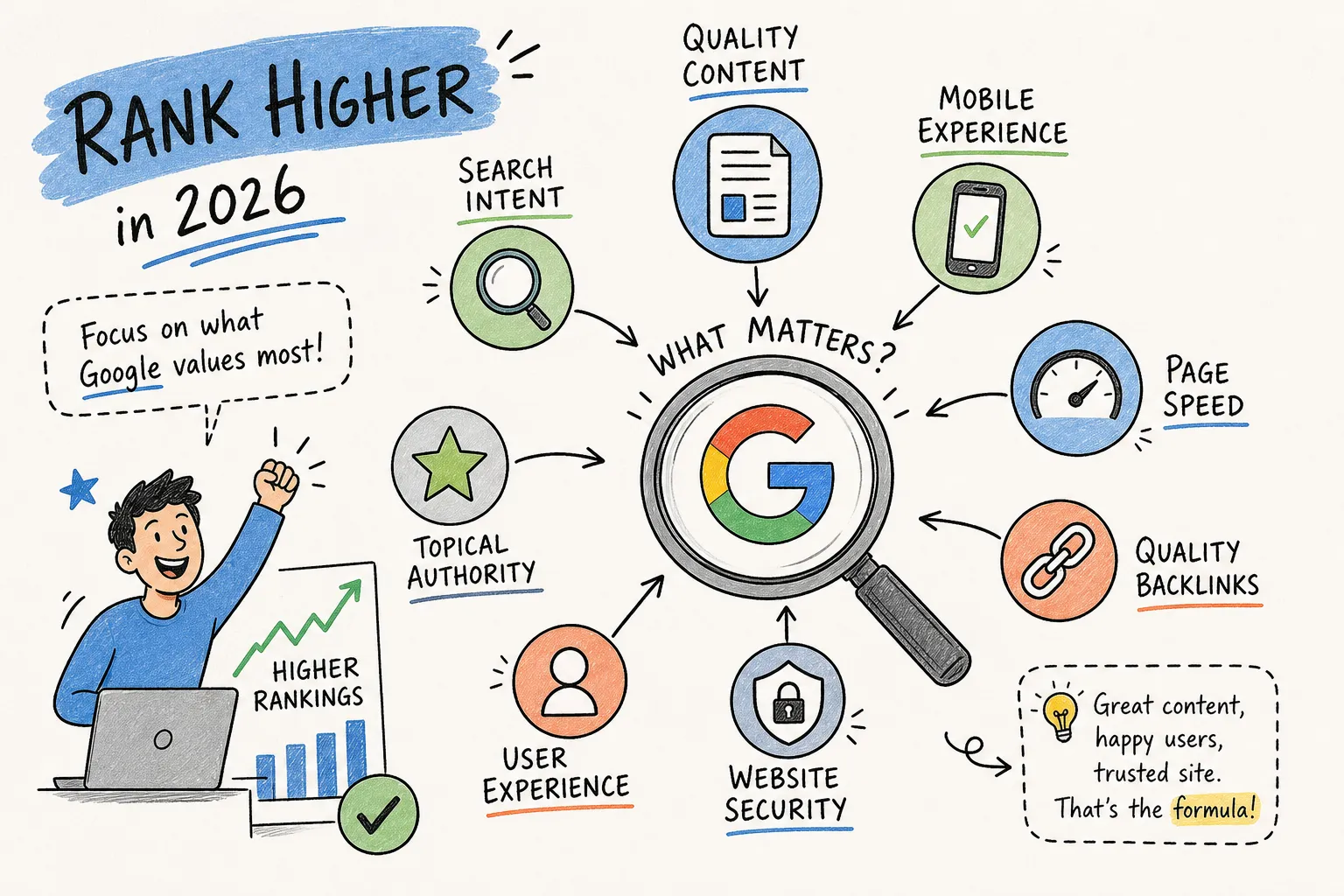
If you’ve ever searched “what are the most important Google SEO ranking factors,” you’ve probably landed on a list of 200 signals that leaves you more confused than when you started. Most of those lists mix confirmed signals with speculation, and chasing all of them at once leads quickly to wasted effort and minimal results. The real question isn’t how many factors exist, it’s which ones actually move rankings for real sites without a team of engineers or an agency budget.
At AISEO Round Table, this is the most common question we hear from bloggers, freelancers, and small business owners who want a clear starting point rather than another overwhelming checklist. So here’s the practical answer: nine factors, grounded in Google’s own Search Central documentation and recent industry correlation studies, that consistently separate pages that rank from pages that don’t.
By the end of this article, you’ll know which signals carry the most weight, why each one matters, and what to tackle first.
What Are the Most Important Google SEO Ranking Factors? Content Quality and Search Intent
Google doesn’t rank “good writing” in isolation. It ranks content that matches what a searcher actually wanted when they typed a query. That distinction separates a 600-word post that earns a featured snippet from a 3,000-word guide that covers everything except the actual point. Search intent optimization, understanding the why behind a query, is where ranking success begins.
1. Helpful, experience-backed content outperforms keyword-stuffed pages
Google’s “helpful content” framing is clear in its own documentation: content should be created for people first and demonstrate firsthand experience with the topic. A product review written by someone who actually used the tool, with specific observations and honest tradeoffs, will likely outperform a generic roundup that aggregates manufacturer specs with no direct knowledge behind it, though other factors like links, intent match, and E-E-A-T all influence the final outcome as well.
Recent correlation data from Ahrefs confirms this direction. Ahrefs found no correlation between Flesch Reading Ease scores and rankings, while usefulness and relevance do correlate with stronger performance. That single finding is the most practical summary of what “content quality” actually means in 2026.
2. How to match your content to what searchers actually want
Search intent falls into four categories: informational (someone wants to learn), navigational (they want a specific site), transactional (they’re ready to buy), and commercial (they’re comparing options). When your content format, depth, and angle match what Google is already rewarding for a given query, you’re competing on the right field.
The fastest way to check intent before writing is to search your target keyword and study the top five results. Look at what content type ranks, how long those pages are, and what angle they take. Some keyword tools, including KWFinder, include intent indicators that can save time when researching a batch of keywords. AISEO Round Table’s KWFinder review walks through how to use that feature in a real workflow.
Backlinks and Referring Domains, Among the Most Important Google SEO Ranking Factors
Backlinks remain the most consistently correlated off-page signal in every major industry study. But the specific finding from recent analyses changes how you should approach link building.
3. Why link diversity matters more than chasing high-authority sites
Referring domain diversity shows the strongest correlation with top rankings at +0.62 in recent backlink correlation analyses, including studies published by Ahrefs and Backlinko. That number has a clear practical implication: getting ten backlinks from ten different sites outperforms getting ten links from the same domain.
Google treats diverse referring domains as independent vouches for your content. Think of it like ten different people recommending a restaurant versus one person recommending it ten times, the diversity of endorsement carries more weight.
The common beginner mistake is fixating on Domain Rating (DR) scores rather than unique referring domains. High-authority links help, DR 35+ links show a +0.52 correlation in those same analyses, but diversity is the stronger signal. A few links from niche-relevant, modestly-trafficked blogs can outperform a single high-DR link if those sources are genuinely independent.
4. How to build backlinks without an agency or a big budget
Total backlink volume still shows a meaningful +0.55 correlation with rankings in the same industry analyses. The direction is clear: build broadly and consistently. Practical approaches that don’t require an outreach budget include writing guest posts for niche blogs, publishing original data that others in your space will cite, and submitting to resource pages with a relevant, non-spammy pitch.
AISEO Round Table’s free link building guide covers a step-by-step workflow for finding resource pages and writing outreach emails that get replies. Treat it as a consistent monthly habit rather than a one-time sprint. As an illustrative starting point for newer sites, three to five new referring domains per month is a reasonable goal, though the right pace will vary based on your niche, site age, and existing backlink profile.
E-E-A-T: How Google Evaluates Whether Your Site Deserves to Rank
E-E-A-T stands for Experience, Expertise, Authoritativeness, and Trustworthiness. Google explicitly frames trust as the foundation: a page can have credentials and backlinks but still fall short if it isn’t trustworthy. While E-E-A-T principles apply broadly across niches, Google’s quality rater guidelines place the heaviest scrutiny on YMYL (Your Money or Your Life) topics, health, finance, legal, and safety, where low-quality content can have real-world consequences. That said, demonstrating E-E-A-T signals is worth the effort regardless of your niche.
5. What Google actually looks for when assessing E-E-A-T
Google’s Search Central documentation asks a specific set of questions about any page: Is it clear who created the content? Does the author show firsthand experience? Is the site transparent about who operates it and how content is produced? These aren’t rhetorical. They’re a practical checklist a site owner can verify in an afternoon.
Concretely, that means author bylines linking to detailed author bios, citations with links to original sources, HTTPS, an About page, a Contact page, and a Privacy Policy. Google’s quality raters also look for external reputation signals such as reviews and third-party mentions. According to Google’s own guidance, disclosing how content is produced, including AI use, is part of demonstrating trustworthiness.
Here are practical improvements you can make today:
- Add a detailed author bio to every post
- Update older content with current sourcing and outbound links to original research
- Link to your Contact and About pages from the footer
- Cite primary sources rather than secondary summaries wherever possible
These aren’t optional extras when quality raters are evaluating your site’s credibility.
Core Web Vitals and Page Experience: Technical Tiebreakers You Can’t Ignore
Core Web Vitals are a tiebreaker, not a primary ranking signal. When two pages are similarly relevant and authoritative, Google uses page experience signals to determine which one surfaces higher. That framing clarifies the priority: fix content and links first, then audit your Core Web Vitals so they don’t silently cost you positions against close competitors.
6. LCP, INP, and CLS: what the thresholds mean in plain English
Three metrics make up Core Web Vitals. Google evaluates each at the 75th percentile of real user data, so lab scores alone don’t reflect your actual status:
- LCP (Largest Contentful Paint): measures how quickly the main content loads. Target: under 2.5 seconds.
- INP (Interaction to Next Paint): measures how fast a page responds to clicks and taps. Target: under 200 milliseconds.
- CLS (Cumulative Layout Shift): measures how much the layout shifts while loading. Target: under 0.1.
How to check your scores and fix common issues without a developer
Google Search Console’s Core Web Vitals report and PageSpeed Insights are both free and show exactly which pages fail. For LCP, the most common causes on WordPress sites are oversized hero images and lazy-loading applied to the main image. For INP, too many third-party scripts, chat widgets, ad networks, and social embeds, block the main thread. For CLS, images and ads without reserved dimensions are almost always responsible.
Many of these fixes are achievable at the plugin level: compress and convert hero images to WebP, mark the main image as high-priority so it isn’t lazy-loaded, defer non-critical JavaScript, and set explicit width and height dimensions on image and ad containers. A good caching and performance plugin handles most of these options without touching code. That said, some issues, server-level configuration, custom JavaScript, or heavily customized themes, may still need developer attention.
On-Page SEO, Mobile-First Indexing, and User Engagement Signals
These three factors form the structural layer that supports everything above. They don’t replace strong content and good backlinks, but gaps in any one of them quietly limit your ceiling.
7. On-page elements that still move the needle in 2026
Google’s Search Central documentation points to five specific on-page elements: unique and descriptive title tags, organized headings (H1, H2, H3), descriptive URLs, alt text on images, and clear written content structured for readability. These aren’t keyword-stuffing opportunities. They’re signals that confirm to Google what a page covers and help match it to the right queries.
Internal linking belongs in this group. Linking to relevant pages within your own site helps Google understand your site structure and passes relevance signals between pages. AISEO Round Table’s on-page SEO guide walks through each element with a step-by-step process using Mangools to verify keyword placement and search volume before publishing.
8. Mobile-first indexing and what it means for your rankings
Google has used mobile-first indexing as the default since 2023, which means the mobile version of your site is what Google crawls and ranks. If your mobile version hides content behind a collapsed menu, strips navigation, or loads slowly on a phone, your rankings reflect that mobile experience, not your polished desktop version.
The fix is straightforward: make sure your mobile site carries the same primary content, headings, structured data, and key navigation links as your desktop version. Layout differences between mobile and desktop are fine. Content and navigation differences are not.
9. CTR and dwell time: what engagement signals tell Google
Click-through rate (CTR) is the stronger of the two engagement signals in published correlation research, including analyses from Backlinko and CXL. Pages whose observed CTR exceeds the expected CTR for their position tend to move up over time; pages that underperform expected CTR often sit between positions 6 and 10 without improving. These are correlation-based findings, not proof of direct causation, but the pattern is consistent enough to treat your title tag and meta description as direct levers for ranking improvement, not just cosmetic elements.
Dwell time also correlates with rankings in industry studies, though Google hasn’t confirmed it as a direct ranking signal. A user who bounces immediately signals that the page didn’t deliver. Track CTR in Google Search Console and monitor time-on-page and bounce rate vs. dwell time in Google Analytics or a comparable analytics platform. A high bounce rate on a specific post is a content quality flag worth investigating, not a number to ignore.
What to Fix First: A Practical Priority Order
Now that you understand what are the most important Google SEO ranking factors, here’s the sequence to act on: start with search intent and content quality because they have the highest leverage and cost nothing to address. Then handle E-E-A-T basics, author bios, transparent sourcing, and trust pages. Next, focus on earning referring domain diversity through consistent link building. After that, audit Core Web Vitals and resolve the most common failures. Finally, tighten your on-page structure and monitor engagement signals through Google Search Console and your analytics platform.
No single factor wins rankings on its own. Google’s systems evaluate all of these signals together, and a page that’s strong across the board will consistently outperform a page that’s exceptional in one area while neglecting the others.
For each of these nine factors, AISEO Round Table has step-by-step guides and honest tool reviews built for bloggers, freelancers, and small business owners who want professional-level results without a big budget or a technical background. Start with the factor where you have the biggest gap and work through the list from there.