
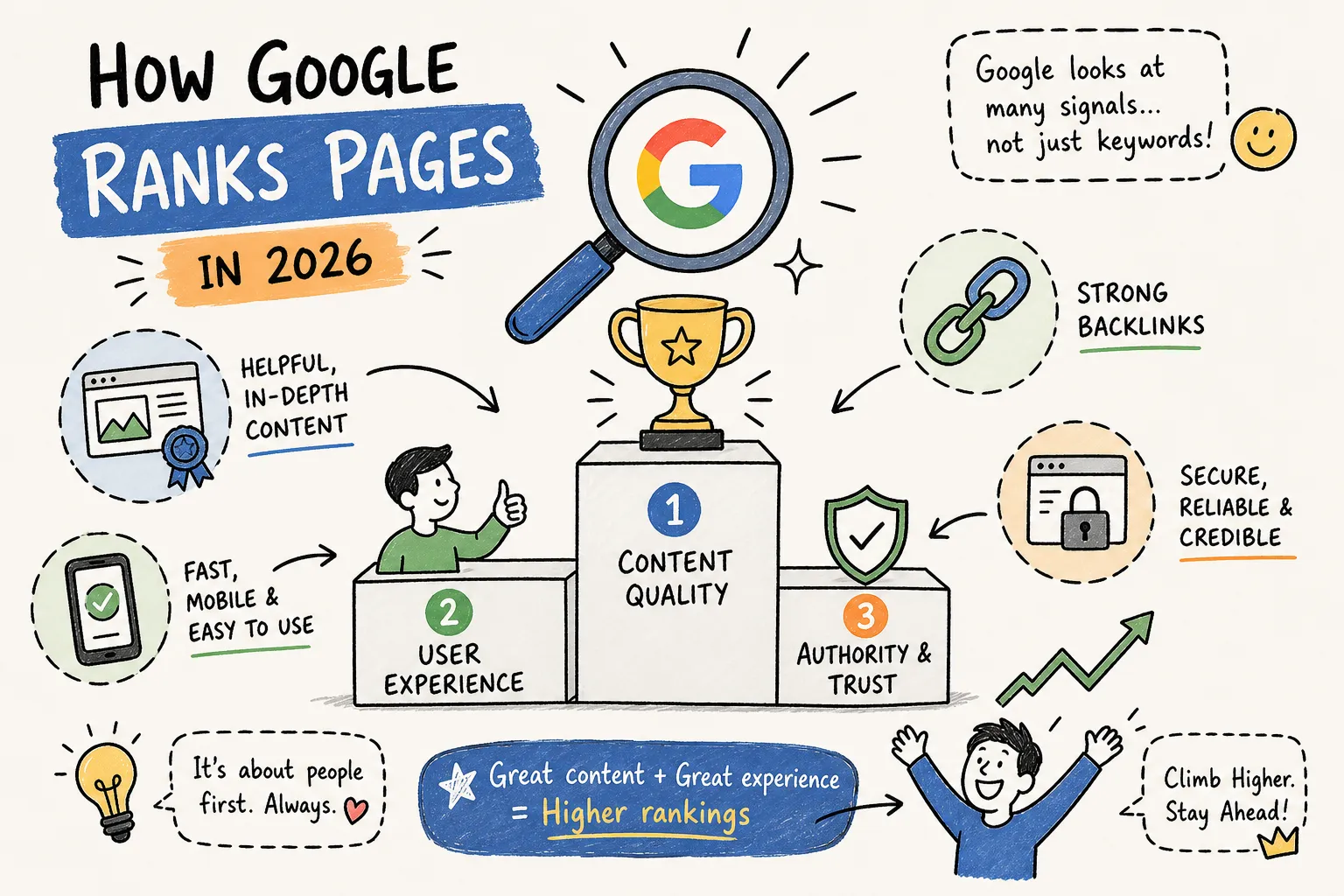
Everyone seems to have a theory about how Google ranks pages. Some will tell you keyword density is the secret. Others swear by backlinks, word count, or posting frequency. The problem is that most SEO advice online mixes a few confirmed signals with a lot of recycled assumptions, and if you’re acting on bad information, you’re wasting time that should go toward things that actually work.
At AISEO Round Table, we track google algorithm changes, test SEO tools hands-on, and dig into what Google confirms versus what the industry believes, you can see that work across our tool reviews, update breakdowns, and side-by-side ranking tests published on this site. That puts us in a position to cut through the noise and give you the real picture. What follows covers what Google officially uses to rank pages, the SEO ranking factors that genuinely shift results, how 2024 through 2026 updates changed the game, the myths worth dropping, and a checklist you can act on right now.
Start here: ranking is not a mystery. It is a system, and systems can be understood.
What Google officially says it uses to rank pages
Google’s “How Search Works” documentation lays out five high-level categories that its systems use to surface results. The first is the meaning of the query, meaning Google works to understand what the searcher wants, not just the literal words typed. The second is relevance of content, which asks whether a page covers the topic the query is about. Third is quality of content, which looks at how trustworthy, accurate, and substantive the page is. Fourth is usability of content, covering how well the page loads and works for a user. Fifth is context and settings, which includes the searcher’s location, language, and search history.
Google’s search ranking algorithm evaluates individual pages on a combination of these signals. No single factor controls your position across every query and every niche. Think of it like a hiring committee evaluating candidates on multiple criteria simultaneously. One great interview doesn’t automatically get you the job if your resume is thin and your references are weak. The same logic applies here: strong content alone does not compensate for poor usability, and a fast page means nothing if it does not match what the searcher wants.
Some signals carry more weight than others depending on query type and competition level, which is exactly what the next section addresses.
How Google Ranks Pages: The Signals That Genuinely Move Search Results
Content relevance and matching what searchers actually want
Google’s language understanding systems, including RankBrain, BERT, and MUM, are built to understand intent, not just match keywords. This means Google evaluates whether your page answers the question behind the query, in the format and at the depth the searcher expects. Matching the structure, angle, and completeness of what already ranks is often more valuable than repeating a keyword phrase a set number of times. Understanding how Google ranks websites at this level means thinking about intent first, content second. For additional context from our site, see Google Says Ranking Systems Reward Content Made for Humans, AISEO Round Table.
The practical implication is clear: before you write or optimize a page, look at what already ranks for that query. If the top results are step-by-step guides, publishing a general overview puts you at a disadvantage before you write the first sentence. Intent alignment is a prerequisite, not an afterthought.
E-E-A-T and what it means for your pages
E-E-A-T stands for Experience, Expertise, Authoritativeness, and Trustworthiness. It is not a single score that Google calculates for your page. It is a framework that Google’s quality raters use to evaluate search results, and Google’s systems are designed to approximate those judgments at scale. On an actual page, this shows up as author credentials, first-hand experience signals, linked sources, and the overall reputation of the site.
Google’s Search Quality Rater Guidelines specifically instruct evaluators to look for evidence that content comes from direct, lived experience with the topic. That means writing from personal use of a product, a real visit to a location, or genuine hands-on knowledge carries weight. Trust is described as the most important component of E-E-A-T overall, so pages that lack credibility signals face an uphill battle regardless of their other strengths.
Backlinks as a trust signal, not a volume contest
Google uses links to understand what pages are about and to assess how trustworthy they are. That is confirmed directly in Google’s own documentation and has been consistent across years of algorithm changes. What has also been consistent is this: a contextually relevant link from an authoritative source is typically far more valuable than many low-quality directory links combined.
The goal is not to accumulate links at volume. The goal is to earn links from pages that are topically related and genuinely trusted. An editorial mention from a well-regarded industry publication often moves the needle more than a pile of footer links from unrelated sites. Quality, topical relevance, and editorial context are what the PageRank algorithm and its successors have always rewarded most. For practical tactics on building the right links, read our playbook at Off-Page SEO: Master Backlinks, Outreach & Authority, AISEO Round Table.
Core Web Vitals and Page Experience in Plain English
LCP, INP, and CLS: what each one actually measures
Google measures page experience through three Core Web Vitals. Largest Contentful Paint (LCP) measures how fast the main content of a page loads; the target is 2.5 seconds or less. You have felt a poor LCP score every time you waited several seconds staring at a mostly blank screen before anything useful appeared. Interaction to Next Paint (INP) measures how quickly a page responds when you click or tap something; the target is 200 milliseconds or less.
Cumulative Layout Shift (CLS) measures how much the page moves around visually while it loads; the target is 0.1 or less. A page with a high CLS score is the one where you go to tap a button and the whole layout shifts just before your finger lands, sending you somewhere you did not mean to go. For a clear primer on these metrics, see Cloudflare’s explanation of Core Web Vitals.
How much page experience signals affect your ranking in practice
Google describes Core Web Vitals as one part of the page experience system, not a dominant ranking driver. They function more like a tiebreaker: when two pages are similarly relevant and authoritative, the one with stronger technical performance has the edge. Poor scores do create a real disadvantage against competitors who pass all three thresholds. Following the March 2026 core update, some industry reports observed a shift toward holistic Core Web Vitals scoring, reportedly treating LCP, INP, and CLS as a combined performance signal rather than three independent checks, though Google has not officially confirmed this change. Sites passing all three thresholds appeared to see ranking improvements in community data, while sites failing one or more metrics saw ground lost.
The honest takeaway: fix technical performance because it matters to real users and because it compounds your other strengths. Do not expect passing Core Web Vitals to rescue a page with weak content or no links pointing to it.
How Google’s 2024 to 2026 Updates Reshaped What Gets Rewarded
The helpful content direction and what it actually penalized
The March and August 2024 core updates consistently targeted the same categories of pages: thin content, heavily scaled AI-generated copy, and content built primarily to capture rankings rather than to inform a reader. Google integrated the Helpful Content system more directly into core ranking during this period, which meant manipulation-oriented pages faced stronger headwinds across the board. Original, people-first pages with clear subject matter knowledge held their positions or improved.
The pattern is worth internalizing: Google is not punishing AI tools or long content or any specific format. It is penalizing pages that exist for the algorithm rather than the person. Writing for a reader, covering a topic with genuine depth, and demonstrating that you know what you are talking about have been the consistent winners across every major update in this period.
What the 2026 core updates specifically targeted
The March 2026 core update brought the reported shift to holistic Core Web Vitals scoring described above, based on SEO community observations rather than official Google confirmation. The May 2026 core update continued Google’s push to surface relevant and satisfying content, with community reports pointing to stronger detection of scaled AI content and notable volatility for directory and aggregator pages in local-intent queries. Google’s official communication on the May update described it as a standard broad core update focused on helpful, reliable content. For a concise update timeline that tracks major changes through 2026, see this Google algorithm update history, complete timeline.
Every update from 2024 through 2026 has reinforced the same direction: quality, intent alignment, and real user value win consistently. There is no evidence of a different path opening up.
Common Ranking Myths That Waste Time and Effort
Tactics that look important but rarely shift results
Focusing on a keyword density target is not an effective SEO strategy. Google’s language systems understand context and intent well enough that hitting a specific percentage of keyword repetition does nothing except make your writing sound unnatural. What matters is whether the content covers the topic thoroughly and in the format searchers expect. The meta keywords tag is also not a ranking input; Google has officially confirmed it ignores that tag entirely, so any time spent populating it is time spent on nothing.
Social signals are another common distraction. Google has publicly denied that likes, shares, or follower counts are direct ranking factors. Social can drive traffic and brand visibility, which may create indirect effects over time, but there is no confirmed direct path from a social share to a ranking improvement. Stop optimizing for metrics that do not connect to the actual ranking system.
What pages that hold their rankings over time actually share
Pages that maintain strong rankings over multiple updates share a recognizable pattern. They match the searcher’s intent, demonstrate real subject matter knowledge, earn links naturally because the content is genuinely worth referencing, and load without friction. No tricks, no keyword stuffing, no link schemes. Pages built to genuinely satisfy the query tend to compound their visibility over time rather than spike during one favorable period and then fade.
A Practical Checklist to Act on These Google Ranking Factors
Prioritizing the signals with the highest return first
Work through ranking improvements in this order. Start with intent alignment: is your page answering the right question in the right format for the query you are targeting? Next, move to quality signals: does the page demonstrate real expertise and first-hand knowledge? From there, address technical health: does it meet Core Web Vitals thresholds and load cleanly on mobile? Finally, evaluate your link profile: does anything credible point to this page?
This sequence works because content problems cannot be fixed by faster loading times, and link building does not rescue a page that does not match what searchers want. Fix the foundation first, then build on it. Most of these steps are approachable without a technical background, though Core Web Vitals improvements may occasionally require a developer for implementation.
Using keyword data and SERP analysis to guide your next move
Ranking decisions should start with real data, not assumptions. Before investing hours creating or rewriting content, look at what already ranks for your target keyword: how authoritative are those pages, what do they cover, and how difficult is that keyword realistically to pursue? This is where the right tools make a concrete difference. We have reviewed Mangools on AISEO Round Table, and in our assessment its KWFinder keyword difficulty scores combined with SERPChecker‘s 45-plus competitive metrics make it easier to evaluate whether a keyword is worth pursuing before you write a single sentence. SERPChecker also shows you how SERP features like answer boxes and carousels affect click-through potential for organic results, which changes how you prioritize targets.
Skipping this step is a frequent reason pages fail to rank, even well-written ones. You can produce excellent content and still fall short if you aimed at a keyword where every ranking page carries a years-old backlink profile you cannot realistically match. Data first, execution second.
The Bottom Line on How Google Ranks Pages
How Google ranks pages is not a black box. It uses a layered signal system built on relevance, content quality, user experience, and trust, and it has consistently rewarded content that genuinely helps people across every major update from 2024 through 2026. The Google ranking factors are documented, the patterns are visible in real search results, and the direction has not changed. For an accessible breakdown of documented ranking factors, see Backlinko’s guide to Google ranking factors.
You do not need an agency or a technical background to act on this. The checklist above is followable by anyone who can open a browser and look critically at their own pages. The tools to do competitive research properly are available at a range of price points, including free options, and the guides to use them are right here on AISEO Round Table, for a wider strategic playbook, consult The Ultimate Guide to SEO: Rank Higher in 2025, AISEO Round Table.
Pick one item from the checklist, apply it to your most important page today, and start from there. Understanding this system is only useful if you do something with it.