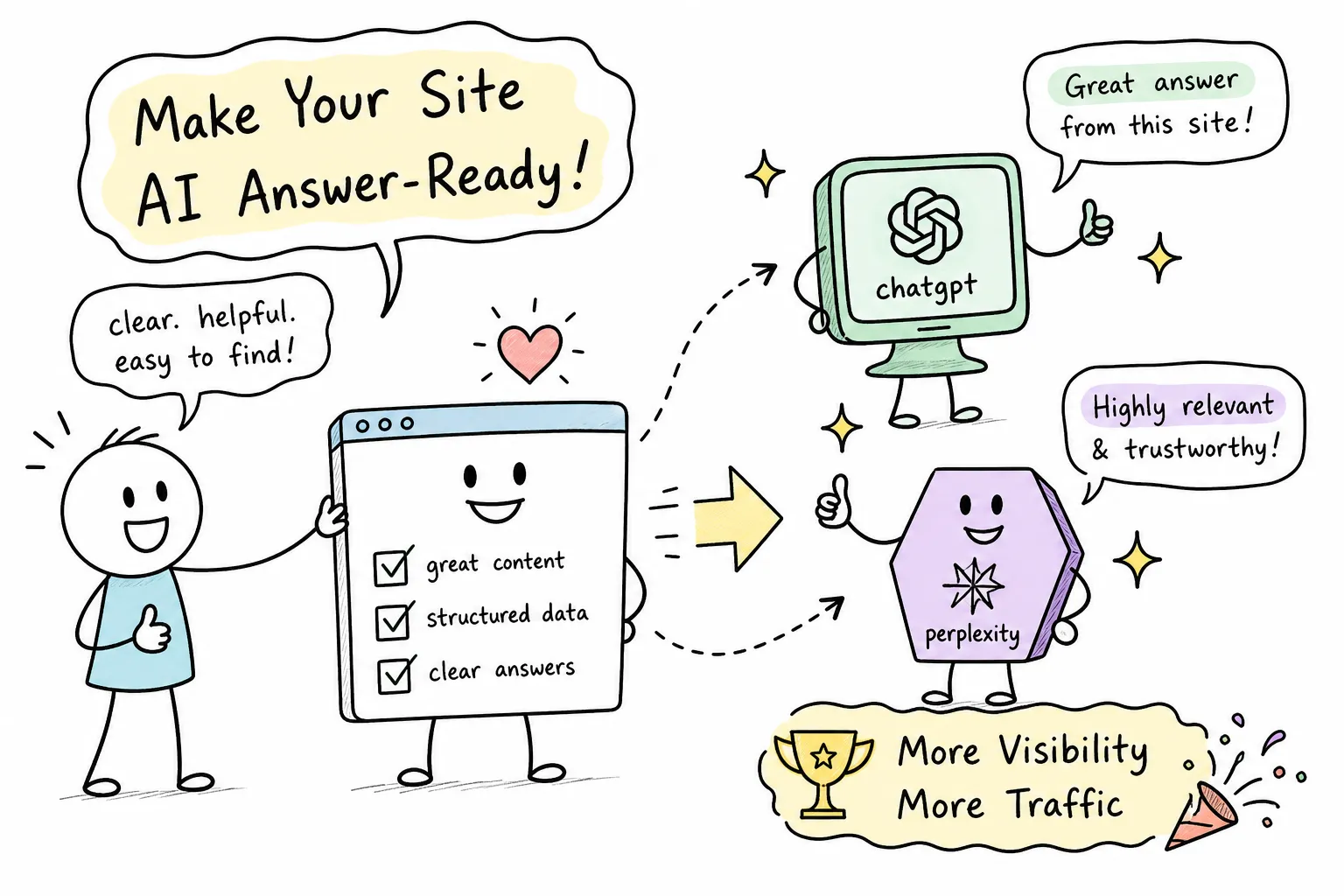
If you’ve been asking yourself how do I optimize my website for ChatGPT and Perplexity answers, you’re asking exactly the right question, and you’re not alone. Millions of searches now end inside ChatGPT or Perplexity without a single click to a website. The user gets an answer, the AI gets the credit, and your page sits invisible in the background even if it provided the source material. The good news is that getting cited by these tools is not random luck. There are specific, repeatable tactics that increase the odds your content appears as a named source inside those AI-generated answers, and this guide walks through all of them.
Here at AISEO Round Table, we built this workflow from the ground up by analyzing how retrieval-augmented generation actually works, what structures show up most in cited pages, and what monitoring steps let you verify progress. No abstract theory, just a concrete checklist you can start applying this week.
How to Optimize Your Website for ChatGPT and Perplexity Answers: Understanding Why AI Engines Cite Some Pages and Skip Others
Understanding the selection process is the foundation for everything else when you want to optimize your site for AI answers. ChatGPT and Perplexity both use a two-stage flow called retrieval-augmented generation, or RAG. In the first stage, the engine breaks the user’s question into sub-queries and scans a set of candidate web pages. In the second stage, it generates a final answer and attaches citations to the specific claims it borrowed from external sources.
The most important thing to understand is that AI engines evaluate at the passage level, not the page level. A page can be accurate, well-researched, and technically correct, and still get skipped if the answer is buried three paragraphs down or written in a way that makes clean attribution difficult. The engine is not reading your page the way a human does. It is scanning for quotable, attributable passages that directly support specific claims.
The four signals that determine whether your page gets cited are relevance, extractability, freshness, and source trustworthiness. Relevance means your content closely matches the query. Extractability means the answer is clearly stated and easy to isolate. Freshness means the content reflects current information. Trustworthiness means the page is independently validated by other credible sources. An engine may read twenty candidate pages and cite only three. Your job is to make your page one of those three across all four signals.
Traditional search ranks pages for human clicks. AI citation selects passages for claim-level attribution. That is a meaningful difference because relevance alone is no longer enough. A page that ranks on page one of Google can still get ignored by Perplexity if the content structure makes extraction hard.
Content Structure That Makes Your Pages Citation-Ready
The single most impactful structural change you can make is leading with your direct answer. In our citation analysis across hundreds of AI-generated responses, the top-cited sources consistently answered the core question within the first 100 words of the page. This is sometimes called the BLUF approach: Bottom Line Up Front. State the direct answer in your opening paragraph before any backstory, context, or caveats. This is one of the fastest wins available in generative search optimization.
Here is a quick before-and-after to make that concrete:
Buried version: “The history of schema markup goes back to 2011 when Google, Bing, and Yahoo collaborated on a shared vocabulary… which is why, ultimately, FAQPage schema can help your content appear in AI answers.”
Lead version: “FAQPage schema increases your chances of being cited by AI engines because it wraps your questions and answers in a format the model can extract cleanly.”
The second version gets cited. The first version gets skipped.
Q&A and FAQ blocks are the highest-value structures for AI citation. Write FAQ sections that mirror the exact phrasing a user would type into ChatGPT or Perplexity, followed by a clear, self-contained answer in two to four sentences. Each FAQ answer should be able to stand alone as a quotable unit without requiring surrounding context. These blocks work both as schema targets and as directly scannable content the model can quote word-for-word.
Short, modular paragraphs follow the same logic. AI systems extract individual sections, not full articles. Each paragraph should carry one complete idea that makes sense without the paragraphs around it. For procedural queries, bulleted steps serve best. For definitional or explanatory queries, short prose paragraphs work better. The goal in both cases is the same: give the model a clean, self-contained unit it can attach to a claim in its answer.
Schema Markup That Signals Your Content to Generative Engines
Schema markup does not guarantee citation, but it gives AI engines a cleaner semantic map of your page’s purpose and content. The priority schema types that matter most for AI visibility are:
- FAQPage, for real question-and-answer sections (this is the core of FAQ schema for generative AI optimization)
- QAPage, for single canonical question pages
- Article and NewsArticle, for editorial content
- Organization and Person, for entity credibility
The key is matching the markup to the page’s actual content purpose, not layering schema on as a generic overlay.
For each schema type, specific properties carry the most weight:
- FAQPage:
mainEntity,Question,name,acceptedAnswer,text - Article:
headline,description,author,datePublished,dateModified,publisher - Person / Organization:
name,sameAs,jobTitle,affiliation,logo
JSON-LD is the recommended implementation format for all of these because it keeps the markup separate from your HTML and is easier for parsers to read cleanly.
Before publishing, validate your markup using Google’s Rich Results Test and the Schema.org validator. Clean, error-free markup paired with clear prose gives the strongest combined signal. Schema without clear underlying content is noise. Clear content without schema is a missed opportunity. The combination is what moves the needle.
For practical context on how structured data plays into AI-era search, see research on structured data in the AI search era, which explains why markup and clear content need to work together for extraction by generative systems.
Authority Signals That Make AI Engines Trust Your Source
Off-page authority is where many site owners underinvest, and it directly affects how often generative engines reference your content as a source. High-quality backlinks from relevant, credible sites are a strong signal, but the more specific finding from our own citation analysis is that breadth of referring domains matters more than raw link count. Being referenced across many different trusted sources signals independent validation, and that appears to be what AI engines weight most heavily, not the total number of links from a handful of the same domains.
Focus your link-building efforts on earning citations from editorial, educational, or industry-authority pages in your niche. A single mention in a well-regarded industry publication carries more weight than ten links from generic directories. The goal is independent corroboration across credible contexts, which signals to the retrieval system that your page’s claims are verified and defensible.
For a deeper look at how link distribution and link equity influence authority signals, review resources that explain why diversity of referring domains outperforms sheer link volume.
Author credentials are the on-page counterpart to off-page authority. Named authors with visible bios, job titles, and links to professional profiles increase the credibility signal an AI engine assigns to a page. Set up a proper author bio with links to LinkedIn or published work, and connect it to your Organization schema using the sameAs property. This creates a clear entity graph that links your author to a real-world professional identity, a tactic that matters increasingly for ChatGPT citations and similar source-attribution systems.
Original research and first-party data are citation magnets because they cannot be duplicated elsewhere. A proprietary statistic, a survey result, or an aggregated dataset specific to your niche gives AI engines something unique to cite that no other page can provide. Even a single original data point per article can anchor an AI-generated answer. Run a survey of your audience, publish original analysis, or aggregate data your niche lacks. The investment is modest and the citation payoff is disproportionate.
For additional perspective on factors that influence whether AI tools like ChatGPT cite a page, see reporting on the top factors influencing ChatGPT citations.
Tracking Whether AI Engines Are Actually Citing Your Pages
Manual citation checks are the most direct method and require no special tools to get started. Open ChatGPT with web browsing enabled, Perplexity, and any other AI tools relevant to your niche, then query them with the exact questions your pages target. Check whether your domain appears as a cited source in the response. Log your results in a simple spreadsheet with columns for the query, platform, cited or not cited, page URL, and date. (If you want background on interacting with ChatGPT programmatically and for SEO tasks, see our piece on ChatGPT for SEOs: A Master Class in Prompt Engineering, AISEO Round Table.)
For traffic-level signals, configure Google Analytics 4 to detect referral traffic from domains like chatgpt.com and perplexity.ai, and create custom channel groupings so that AI-driven visits are not buried in generic referral data.
Google Search Console is useful for monitoring visibility shifts even when direct AI attribution is limited. Zero-click traffic changes across pages you know are targeting AI-cited queries are a useful proxy for whether your optimization work is having an effect.
If you need ongoing monitoring at scale, dedicated platforms like Otterly.ai and similar AI citation trackers can automate the tracking of brand mentions and citation frequency across multiple answer engines. For most bloggers and small business owners, the manual plus GA4 approach is a solid starting point. We publish regularly updated guides at AISEO Round Table on Answer Engine Optimization (AEO) and GEO strategy as the citation behavior of Perplexity and ChatGPT continues to evolve, bookmark us to stay current without having to track every platform change yourself.
The iteration loop is straightforward. Check which pages get cited. Compare their structure to pages that do not. Update the non-cited pages to lead with a direct answer, add FAQ blocks, and tighten paragraph modularity. Retest after 30 days. This cycle compounds over time because each iteration gives you cleaner data on what the engines in your specific niche actually respond to.
Start With One Page, Not Your Whole Site
Here is the full checklist in seven steps to optimize your website for ChatGPT and Perplexity answers: lead with your direct answer, build FAQ blocks that mirror real user queries, implement matching schema in JSON-LD, earn third-party citations from credible domains, credential your authors with visible bios and entity markup, publish original data your niche does not have, and monitor results manually before adding tooling.
If you want a step-by-step walkthrough of those implementation steps, see our guide How to Optimize for Answer Engines (6 proven Step-by-Step Guide) which expands each checklist item into a practical editorial workflow.
Optimizing for AI citation is not a one-time project. It is an ongoing editorial habit. Each new page you publish is an opportunity to follow the lead-answer structure by default. Each FAQ section you add is a permanent extraction target for every AI tool that indexes your site going forward. The compounding effect of consistent structure across your content library is what drives sustained citation presence.
Frequently Asked Questions
How do I optimize my website for ChatGPT and Perplexity answers?
To optimize your website for ChatGPT and Perplexity answers, lead every page with a direct answer to the target question within the first 100 words, add FAQ sections written in natural user phrasing, implement FAQPage and Article schema in JSON-LD, build backlinks from editorially credible domains, and credential your authors with visible bios connected to Organization schema. Then track your citation appearances manually in both tools and refine based on what gets referenced versus what gets skipped.
Does schema markup help with AI citation?
Schema markup gives AI engines a cleaner semantic map of your content’s structure and purpose. FAQPage schema is especially valuable because it wraps questions and answers in a format that generative models can extract cleanly for source attribution. It does not guarantee citation, but when paired with clear underlying content, it meaningfully improves the odds of being referenced in AI-generated answers.
How can I tell if ChatGPT or Perplexity is citing my site?
The fastest method is manual: query ChatGPT with web browsing enabled and Perplexity using the exact questions your pages target, then check whether your domain appears as a cited source. Log results in a spreadsheet. For traffic-level signals, set up custom channel groupings in Google Analytics 4 to capture referral visits from chatgpt.com and perplexity.ai separately from other referral traffic.
Pick one page your site already ranks for and apply the lead-answer and FAQ structure from this guide today. Run a manual citation check in ChatGPT and Perplexity within 48 hours and record the baseline. That single action gives you your first real data point, and real data is always the best place to start.