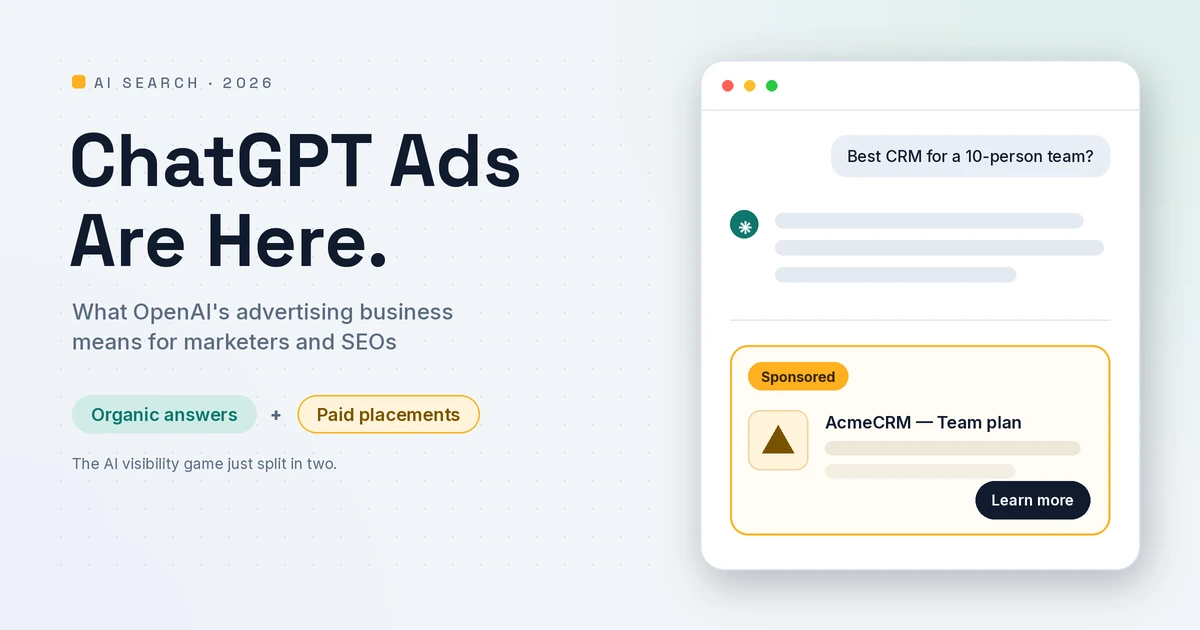
For years, the AI visibility game had one rule: earn your way in. If ChatGPT mentioned your brand, it was because your content, reviews, and reputation made you the natural answer. That era is ending. OpenAI has moved from quietly posting advertising job listings to running a live, expanding ad business inside ChatGPT, complete with a self-serve Ads Manager, agency partnerships, and performance bidding.
This is arguably the most consequential development in search marketing since Google’s AI Overviews began reshaping the SEO world. A paid placement layer inside the world’s most-used AI assistant changes how brands get discovered, how budgets get allocated, and how “showing up in AI answers” is defined. Here’s what’s happening, why it matters, and exactly what to do about it.
What OpenAI Is Actually Building
From Job Listings to a Live Ad Platform
The early signals were easy to dismiss. Job postings for ad engineers and monetization leads hinted that OpenAI was exploring image, video, native, and conversational ad formats. Then the hints became reality: OpenAI began testing ads in ChatGPT in the United States on February 9, 2026, limited to logged-in adult users on the Free and Go tiers.
The rollout accelerated quickly. Within months, the pilot expanded to markets including Canada, Australia, New Zealand, Japan, and South Korea, with Latin American countries next in line. Reporting suggested the pilot generated over $100 million in its first six weeks, and OpenAI is reportedly targeting roughly $2.5 billion in ad revenue this year with far bigger ambitions by 2030.
In May 2026, OpenAI launched a beta self-serve Ads Manager, letting businesses of any size register, set budgets and bids, upload creative, and track performance directly. Major agency holding companies (Dentsu, Omnicom, Publicis, WPP) and ad-tech players (Adobe, Criteo, Kargo, Pacvue, StackAdapt, LiveRamp) are already plugged into the ecosystem. Criteo alone reports more than 2,000 brands advertising on ChatGPT through its platform.
Ad Formats: Native, Conversational, and Built for Decisions
Today’s ChatGPT ads appear as a single, clearly labeled sponsored unit below a response when there’s a relevant match to the conversation. The unit may feature one or more products, and users can dismiss it, ask why they’re seeing it, or clear their ad data entirely.
But this is only phase one. OpenAI has stated it plans to evolve the program with new formats, objectives, and buying models and to build new ways for businesses to interact with consumers inside ChatGPT, including letting users message an advertiser directly from an ad. The direction of travel is unmistakable: richer, more interactive, more conversational ad experiences.
Who Sees Ads and Who Doesn’t
Ads currently appear only for Free and Go tier users. Plus, Pro, Business, Enterprise, and Education accounts remain ad-free, and OpenAI says it won’t show ads to users it knows or predicts to be under 18. The company also insists that ads never influence ChatGPT’s organic answers, that conversations stay private from advertisers, and that advertisers only receive aggregated performance data.
That free-and-Go audience is the majority of ChatGPT’s user base, which now approaches a billion people. In other words, the ad-eligible audience inside ChatGPT is already one of the largest in digital advertising.
Why a Paid Layer Inside ChatGPT Changes Everything
Organic AI Visibility Now Has a Paid Rival
Until now, generative engine optimization was the only way to influence how your brand appeared in AI assistants. Marketers focused on structured content, authority signals, and citations the earned-media playbook. That playbook still works, but it no longer operates in a vacuum.
The parallel to classic search is obvious. Google spent two decades training marketers to think in terms of organic results plus paid results on the same page. ChatGPT is now recreating that dual economy inside a conversation: the organic answer above, the sponsored unit below. If history repeats, brands that ignore the paid layer will watch competitors buy their way into decision moments that organic visibility alone used to own.
Intent-Rich Conversations Are the New Keyword Data
OpenAI’s pitch to advertisers centers on one idea: people use ChatGPT while actively exploring options, comparing choices, and making decisions. A conversation like “help me choose a project management tool for a 10-person remote team” carries far more context than a three-word Google query ever could.
Ads are matched to the topics of the current chat, and users who opt into personalization can be targeted using signals from past chats and ad interactions. For marketers, this means ad relevance in ChatGPT is driven by conversational context rather than keywords a fundamentally different targeting model that rewards a deep understanding of customer decision journeys, not just search volume. Your existing keyword research process is still the foundation, but it needs a conversational layer on top: what questions do people ask, in what sequence, on the way to buying what you sell?
How ChatGPT Ads Work for Advertisers
Ads Manager, Bidding, and Pricing Models
The beta Ads Manager supports two campaign objectives. Reach campaigns are bought on a CPM basis, while Clicks campaigns use cost-per-click bidding OpenAI suggests starting CPC bids around $3–$5. Delivery runs through a relevance-weighted, second-price auction: when multiple advertisers are eligible for a conversation, the most relevant ad wins, not simply the highest bid.
Notably, the previous $50,000 minimum spend requirement has been removed, opening the platform to small and mid-sized businesses a deliberate echo of how Google Ads democratized search advertising.
Measurement, UTMs, and Conversions
Ads Manager reports impressions, clicks, spend, CTR, average CPC/CPM, and conversions. Advertisers can set up conversion measurement directly, or append UTM parameters to landing page URLs and track ChatGPT-driven traffic in their existing analytics stack the same discipline you’d apply to any campaign tracked through tools covered in your broader technical SEO checklist. Partnerships like LiveRamp’s Conversions API integration extend measurement beyond browser-based tracking.
If you already manage location-based or local campaigns, the fundamentals carry over too; the same rigor Google requires for representing your business accurately (see Google’s business guidelines) applies to how you present offers inside conversational ads.
What This Means for Your SEO and GEO Strategy
Organic Citations Still Matter Maybe More Than Ever
Paid placement does not replace organic AI visibility; it sits beside it. ChatGPT’s actual answers remain independent of advertising, which means the work of optimizing your site for ChatGPT and Perplexity answers clear lead answers, schema markup, FAQ blocks, authority signals is untouched and arguably more valuable. When a sponsored unit and an organic mention of your brand appear in the same conversation, trust compounds.
This is the moment to get serious about optimizing for AI answers as a distinct discipline, and to settle your AEO vs GEO strategy question: which conversations do you need to win organically, and which are worth paying for?
The Free-Tier Audience Is the Ad Audience
Because ads only run on Free and Go tiers, the ad-exposed audience skews toward consumers, students, and cost-conscious users not enterprise buyers on Business or Enterprise plans. B2C brands, D2C e-commerce, local services, and impulse-friendly categories will likely see the fastest returns. High-ticket B2B marketers should still watch closely, but organic AI visibility remains their primary lever for reaching professional users on ad-free tiers.
Rebalance Budgets Between Earned and Paid AI Visibility
The practical implication for 2026 planning: AI visibility now has two line items. One funds content, digital PR, and structured data the earned side, well covered in a modern GEO strategy for AI search visibility. The other funds experimentation with ChatGPT Ads while CPCs are early and competition is thin. Early-mover pricing rarely lasts; the advertisers learning the auction now will hold an efficiency advantage when the crowd arrives.
Action Plan: 7 Steps Marketers Should Take Now
- Audit your current AI visibility. Run your core buying questions through ChatGPT (on a free account) and document when your brand appears organically, when competitors appear, and when sponsored units show up.
- Sign up for advertiser updates. Register interest through OpenAI’s advertiser portal and request Ads Manager beta access so you’re not waiting in line when your market opens.
- Map conversational intent, not just keywords. Extend your keyword research into full decision journeys the multi-turn questions people ask before buying in your category.
- Run a small CPC test. Start with the recommended $3–$5 CPC range on your highest-intent decision topics, with UTM-tagged landing pages, and benchmark against Google Ads and Performance Max results.
- Strengthen the organic layer. Keep investing in lead-answer copy, schema, FAQ content, and authoritative mentions so you win the answer itself, not just the ad slot beneath it.
- Prepare your landing pages for conversational traffic. Visitors arriving from a ChatGPT conversation already have context; pages should confirm specifics fast rather than restart the pitch.
- Set up a measurement framework early. Separate ChatGPT-referred traffic in analytics now, so you have a clean baseline before ad-driven and organic AI traffic start blending.
Risks and Open Questions
Marketers should keep three uncertainties in view. First, format evolution: today’s single below-the-answer unit could expand into video, carousel, or in-conversation formats that change creative requirements overnight. Second, user tolerance: OpenAI reports ad dismissal (“cross-out”) rates falling and no measurable degradation in user behavior, but conversational interfaces are intimate, and a misjudged expansion could trigger backlash that reshapes the product. Third, ecosystem effects: as more assistants monetize, the line between organic AI answers and commercial influence will face constant scrutiny and regulators are watching. Building durable organic authority remains the hedge against every one of these risks.
Conclusion
OpenAI’s advertising business has moved from speculation to a scaled reality: a self-serve platform, CPC bidding, thousands of brands, multiple markets, and billion-dollar revenue targets. For marketers, the “AI visibility” game has officially split into two arenas the answers you earn and the placements you buy. The winners of the next few years will be the brands that treat these as one integrated strategy: rigorous generative engine optimization to own the organic answer, plus disciplined, well-measured experimentation in ChatGPT Ads while the auction is still young. The window to be early is open right now. It won’t stay open long.
FAQs
1. Are ads live in ChatGPT right now? Yes. OpenAI began testing ads in the US on February 9, 2026, and has since expanded to markets including Canada, Australia, New Zealand, Japan, and South Korea, with more planned.
2. Which ChatGPT users see ads? Only logged-in adult users on the Free and Go tiers. Plus, Pro, Business, Enterprise, and Education accounts do not see ads, and OpenAI avoids showing ads to users it believes are under 18.
3. Do ads change ChatGPT’s answers? OpenAI says no. Ads run on separate systems, are clearly labeled, appear below the response, and advertisers cannot influence, rank, or alter organic answers.
4. How are ChatGPT ads priced? Advertisers can buy on a CPM basis (Reach objective) or CPC basis (Clicks objective) through a relevance-weighted, second-price auction. OpenAI suggests starting CPC bids of roughly $3–$5, and the former $50,000 minimum spend has been removed.
5. Can small businesses advertise on ChatGPT? Yes. The beta self-serve Ads Manager is designed for businesses of all sizes, and campaigns can also be run through agency and ad-tech partners like Dentsu, WPP, Criteo, and StackAdapt.
6. Does this make GEO and organic AI optimization obsolete? No the opposite. Organic answers remain ad-free and independent, and they reach the paid tiers where ads never appear. Earned AI visibility is now the foundation, with paid placement as an accelerant.
7. Do advertisers get access to user conversations? No. OpenAI states that conversations are kept private from advertisers, who receive only aggregated, non-identifying performance data such as impressions and clicks.
8. How should I track traffic from ChatGPT ads? Add UTM parameters to your landing page URLs, use the conversion measurement tools in Ads Manager, and segment ChatGPT-referred sessions in your analytics platform to compare performance against other channels.