If you have spent the past year watching Google Search Profiles from the sidelines because you could not hit 100,000 followers, that wait is officially over. Google announced on August 13, 2026 that it is cutting the minimum subscriber requirement for three of the four supported social platforms, opening the door to a much larger pool of creators, journalists, and independent publishers who want their branded presence to appear directly in Google search results.
This is not a minor tweak. It is a 65 percent reduction in the barrier to entry on YouTube, Instagram, and X, and it signals a meaningful shift in how Google is thinking about creator visibility inside its search ecosystem. For mid-sized content creators who have spent years building genuine, engaged audiences without crossing the six-figure follower threshold, this update changes the game entirely.
What Just Changed with Google Search Profiles
Google updated its official help documentation to reflect new minimum follower thresholds for the Search Profiles feature. The change was also confirmed publicly by Robby Stein, a product lead at Google, who posted on X that the company is deliberately widening access so that more creators and publishers can set up their profiles and be more easily discoverable in search.
Previously, every supported platform carried the same requirement. You needed at least 100,000 subscribers or followers on YouTube, Instagram, X, or TikTok to be eligible to apply. That cutoff made the feature feel like an exclusive club reserved for major media brands and top-tier influencers with fully established audiences. Independent writers, regional publishers, and niche community builders were shut out regardless of how engaged or loyal their audiences actually were.
The updated requirements look significantly different for three of the four platforms, while TikTok remains unchanged for now.
Key points to understand about this change:
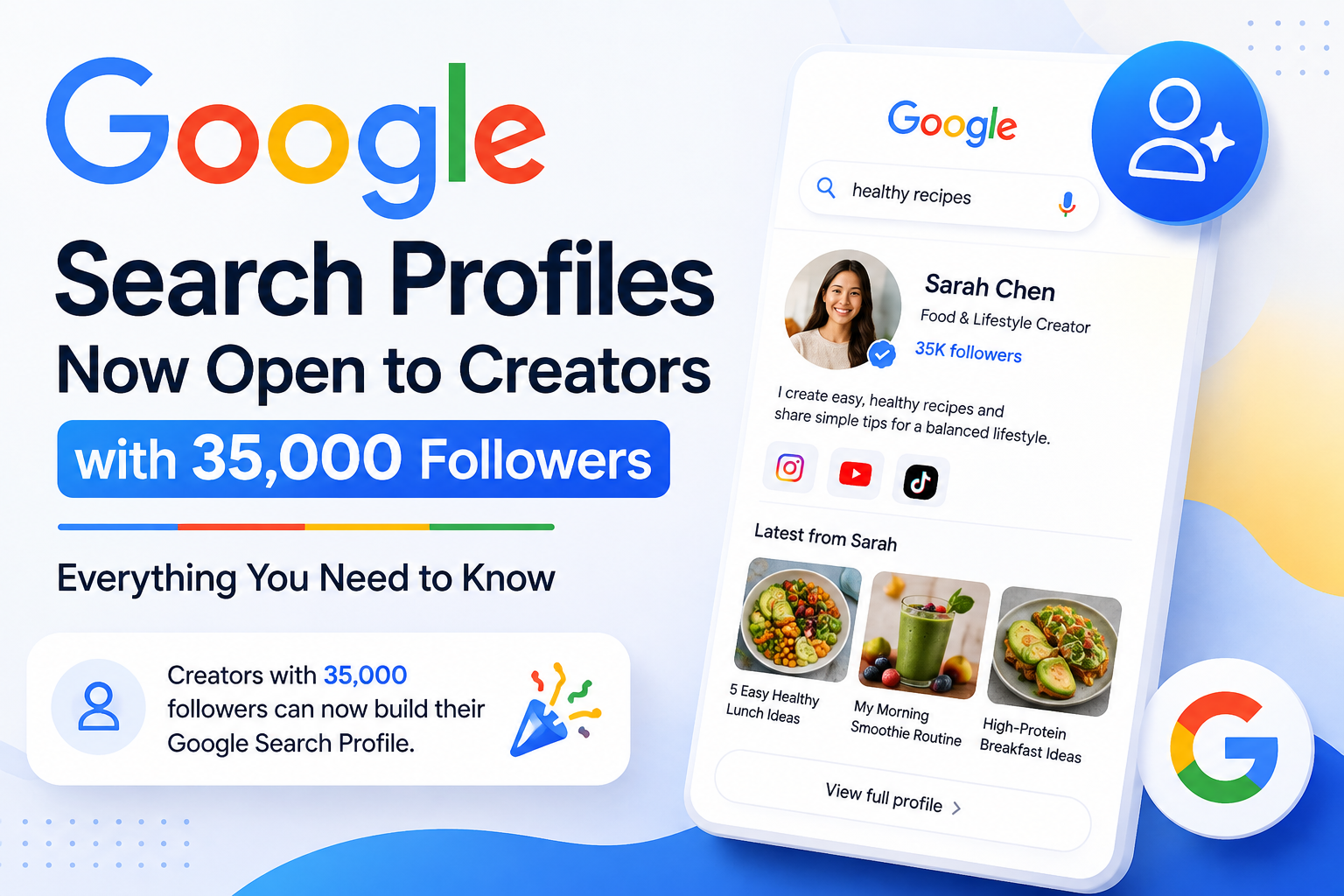
YouTube, Instagram, and X now require only 35,000 followers for eligibility. TikTok still requires 100,000 followers with no announced change. The feature is also expanding to additional countries in the near future. You only need to meet the threshold on one platform to qualify. Search Profiles give creators a dedicated, shareable space that appears directly in Google Search.
Old Requirements vs New Requirements: A Clear Comparison
The change is straightforward to understand when you lay the numbers side by side. Three out of four platforms received a significant reduction while TikTok held at its original threshold.
YouTube: Previously 100,000 followers, now 35,000 followers. A 65 percent reduction.
Instagram: Previously 100,000 followers, now 35,000 followers. A 65 percent reduction.
X (formerly Twitter): Previously 100,000 followers, now 35,000 followers. A 65 percent reduction.
TikTok: Previously 100,000 followers, still 100,000 followers. No change.
One important detail that often gets overlooked: you only need to satisfy the minimum on at least one of these platforms, not all of them. If your YouTube channel has crossed 35,000 subscribers but your Instagram is still in the early stages of growth, you can qualify on the strength of YouTube alone and still connect all your other social accounts to your completed Search Profile.
What Is a Google Search Profile and Why Does It Matter for SEO
A Google Search Profile is a dedicated, shareable page that appears directly in Google Search when someone searches for a creator, journalist, publisher, or brand by name. Google describes the feature as a space designed to help audiences find accurate and up-to-date information about sources on Search, while also giving creators a structured place to highlight content from across their platforms.
In practical terms, when your Search Profile is live, users who search your name or brand on Google will see a rich result that includes a large header image, links to all your connected social accounts, your most recent articles or content pieces, and a follow button that allows people to subscribe to your updates directly from within the search results page.
This matters enormously from both an SEO and a brand visibility standpoint. Think of it as Google’s version of a verified, structured knowledge panel specifically built for content creators. It accomplishes several things simultaneously.
It controls the first impression in search. When someone searches for your name or brand, the top result shapes their entire perception of who you are. A polished Search Profile ensures that the information Google surfaces is accurate, current, and curated by you rather than pieced together from scattered third-party sources or outdated mentions.
It drives cross-platform discovery. Your Search Profile connects all your platforms in one unified place. A reader who finds you through an article can immediately see your YouTube channel, your Instagram feed, and your X account without hunting across the internet. This kind of frictionless discovery is something that even strong entity SEO strategies take months to build organically, and a Search Profile compresses that timeline considerably.
It builds trust and authority. Google’s quality evaluation systems place increasing weight on the question of who is behind the content. A Search Profile signals to both users and Google’s evaluators that you are a real, established source with a verifiable cross-platform presence. That is the foundation of what Google calls E-E-A-T: Experience, Expertise, Authoritativeness, and Trustworthiness.
Who Now Qualifies for a Google Search Profile
The shift from 100,000 to 35,000 is more than a number change. It represents a fundamental expansion in the type of creator Google is willing to surface prominently in search results. Here is a realistic picture of who now falls inside the eligibility window.
Mid-tier YouTubers and video creators. A YouTube channel with 35,000 subscribers carries genuine influence within a niche. Education channels, personal finance explainers, cooking creators, and local news video operations all routinely reach this level without breaking into mass market territory. These creators now have a direct, accessible path to a Search Profile that did not exist before.
Niche Instagram publishers. Many B2B thought leaders, food photographers, travel journalists, and lifestyle brands operate Instagram accounts in the 35,000 to 99,000 follower range with highly engaged, loyal audiences. They were previously invisible to this feature despite significant real-world authority and community trust.
Independent journalists and newsletter writers. Writers who have built audiences on X across beats like technology, politics, sports, or finance often operate in the mid-five-figures range. For them, a Search Profile is a critical credibility signal, especially as AI-generated content makes it harder for readers to quickly verify the human expertise behind what they are reading.
Regional and local news outlets. Many community media brands have substantial digital followings without achieving national scale. The new threshold recognizes that local journalism carries genuine authority even without millions of subscribers behind it.
Something worth highlighting: meeting the threshold on a single platform is all that is required. If your YouTube channel has 40,000 subscribers but your Instagram following is still growing, you qualify on YouTube alone. You can still link every other platform in the completed profile.
Why Google Lowered the Threshold
Google rarely explains the full reasoning behind product decisions, but this one is not difficult to interpret. Several forces are clearly working together to make this change the logical next step.
The ongoing response to low-quality and AI-generated content. As synthetic content floods the web at scale, Google has a growing strategic interest in helping users identify credible human voices quickly and reliably. Search Profiles are one mechanism for doing exactly that. By extending them to a wider group of legitimate creators, Google builds a richer ecosystem of verified sources visible in search results. This connects directly to Google’s broader work on showing clearer quality signals alongside content as AI reshapes how search operates.
Competition for creator loyalty. Google is not the only platform working hard to attract and retain content creators. YouTube, which Google owns, competes directly with TikTok and Instagram Reels for video creators. Offering meaningful search visibility benefits to mid-sized YouTube creators is a smart retention play that makes the Google ecosystem stickier and more rewarding for creators who might otherwise prioritize other platforms.
The rise of personal brand as an SEO asset. The search landscape of 2026 rewards personal brands in ways that were simply not true five years ago. Audiences increasingly search for people and publishers by name rather than just by topic. If someone follows a particular food writer or finance analyst, they are likely to search that person’s name directly. A Search Profile captures that branded intent and converts it into a richer, more satisfying result.
Scaling the product toward mainstream adoption. Search Profiles appear to be moving from a limited rollout toward a fully mainstream feature. Broadening the eligibility criteria is a logical step in that scaling process, similar to how Google has expanded other features over time by relaxing initial gating conditions once the core product proved stable.
The TikTok Exception: Why the Bar Stays at 100,000
One detail in this announcement that drew attention across the SEO and creator communities is that TikTok did not receive the same reduction. While YouTube, Instagram, and X all dropped to 35,000, TikTok holds its threshold at 100,000. Google has not issued a specific explanation for this discrepancy, but several reasonable interpretations are worth considering.
Ongoing regulatory uncertainty. TikTok has faced sustained regulatory scrutiny in the United States and across parts of Europe for several years running. That environment creates practical hesitancy for Google to deepen its visible integration with TikTok at a product level, particularly in a feature that explicitly lists and connects platforms in search results.
Differences in how follower metrics behave. TikTok’s follower dynamics differ meaningfully from those on YouTube and Instagram. Content on TikTok can reach millions of views through algorithmic distribution without translating into sustained subscriber or follower growth, which can make follower counts a noisier and less reliable signal of genuine, sustained audience engagement compared to the other platforms in the program.
Platform relationship dynamics. YouTube is owned by Google. Instagram and X operate under established API partnerships that facilitate account verification and data sharing in ways that TikTok’s relationship with Google’s infrastructure does not replicate. A higher threshold on TikTok may reflect greater caution about the reliability of account and follower data available through that particular integration.
How to Claim Your Google Search Profile Step by Step
If you now meet the updated eligibility requirements, here is a practical walkthrough of the application process. The entire process is managed through Google’s own tools and does not require any technical SEO expertise.
Step 1: Verify your platform eligibility. Count your current followers on YouTube, Instagram, X, and TikTok. You need to meet or exceed the threshold on at least one platform. At 35,000 on YouTube, Instagram, or X, you are eligible to begin the application.
Step 2: Navigate to Google’s Search Profile application. Visit the official Google support documentation for Search Profiles and follow the link to the application section. You will need to sign in with the Google account associated with your creator presence. Make sure you are using the account most closely tied to your public identity or brand.
Step 3: Connect your social accounts. You will be guided through connecting each social platform you want to include in your profile. This involves authenticating your accounts through each platform’s standard authorization process. Connect all relevant accounts, not just the one that qualified you, so your profile presents as complete and comprehensive as possible.
Step 4: Upload a header image and complete your profile details. Your Search Profile features a large, prominent header image at the top of the result. Choose something that clearly and immediately communicates your brand identity, since this will be the first visual impression users encounter when your profile appears in search results. Fill in all available description fields and link every platform you are active on.
Step 5: Submit your application and wait for review. Google reviews all Search Profile applications before they go live in search results. The review period can range from a few days to a few weeks depending on application volume. During this time, keep all your connected social accounts active and publicly accessible to avoid any complications in the verification process.
Step 6: Monitor your profile and keep it updated. Once approved, treat your Search Profile as a living part of your digital presence. Update your header image for major campaigns or seasonal moments, verify that your connected platforms stay current and active, and check periodically that your most recent content is surfacing correctly in the profile feed.
SEO Implications for Creators and Publishers
The expansion of Google Search Profiles carries implications that extend well beyond the feature itself. It is worth thinking carefully about what this means for your broader digital presence and search strategy.
Branded search now has a dedicated destination. When readers search your name or brand, they will land on a structured, rich result rather than a scattered collection of profile pages and third-party mentions. This directly improves the quality of your branded search experience and significantly reduces the chance that a negative result, an outdated piece, or an unrelated person with a similar name dominates the first impression.
It reinforces your author authority in Google’s systems. Search Profiles strengthen the connection between your content and your identity in Google’s knowledge systems. This ties closely to how Google evaluates author authority, a signal that has grown considerably more important as Google has moved to reward demonstrated expertise in specific topics. Understanding how AI reasoning modes surface different sources shows just how fragmented visibility has become across the modern search landscape, and a Search Profile gives you a centralized, Google-verified anchor point within that fragmentation.
The follow feature creates a direct audience relationship. Users who follow you from your Search Profile will see updates from your content in their Google search experience going forward. This is a genuinely new distribution channel that most creators are not yet thinking about strategically. Building a follower base through your Search Profile deserves the same intentional effort you would put into growing an email list or a newsletter subscription base.
Cross-platform linking supports your overall authority signals. By connecting your YouTube, Instagram, X, and other accounts through a Google-verified profile, you create a structured network of identity relationships that Google can factor into its broader understanding of who you are. This is not a direct ranking factor in the conventional sense, but it contributes meaningfully to the web of signals that define how Google models your authority as a creator or publisher.
If you are thinking about strengthening your presence through off-page signals alongside your Search Profile, our guide on digital PR for SEO covers the complementary approach of earning editorial links through genuinely newsworthy content. Both strategies work toward the same underlying goal: making your identity and your authority legible to Google and to your audience at the same time.
You may also want to look at how the desktop vs mobile CTR landscape is shifting in 2026 to ensure your Search Profile strategy accounts for how users are actually finding and clicking through results on different devices.
Global Expansion: More Countries Coming Soon
The subscriber threshold change was not the only announcement embedded in Robby Stein’s post on X. He also confirmed that Google Search Profiles will expand to additional countries in the near future. Currently the feature is available in a limited set of markets, meaning that many creators in Europe, Asia, Latin America, and other regions have been unable to claim profiles even when they met the follower requirements.
The timing of both announcements together points to a coordinated effort by Google to accelerate adoption of the Search Profiles product at a global scale. Lowering the eligibility bar and widening the geographic reach at the same time is the kind of paired growth decision that signals this feature is moving from controlled rollout toward broad mainstream availability.
If you are based outside the currently supported countries, now is an ideal time to ensure your social accounts are fully set up, actively maintained, and that your follower counts are tracking toward the new thresholds. That way you are positioned to apply the moment availability reaches your market rather than needing to scramble to get your accounts in order after the announcement.
Conclusion
Google’s decision to lower the minimum follower requirement for Search Profiles from 100,000 to 35,000 on YouTube, Instagram, and X is one of the more genuinely creator-friendly product moves the company has made in recent memory. It acknowledges that real influence and subject matter authority do not live exclusively in accounts with six-figure follower counts, and that mid-sized creators with engaged, loyal audiences deserve the same branded search presence that was previously accessible only to the largest publishers and most prominent influencers.
For creators who now qualify, the practical next step is clear: apply for your Google Search Profile, connect all your accounts, upload a strong header image, and start treating your Google search presence as a channel worth actively managing. The follow feature alone makes claiming your profile worthwhile immediately, since it gives you a direct line to readers who discover you through search and want to stay connected to what you publish next.
For those who are still building toward the 35,000 threshold, this update is also a meaningful signal. Google is interested in creator verification and is clearly willing to keep lowering barriers as the product matures and the ecosystem grows. Invest in building a genuine, engaged audience on at least one platform, and reaching Search Profile eligibility becomes a natural milestone rather than a distant ceiling.
Stay connected with AISEO Round Table for the latest developments in Google search, creator SEO, and the evolving landscape of digital visibility as we move through 2026 and into what comes next.
Frequently Asked Questions
What is the new minimum follower count to qualify for a Google Search Profile?
As of August 13, 2026, the minimum requirement is 35,000 followers on YouTube, Instagram, or X. TikTok retains its original threshold of 100,000 followers. You only need to meet the minimum on one platform to be eligible to apply.
Do I need 35,000 followers on every platform to qualify?
No. You only need to meet the minimum on at least one supported platform. If you have 40,000 YouTube subscribers but fewer followers on your other accounts, you can still apply and connect all your accounts to your Search Profile once approved.
Why did TikTok not receive the same reduction as the other platforms?
Google has not issued an official explanation for the TikTok exception. The most likely contributing factors include ongoing regulatory scrutiny of TikTok in major markets, differences in how TikTok follower metrics reflect genuine sustained audience engagement, and structural differences in how Google’s systems interface with TikTok compared to YouTube, Instagram, and X.
What does a Google Search Profile actually look like in search results?
A Search Profile appears as a rich result when someone searches for your name or brand. It includes a large header image, links to all your connected social accounts, a follow button, and a feed of your most recent content and articles. It is designed to function as your definitive, shareable branded presence directly on Google Search.
Will having a Google Search Profile improve my search rankings?
A Search Profile is not a direct ranking signal for your website pages in the traditional sense. However, it strengthens your branded search experience, reinforces your author authority and entity signals in Google’s knowledge systems, and opens a new audience distribution channel through the follow feature. All of these contribute to a healthier and more authoritative search presence over time.
Is Google Search Profile available in all countries?
Currently the feature is available in a limited number of markets. Google has announced that Search Profiles will expand to additional countries in the near future. If you are outside the supported regions, watch for official announcements and prepare your accounts so you can apply quickly when the feature becomes available in your location.
How long does Google take to approve a Search Profile application?
The review process typically takes anywhere from a few days to several weeks depending on current application volume. During the review period, keep your connected social accounts active and publicly accessible to avoid any issues with the verification process.
Can a business or brand claim a Google Search Profile, or is it only for individual creators?
Google Search Profiles are designed for both individual creators and publishers, which includes media organizations, newsletters, content brands, and other editorial entities. As long as the account meets the follower threshold on at least one supported platform, a business or publication is eligible to apply.