Paid ads can drain your margin fast. Many ecommerce SEO guides feel aimed at larger teams with a dedicated developer, a six-figure tool budget, and a content team on retainer. If you’re running a Shopify or WooCommerce store solo, or close to it, those guides leave you more confused than when you started.
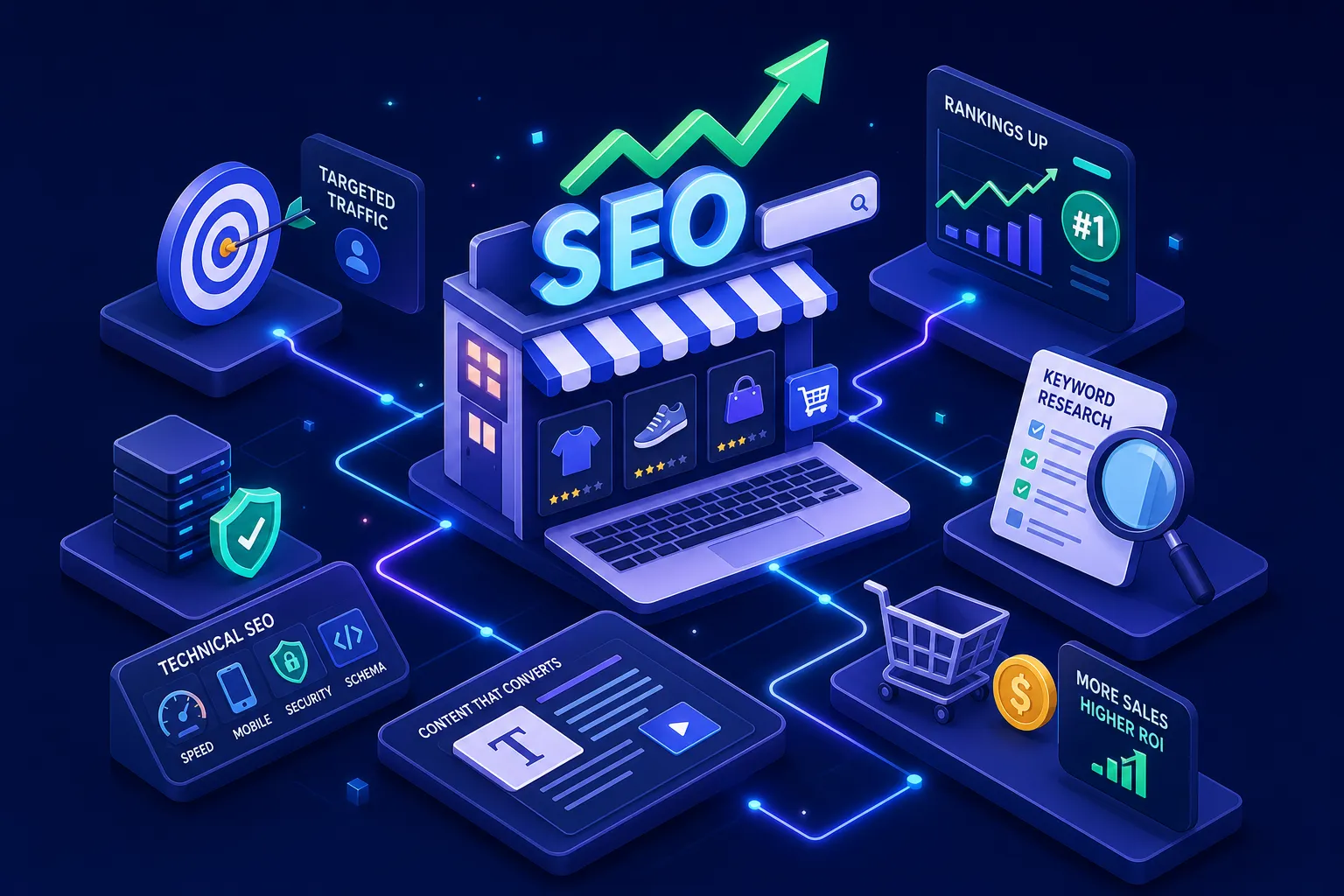
Here at AISEO Round Table, the question we hear most from small store owners is simple: where do I even begin? This guide answers that directly with a step-by-step ecommerce SEO strategy that covers keyword mapping, product and category page optimization, technical fixes, link building, and performance tracking, without skipping the details that actually matter. Every section is built for lean operations where one person makes all the calls. Think of this as your ecommerce SEO playbook: practical, sequenced, and built around ecommerce SEO best practices that work without an agency budget.
Mapping keywords to your product catalog before you touch anything else
Most store owners skip this step entirely and just “add keywords” to whatever page feels relevant. That approach creates a messy situation where three product pages compete for the same term, splitting authority and leaving Google unsure which URL to rank. Keyword-to-page mapping solves this before it becomes a problem.
The two-layer keyword approach
Think of your keyword strategy in two layers. Commercial-intent keywords, things like “waterproof hiking boots men” or “best trail running shoes for beginners”, belong on product pages where someone is ready to buy. Broader terms like “men’s hiking boots” or “trail running shoes” belong on category pages, because a shopper using those terms wants to browse options, not jump straight to a single product. Before you assign any keyword to a page, pull up the actual Google search results for that term and look at what’s ranking: product pages or category pages. The SERP tells you the intent more clearly than any tool.
Using a keyword tool without overspending
You don’t need a $500-per-month platform to do this well. Budget-friendly tools like KWFinder by Mangools, Ubersuggest, and Google Keyword Planner all give you keyword difficulty scores and monthly search volume at a price that works for small store owners. For guided help, see our Best Keyword Research Strategies to Boost Your SEO, it walks through exactly how to use these tools for ecommerce keyword research. The goal is to find terms with real buyer intent and a difficulty score your domain can realistically compete for. Filter for modifiers like “best,” “buy,” “for women,” “under $50,” or product-specific descriptors. Those long-tail variations convert better and are far more winnable than broad head terms on a new or small site.
How to optimize product pages so Google and shoppers both convert
Your product page has two jobs: rank in search results and close the sale. Most product pages fail at both, mainly because they use manufacturer copy that’s duplicated across dozens of other sites and offer no compelling reason to buy beyond a price tag. Unique, benefit-driven copy fixes this immediately.
The on-page elements that matter most
Start with your title tag: keep it between 50 and 60 characters, put the primary keyword early, and include a differentiator when space allows. For example, “Men’s Trail Running Shoes | Lightweight Grip | Brand” works better than a generic product name with no context. Your H1 should match the product name closely, and you get exactly one per page. The meta description should land around 130 to 160 characters, lead with a benefit, and give the shopper a reason to click over the other results. For the product description itself, lead with benefits before specs: “Built for rocky trails, this shoe combines breathable mesh and responsive cushioning” is more persuasive than a list of materials and dimensions.
Product schema markup and why it’s worth the setup time
Product schema often delivers significant SEO value on a product page. When implemented correctly, it makes your listing eligible for rich results, learn more about using structured data to drive more organic traffic, and Google can display your price, stock status, and star ratings directly in the search results, which increases click-through rates before anyone even lands on your site. Rich snippets and their impact for ecommerce are covered in detail in an industry guide about the importance of rich snippets for an ecommerce website. The core JSON-LD fields to include are name, offers.price, offers.availability, aggregateRating, and sku. On Shopify, many themes handle this automatically or through a simple plugin; on WooCommerce, a structured data plugin handles the heavy lifting without touching code. Add aggregateRating only if you have genuine on-page reviews, and keep availability in sync with your actual inventory.
Images, alt text, and the missed SEO opportunity
Product images are an overlooked ranking signal that most store owners don’t think about as an SEO task. Rename your image files before uploading: “mens-trail-running-shoes-black.webp” performs better than “IMG_4832.jpg.” Write alt text that describes what’s actually in the image in plain language, “Black men’s trail running shoe with aggressive tread”, rather than stuffing it with keywords. Compress images to .webp format to keep file sizes small, which directly improves page load speed and your Core Web Vitals scores.
Category page SEO: the growth lever most small stores ignore
Category pages often rank for your highest-volume, highest-intent keywords, yet most small store owners treat them as a grid of products and nothing else. A shopper searching “men’s trail running shoes” wants to browse options, which is exactly what a category page delivers. That’s why Google consistently surfaces category pages for broader browse-intent terms like those.
Writing category page copy that actually helps rankings
An intro of at least 300 words, placed above or below your product grid, gives Google the clearest signal about what the page covers. A concise paragraph above the grid works well for user experience; the bulk of the descriptive copy can sit below the product listings where it won’t interrupt browsing. Describe what’s in the category, use natural semantic variations of your main keyword, and link to key subcategories or related pages. This isn’t filler text you’re hiding at the bottom of the page. It’s the primary text signal on a page that otherwise consists of images, filters, and prices. A straightforward heading structure works best: one H1 for the category name, H2s for sections like “How to choose” or “Popular subcategories,” and a small related-links block near the bottom.
Handling filters and faceted navigation without creating duplicate pages
The core rule for faceted navigation is simple: only index filter combinations that match real search demand. Everything else should be canonicalized back to the main category page or set to noindex. On Shopify, this means controlling which collection tag pages are crawlable and making sure your sitemap doesn’t include every filter variant. If you need a technical walkthrough for faceted nav on common storefronts, this guide on how to audit faceted nav SEO on Shopify and WooCommerce is a practical reference. On WooCommerce, attribute archive pages can multiply quickly, so audit which ones have genuine search volume before leaving them indexable.
On Magento, layered navigation is the most common source of crawl budget waste on the platform. The fix is the same across all three: a small whitelist of high-value facet pages gets indexed, and everything else gets a canonical pointing to the parent category.
Technical fixes that unlock your store’s ability to rank
Technical SEO is the foundation everything else builds on, without it, Google simply won’t surface your work, even when your product copy is strong and your backlinks are legitimate.
Core Web Vitals and page speed for ecommerce stores
Google’s three targets are LCP under 2.5 seconds, INP under 200 milliseconds, and CLS under 0.1, measured at the 75th percentile of real user loads. In plain terms: LCP measures how fast your hero product image appears on screen; INP measures how quickly the page responds when someone taps “Add to Cart”; CLS measures whether buttons and images jump around as the page loads. For an ecommerce-specific overview of Core Web Vitals and why they matter, see this resource on Core Web Vitals in ecommerce.
The most practical fixes for ecommerce are compressing and preloading hero images, reducing third-party app scripts (especially on Shopify where app bloat is common), and setting explicit width and height attributes on all images so the browser reserves space before they load. Serving assets through a CDN rounds out the list. Together, these four changes address the majority of Core Web Vitals failures seen in small store audits.
Site architecture and internal linking for a crawlable catalog
Any product on your site should be reachable within three clicks from the homepage. The cleanest structure is a flat pyramid: Homepage to Category to Subcategory to Product. This helps Google allocate crawl budget toward your most important pages and understand which pages carry the most authority. Breadcrumbs play a dual role here: they show shoppers where they are in the navigation and give search engines a clear map of your site hierarchy. Add contextual links inside category descriptions, buying guides, and blog posts to reinforce which product and category pages are most important, rather than relying solely on top navigation.
Building links and content authority without an agency budget
Backlinks still move the needle for ecommerce SEO, and small stores have more link-earning opportunities than they often realize. The key is a consistent process rather than occasional outreach bursts that go nowhere.
Link-building tactics that work for small stores
The most reliable starting points are supplier links, product gifting, and listicle outreach, each suits a different stage of your outreach effort.
Supplier and manufacturer links are the lowest-friction option: if you sell branded or wholesale products, ask brands and distributors to list you as an authorized retailer on their site. This comes from an existing relationship rather than a cold pitch, which makes the success rate significantly higher. Product gifting to niche bloggers and reviewers in your category is a commonly used tactic, identify writers who publish “best of” roundups for your product type and offer to send a sample in exchange for an honest review. Finally, reach out to existing listicles that already rank for “best [your product type]” and pitch your product for inclusion. These articles already have authority; getting added to one costs you only the time to send a well-written email.
Using a blog to support product and category page rankings
A topical cluster strategy turns your blog from an afterthought into an authority-building machine. The structure is straightforward: a central category page acts as the hub, supported by related guides, comparisons, and how-to articles that all link back to it. A store selling outdoor gear might publish a “hiking boots buyer’s guide” that links to three different category pages. This builds topical authority for those commercial terms and captures long-tail informational traffic from shoppers who are still in research mode. Those informational visitors often convert when they land on a well-structured category or product page later in their buying journey.
Tracking whether your ecommerce SEO strategy is actually working
There’s no point doing the work if you can’t tell what’s moving. Tracking doesn’t require an enterprise analytics stack. Google Search Console combined with a basic ecommerce analytics setup tells you nearly everything you need to make informed decisions about where to focus next.
The four KPIs worth watching in Search Console
Focus on four data points inside the Performance report. Organic clicks tell you how much traffic your optimizations are actually driving. Average position by page shows you whether target product and category URLs are moving up or stagnating. Click-through rate on product and category pages signals whether your title tags and meta descriptions are compelling enough to earn the click, even when you’re ranking. Coverage errors reveal indexing problems like blocked pages, duplicate canonical conflicts, or noindex tags applied accidentally. Use the Pages filter inside the Performance report to see exactly which product and category URLs are getting impressions and clicks, and sort by impressions to find high-visibility pages with low CTR that need a better title or meta description.
Setting a monthly SEO review routine
For small stores, about 30 minutes a month is often enough to catch problems before they compound, larger stores with frequent inventory changes will benefit from more regular checks. Start by reviewing new coverage errors. Then compare position changes on your target product and category pages against the previous month. Finally, look for CTR outliers: pages sitting at positions four through ten with impressions but low clicks are telling you the title tag or meta description isn’t working. Rewrite those and recheck in 30 days. This habit keeps you ahead of slow declines and gives you clear evidence of what’s working so you can do more of it.
Your ecommerce SEO strategy, built to compound over time
The strategy arc is straightforward: map keywords to the right pages before optimizing anything, get your product and category pages tight on copy, schema, and images, fix the technical issues that waste crawl budget, build links through a method you can run on a schedule, and track the four metrics that actually tell you whether organic traffic and revenue are growing.
Most of this is genuinely DIY-friendly, keyword research, on-page copy, meta descriptions, image optimization, and Search Console monitoring require no technical background and no premium tools. A few tasks, like complex faceted navigation fixes or CDN configuration, may call for a developer’s help, and AISEO Round Table has Step-by-Step SEO Audit Guide for Better Rankings and other walkthroughs for those cases. Apply this ecommerce SEO strategy consistently and every improvement compounds over time. Shopify and WooCommerce handle much of the infrastructure; your job is to work through each section and keep showing up.
AISEO Round Table publishes guides covering every piece of this puzzle, from deep-dive keyword research tutorials to step-by-step walkthroughs for schema markup, technical fixes, and getting the most out of Google Search Console. New guides drop regularly on every topic in this ecommerce SEO strategy. Bookmark the site and revisit as you work through each stage. If you want a deeper conceptual framework to pair with these tactics, see our piece on SEO Intelligence: Unlocking Smarter Search Optimization.