
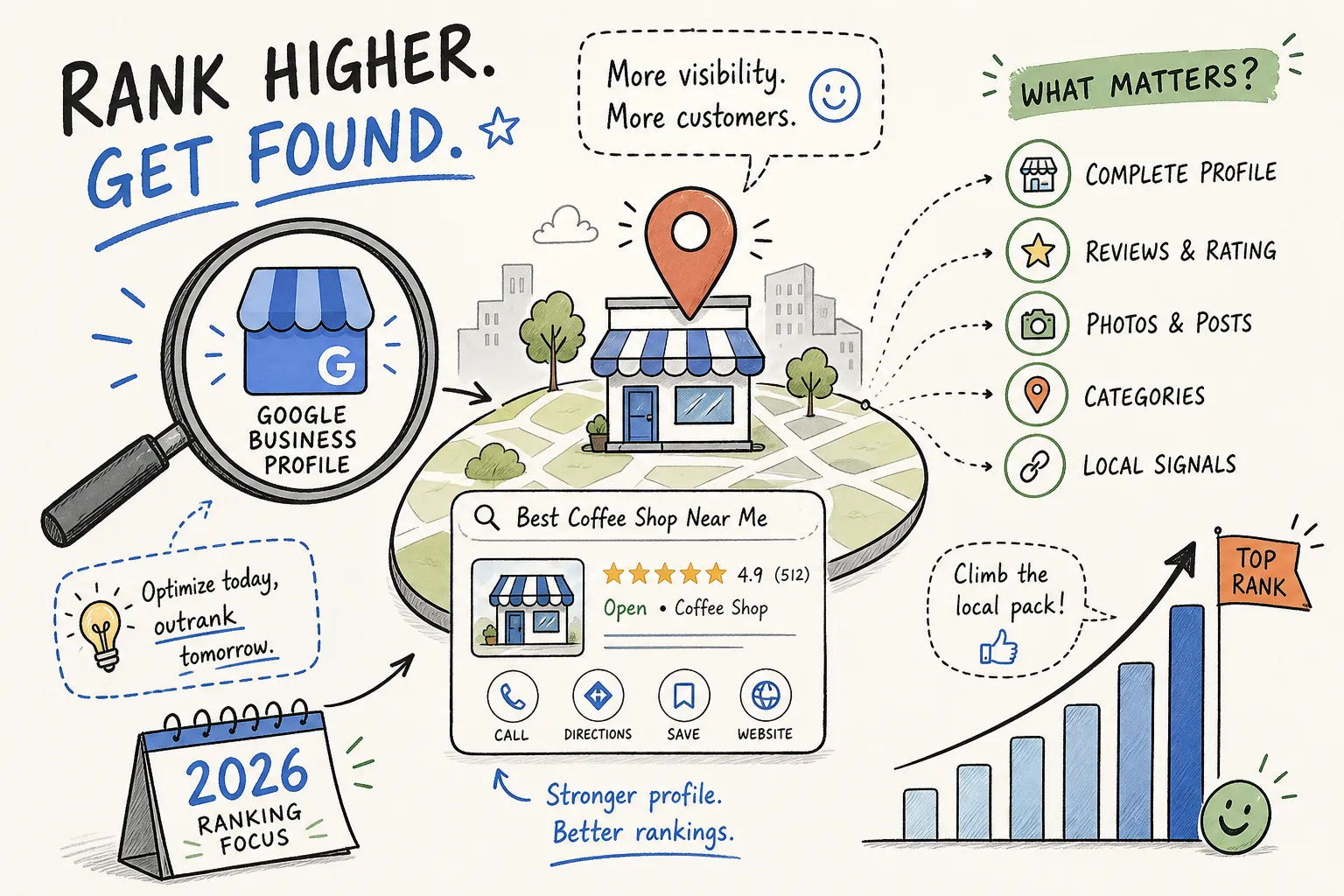
Google Business Profile SEO is one of the highest-leverage activities a small business owner can invest time in, and most profiles still leave that leverage untapped. Many consumers turn to Google Maps or local search before visiting a business in person, yet a large share of Google Business Profiles remain incomplete, outdated, or miscategorized. That gap between showing up in the Local Pack and getting buried on page two is not a mystery. It is a fixable problem, and it starts with understanding what Google actually weighs when ranking local results.
At AISEO Round Table, we focus on SEO strategies that small business owners can implement without an agency, and local search is one of the highest-ROI areas we cover. A well-optimized Google Business Profile costs nothing but time, and the ranking upside is substantial. This guide walks through the entire optimization process: how Google ranks local results, which profile fields move the needle most, a photo and review playbook, citation fundamentals, and a KPI dashboard to measure progress.
Google Business Profile SEO: Why your GBP is the most controllable local ranking signal
Google uses three signals to evaluate local results: relevance, distance, and prominence. Proximity is the one variable you cannot optimize away. If someone searches for a plumber from across town, proximity will always factor against you in that search. That is fine, because proximity is not the only variable, and it is the only one you do not control.
According to BrightLocal’s 2026 Local Search Ranking Factors survey, Google Business Profile signals account for roughly 32% of Local Pack ranking weight. Reviews add another 20%, on-page signals contribute 15%, behavioral signals account for 9%, and links, citations, and personalization fill out the remaining share. These are third-party estimates, not Google-confirmed numbers, but they provide a clear prioritization framework that is far more useful than guessing.
The practical takeaway is direct: fix your GBP before chasing backlinks or building out citation volume. The profile itself, combined with reviews, accounts for more than half of estimated local ranking weight. For a small business owner handling their own SEO, that ratio represents an outsized return on a completely free tool.
Setting the foundation: categories, name, and description
Your primary category, business name, and description are how Google builds its understanding of what you do. Getting these three fields right sets the ceiling for everything else you do on the profile. If they are wrong or vague, the rest of your optimization work has less to build on.
How to choose a primary category that actually matches your business
Your primary category is among the most impactful choices on the entire profile. It tells Google which searches you should compete in and shapes how your listing appears across both Maps and organic local results. Use the most specific match available, not a broad parent category. A family practice physician should not select “Doctor” when “Family Practice Physician” exists in Google’s category list.
A useful decision filter: if someone searched for that category near their location, would you genuinely want your business to appear? If yes, it belongs as a primary or secondary category. Secondary categories should only be added when they reflect real, distinct services your business actively provides. Adding irrelevant secondaries does not help and can dilute your primary category’s signal.
Writing a GBP description that supports local relevance
Google provides up to 750 characters for your description, use them intentionally. The practical goal is to describe what your business does, who it serves, where it operates, and what sets it apart, using natural language that includes the services and location terms you want to rank for. Avoid keyword stuffing and overly promotional phrases like “best in the city” or discount language, as Google’s guidelines flag both types of content and violations can result in profile edits by Google.
A reliable template structure works like this: start with what you do, follow with who you serve, reference your service area, and close with one genuine differentiator. That structure keeps the description readable for customers while covering the topical signals that support local relevance.
Photos, services, and attributes: closing the completeness gap
Profile completeness has become a stronger ranking lever in 2026. Post-update analysis from local SEO researchers, including coverage by BrightLocal, found that profiles missing services, attributes, or photos experienced measurable visibility drops. Completeness is no longer a “nice to have” consideration. It is a baseline requirement for competitive local visibility.
Google Business Profile SEO: photo types, sizes, and upload cadence
Google recommends JPG or PNG images at a minimum of 720x720px, with file sizes between 10KB and 5MB and no heavy filters applied. For your cover photo, use 1024x576px at a 16:9 ratio. Center key subjects in every image to avoid problematic auto-cropping when Google displays them across different placements.
Five photo types build trust and drive completeness:
- Exterior shots so customers can recognize the location
- Interior shots that set accurate expectations
- Team photos that humanize the business
- Product or service action shots that show your work
- A strong cover photo that represents the brand clearly
Add new photos at least every two weeks to signal an active, legitimate business. For visual industries like restaurants, landscaping, or real estate, two to three uploads per week is a better target. For guidance on how to manage and regain control over the images that appear on your profile, see this piece on taking back control of your Google My Business images: how to take back control of local search images.
Services and attributes that tell Google exactly what you offer
Adding pre-defined services from Google’s menu improves both explicit keyword ranking (searches for a specific service name) and implicit ranking (searches that imply a need without naming a service directly). In your GBP dashboard, select all relevant services from the pre-defined list, then add any custom services not already covered. Keep the list current and aligned with the searches you actually want to rank for.
Attributes deserve separate attention. Hours, payment types, accessibility features, and business highlights each fill in context that Google uses to match searches with appropriate results. Missing attributes now appear to hurt local pack optimization more than they used to, so treat the attributes section as a required completion task, not an optional one.
Building a review strategy that lifts rankings and conversions
Reviews carry roughly 20% of estimated Local Pack ranking weight and serve as the most visible conversion signal a local business has. Volume matters, but so do recency, detail, and your response rate. Reviews are not something you set up once and forget.
How to generate reviews without breaking Google’s rules
An effective review generation system comes down to three things: asking at the right moment, making the process frictionless, and building it into a repeatable workflow. The right moment is immediately after a positive service interaction, while the experience is fresh. Making it frictionless means providing a direct review link, a QR code at the register, or an SMS shortcut so customers do not have to search for the review page themselves.
Google’s policy is clear on what is not allowed: incentivized reviews, scripted positive language, and review gating (sending only happy customers to Google while redirecting complaints elsewhere). Each of these practices violates Google’s guidelines and risks profile suppression. Ask openly, ask authentically, and let customers describe their experience in their own words. Detailed, specific reviews convert better and signal more to Google than short, generic ones.
Responding to reviews the right way
Respond to every review, both positive and negative. Responses signal engagement and validate the reviewer’s experience, which matters to future customers reading through your profile. For negative reviews, acknowledge the issue, invite the customer to resolve it offline, and avoid public blame or defensiveness. For positive reviews, a brief, natural response that mentions the service and general area can reinforce local relevance without forcing keywords awkwardly.
Consistent response rates are associated with improved trust and profile engagement. Templates with human oversight work well here: they keep response times fast and brand voice steady, but they should always be personalized enough to feel genuine rather than automated.
NAP consistency, citations, and local authority signals
Citations and NAP consistency are supporting signals, not primary drivers, but inconsistency actively hurts rankings by creating conflicting signals that reduce Google’s confidence in your listing. Your GBP is the source of truth. Every other mention of your business on the web should match it exactly.
NAP stands for name, address, and phone number. Even minor variations create problems. “St.” versus “Street,” different suite abbreviations, or an old phone number on a directory you forgot about, these discrepancies reduce the value of all your citations, including the accurate ones. You may also find that inconsistencies affect how data aggregators push your information downstream, compounding the problem across dozens of directories. The cleanup-first principle applies here: fix existing inconsistencies before adding new listings.
For US small businesses, a clear priority order for citation building looks like this:
- Tier 1: GBP as the authoritative source, then Apple Business Connect, Bing Places, Yelp, Facebook, and the Better Business Bureau
- Tier 2: Data aggregators (Data Axle, Neustar Localeze, Foursquare) that distribute your information to downstream directories
- Tier 3: Local chamber of commerce, city business portals, and regional directories that reinforce geographic relevance
- Tier 4: Industry-specific directories (Healthgrades for medical, Avvo for legal, Houzz for home services, HomeAdvisor for contractors)
Relevance and accuracy matter more than raw quantity. A small number of well-maintained, high-authority listings outperforms dozens of low-quality directory submissions where your NAP does not match.
Tracking GBP performance so you know what’s working
Optimizations without measurement are guesswork. Fortunately, GBP provides enough built-in data to tell you whether your changes are working, you just need to know what to look at. Before you change anything on your profile, record your baseline numbers. Thirty to ninety days after implementing changes, you will have comparison data that tells you whether the optimizations moved the needle.
Inside GBP’s Insights panel, focus on profile views broken down by Search versus Maps, direction requests, website clicks, call clicks, and booking actions. Pay close attention to the breakdown between discovery searches and direct or branded searches. A rising share of discovery searches means customers who did not already know your business name are finding you, a clear indicator of genuine local SEO for Google Maps growth for non-branded queries.
GBP Insights shows engagement data but not keyword rankings. To see whether your profile is appearing in the Local Pack for specific target terms, you need a rank tracking tool alongside it. At AISEO Round Table, we have published a detailed breakdown of how to use SERPChecker for tracking local SERP positions at a specific location level, including Local Pack placement for the keywords that matter to your business. Tracking a handful of core local keywords monthly is enough to detect whether your GBP optimizations are moving your actual search positions, not just your click-through numbers.
Your GBP optimization checklist for 2026
Here is the priority order as a quick-reference summary. Start with your primary category, because that choice shapes everything else on the profile. Then complete your services, attributes, and photo coverage to close the completeness gap. Build a repeatable review generation system and respond to every review you receive. Audit your NAP consistency across existing citations and clean up mismatches before adding new listings. Finally, set up baseline tracking in GBP Insights and pair it with a local rank tracker so you can measure real visibility changes over time.
Maintaining your Google Business Profile SEO as a monthly routine, rather than a one-time setup, is the key to sustaining Local Pack visibility. The businesses that treat it as ongoing maintenance consistently outrank the ones that set it up and walk away. Google continues to update how it weights local signals, so keeping your profile active, complete, and accurate is what keeps you competitive through those changes.
If you want to go deeper on any of these tactics, the AISEO Round Table blog publishes Top Local SEO Strategies for Small Businesses and tool reviews, all written for small business owners handling this work themselves. Check back on the AISEO Round Table blog as Google continues to refine how it ranks local results throughout 2026. The Google Business Profile ranking factors covered here will not change dramatically, but staying current on the specifics is how you stay ahead.