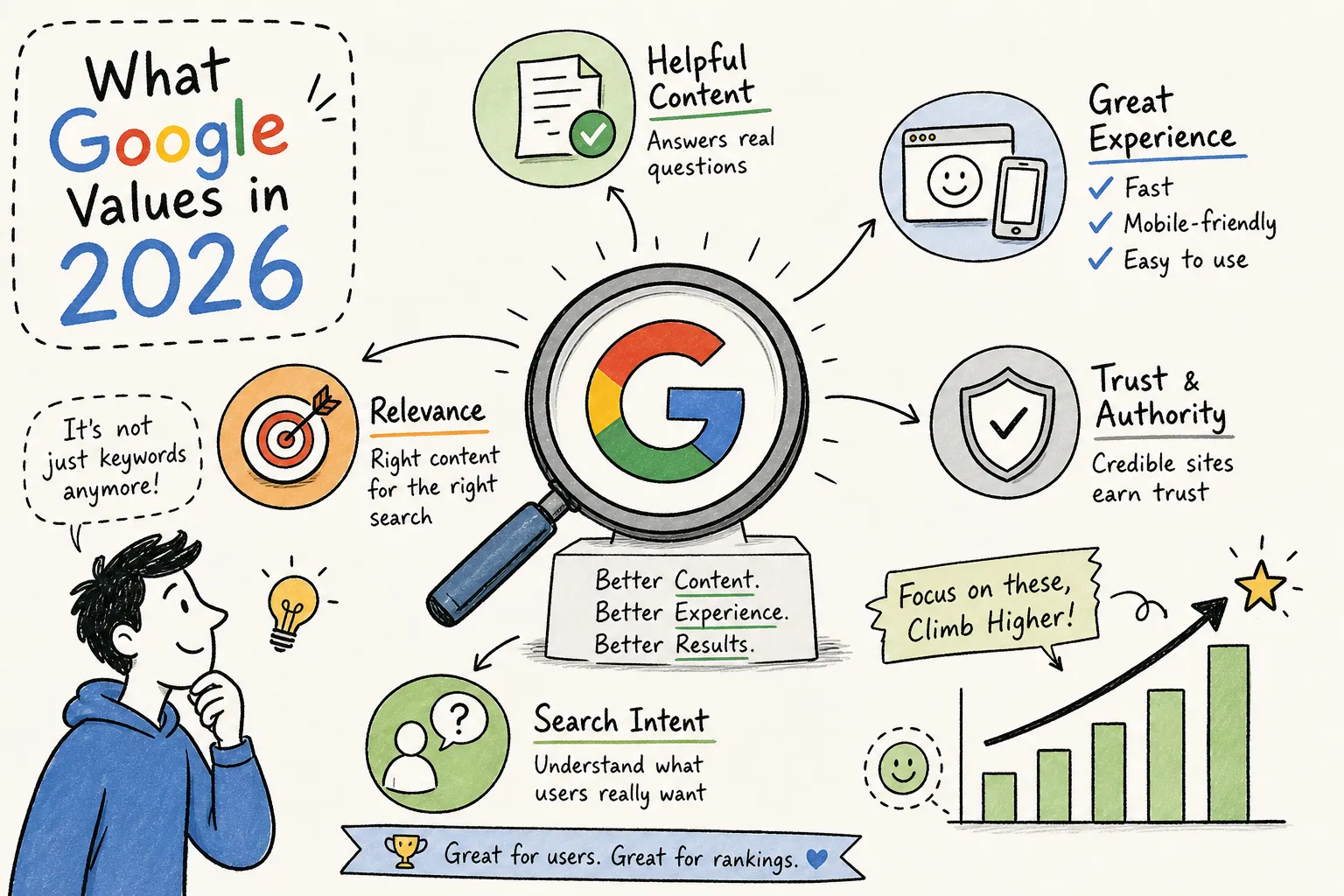
If you want to understand which Google ranking factors in 2026 actually move the needle, you need to look past the recycled checklists. Most SEO advice about Google’s ranking signals gets repackaged year after year with barely any real changes, the same “publish helpful content” mantra, the same on-page checklist. But multiple core updates between March 2024 and May 2026, AI Overviews reshaping how results appear on screen, and Google’s measurable shift toward entity-based trust signals mean the old playbook isn’t enough anymore.
Here at AISEO Round Table, we’ve been tracking these updates and their ripple effects across small blogs, affiliate sites, and local business pages. The patterns are clear. This article gives you a plain-English breakdown of the signals that actually move rankings right now, what the data shows about each one, and where you should focus first.
How Google’s ranking priorities shifted after the 2024 and 2026 core updates
The March 2024 core update was the clearest signal that Google was done tolerating low-quality, scaled content. Google folded the old standalone helpful content system into its core ranking, using multiple signals instead of a single classifier to identify pages that feel made for search engines rather than people. After that rollout, Google reported a 45% reduction in low-quality, unoriginal content in results, surpassing its own projected target of 40%.
The May 2026 core update continued in the same direction, with Google describing it as designed to “better surface relevant, satisfying content for searchers from all types of sites.” The December 2024 spam update added targeted enforcement against manipulative practices, while the November 2024 broad core update focused on elevating overall content quality across the board. The pattern across two years of updates is remarkably consistent: original, people-first content is the baseline Google expects, not a differentiator that earns extra credit.
If your content only clears the helpful content bar, you’re not ahead. You’re just not penalized. Ranking competitively requires building on top of that baseline with stronger signals across content authority, technical performance, link equity, and AI visibility. The sections below cover each of those in order.
E-E-A-T signals that separate trusted pages from forgettable ones
E-E-A-T stands for Experience, Expertise, Authoritativeness, and Trust. Google has been clear that it’s not a single ranking score you can optimize directly; it’s a quality framework that shows up across how content is evaluated by algorithms and quality raters alike. Trust is the most important component, and it operates at both the page level and the site level. We also published a deeper note on how Google rewards content made for humans.
A 2026 audit by OneMagnify found that sites emphasizing original, researched, authoritative content saw a 23.5% better average position compared to more generic content, along with 165% longer engagement time. A separate 16-month study tracking 4,200 articles found that pure AI-generated content ranked 23% lower than human-written content, with the gap widening to 31% by month 16. The researchers attributed much of that gap not just to content quality alone, but to 61% fewer editorial backlinks pointing to AI-generated content. The two signals are closely linked.
How experience and expertise show up as concrete page-level signals
At the page level, E-E-A-T shows up through specific, observable choices. Clear author bylines with relevant credentials, first-hand experience woven into the content, testing products yourself, sharing original observations, citing your own data, and visible sourcing for factual claims all signal that a real person with relevant knowledge produced the content. An author bio that links to a consistent online presence across your niche amplifies this further.
Content that clearly demonstrates the author has actually done the thing they’re writing about outperforms content that simply describes the topic from a distance. If you’re reviewing an SEO tool, showing screenshots from your own account and explaining what you found beats a generic feature summary every time. Google’s quality rater guidance specifically calls out “first-hand experience” as a quality signal even for non-health, non-finance topics.
Trust signals that Google uses to evaluate your whole site
Site-level trust signals matter just as much as the individual page. A complete About page, visible contact information, a privacy policy, and a clear description of who publishes the site all tell Google the business behind the content is real and identifiable. Consistent topical focus across your site also matters; a scattered mix of unrelated subjects weakens the credibility signal that comes with being a recognized voice in a specific area. For more on why niche focus and subject depth matter, see our piece on topical authority. Third-party mentions and citations from credible sources in your niche tie these signals together at the domain level.
Core Web Vitals 2026: Benchmarks your pages need to hit
Core Web Vitals measure how a real user experiences your page loading, responding to interaction, and staying visually stable. Google evaluates these using real user data at the 75th percentile, meaning your page needs to perform well for 75% of actual visitors, not just under ideal lab conditions. Meeting the thresholds keeps you competitive; missing them creates friction that compounds your other weaknesses and drags on rankings when other signals between competing pages are similar. For an authoritative reference on the metrics, see the official Core Web Vitals documentation.
The three metrics and their 2026 pass targets
The three Core Web Vitals each measure a distinct aspect of page experience:
- LCP (Largest Contentful Paint): 2.5 seconds or faster. Measures how quickly the main content element of your page becomes visible to the user.
- INP (Interaction to Next Paint): 200 milliseconds or lower. Measures how quickly your page responds when a user clicks, taps, or types. INP replaced FID (First Input Delay) in 2024, so any guide still referencing FID as a current metric is outdated.
- CLS (Cumulative Layout Shift): 0.1 or lower. Measures how much your page layout jumps around unexpectedly while loading.
Google assesses each metric using field data from real visits, and the 75th percentile threshold is the key number. A page passes only when all three metrics hit “good” for the majority of real users visiting it.
What to do if your pages are currently failing
Open Google Search Console and navigate to the Core Web Vitals report. It shows you which URLs are failing and which metric is the problem. Prioritize your highest-traffic pages first since those failures cost you the most. For LCP wins without a developer, start with image optimization: compress images, convert to WebP format, and add explicit width and height attributes to prevent layout shifts that also hurt your CLS score. Improving server response time through caching or a faster hosting plan delivers the broadest LCP improvement with the least technical complexity.
Why backlinks still matter in 2026 (and what kind Google trusts)
The myth that backlinks are losing relevance keeps circulating, and it keeps being wrong. According to Ahrefs research, the number-one Google result has 3.8 times more backlinks than results in positions two through ten, and pages with at least one backlink perform 10 times better than pages with none. Rather than an official “top three” designation from Google itself, industry analyses consistently show backlinks as one of the strongest measurable correlates of ranking, correlation data across 2025 and 2026 from link-building statistics shows a coefficient of r = 0.38 between referring domain count and ranking position, the strongest correlation among the measured ranking signals.
What changed is not backlinks’ importance but the type that works. Manufactured links, private blog networks, and paid link schemes carry more risk and less reward than ever. Google’s December 2024 spam update and the core update enforcement pattern through 2026 consistently penalized manipulative link practices while rewarding naturally earned editorial links.
How to earn editorial backlinks without a big budget
The most reliable path to editorial links is creating content that other writers and journalists actually want to cite. Original research and data studies earn links because they give other content creators a source to reference. Contributing expert quotes to roundups in your niche builds both links and author recognition. Comprehensive resources, detailed how-to guides, free templates, and calculators, attract natural links because they solve real problems for real people. Referring domain diversity matters more than raw link count; links from many different credible sites outperform dozens of links from the same domain.
AI search ranking signals and the new visibility game in 2026
This is the most significant shift in the search landscape this year. AI Overviews now appear on a large share of informational queries, and they suppress organic click-through rates dramatically. When an AI Overview appears, informational-query CTR drops from 1.76% to 0.61%, a 61% decline, according to Seer Interactive data. Position one loses a meaningful share of its expected clicks when results are compressed below an AI Overview; third-party analyses, including data from Ahrefs, suggest the reduction varies considerably across query types, with some datasets showing drops well above 30%. Zero-click searches now account for somewhere between 56% and 69% of all searches overall (estimates vary by study), rising to approximately 83% when AI Overviews dominate the SERP.
This changes what “ranking well” means in practice. A page can hold position one and receive significantly fewer clicks than it would have two years ago. Tracking ranking position alone is no longer enough. You need to monitor impressions, CTR, and whether your content is being cited inside AI answers.
Optimizing for citation and entity visibility, not just position
Appearing in AI Overviews requires structured, factual content that directly answers questions in clear, citable language. Clear entity signals matter: consistent author name, organizational identity, and demonstrated topical authority across multiple pieces of content. Citing sources and including original data makes your content more likely to be referenced. Early data from 2025 suggests that sources cited in AI Overviews received around 35% more organic clicks compared to uncited results, though overall click volume from citations remains modest, roughly 1% of users click cited sources at all. The traffic volume stays limited, but the brand visibility and authority signal are real. For a practical walkthrough on adapting content strategy to this new environment, see our guide on Mastering AI Overviews and Generative SEO.
How to track these signals without drowning in data
Knowing the signals matters only if you monitor them consistently. Google Search Console covers Core Web Vitals and click-through rate trends for free and should be your first stop. Check the Core Web Vitals report monthly, monitor impressions versus clicks by page to spot AI Overview suppression, and watch for keyword ranking changes in the Performance report. New referring domains are harder to track inside Search Console, which is where a dedicated SEO tool earns its keep.
For bloggers and small business owners who want keyword-level visibility, SERP feature tracking, and competitive insight without the complexity of enterprise platforms, we use and recommend Mangools at AISEO Round Table. KWFinder shows you keyword volume and difficulty data that helps you identify which topics you can realistically rank for right now. SERPChecker lets you see what’s actually showing up in results for your target queries, including which SERP features and AI-adjacent signals are present, so you can calibrate your expectations before investing in a piece of content. We publish hands-on Mangools tutorials and reviews that walk through the exact setup process if you want a step-by-step guide to get your tracking dashboard running.
Bringing it all together with a focused action plan
Understanding the key Google ranking factors in 2026 requires a more complete view than keyword targeting and basic on-page optimization. E-E-A-T builds your site’s credibility layer. Core Web Vitals ensure your pages don’t frustrate users before they read a single sentence. Editorial backlinks confirm to Google that credible sources outside your own site vouch for your content. AI search ranking signals mean the definition of “ranking well” now includes showing up inside AI answers, not just blue links.
Start with whichever signal represents your biggest current gap. If your Core Web Vitals are failing, fix those first because they affect every page. If you have no backlinks, focus on one original research piece or a genuinely comprehensive guide that earns citations. If your E-E-A-T signals are thin, add author pages and first-hand experience to your highest-traffic posts. Measure each one consistently before moving to the next. The sites winning with today’s Google ranking factors aren’t doing everything at once, they’re doing the right things in the right order, with clear data guiding every next move.