
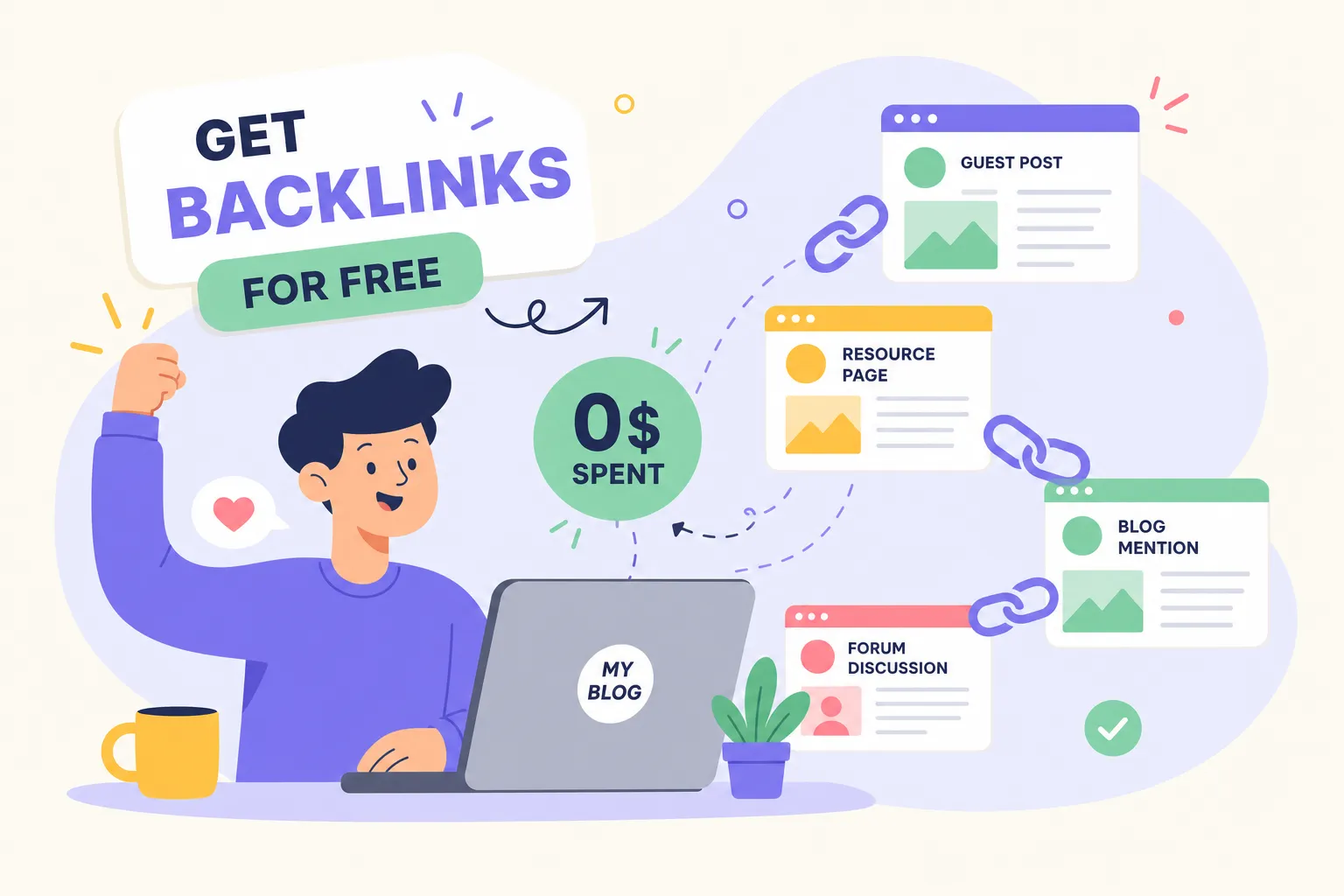
If you’ve ever searched “how do I build backlinks for my blog without spending money,” you’ve probably landed on guides that open with a tool stack costing hundreds per month and assume you have a team to run it. If you’re a blogger, a freelancer, or a small business owner doing this solo, that’s a non-starter. The good news is that the tactics Google actually rewards don’t require a budget at all. It’s a question we get constantly at AISEO Round Table, and the answer is always the same: you don’t need to spend a dime to build a legitimate backlink profile.
This guide covers five proven methods for earning real editorial links, the kind that improve your rankings because another site chose to link to you, not because you paid for placement. You’ll get step-by-step instructions for each tactic, outreach templates you can use today, and a 30-day action plan to put everything into motion. The only investment is your time.
How do I build backlinks for my blog without spending money, and why free tactics win in 2026
Google’s algorithm in 2026 still treats editorial backlinks as the strongest trust signal available. An editorial link is one placed because a site owner or editor genuinely found your content useful, not because money changed hands. Paid links, link exchanges, and private blog networks continue to carry real penalty risk. The irony is that the no-cost link building methods produce exactly the backlink profile Google rewards.
A natural link profile typically includes links from a variety of domains, a varied anchor-text mix, and links earned from pages that are topically relevant to yours. The five zero-cost tactics covered here all produce links that fit that profile. Those five tactics are broken link building, guest posting, HARO outreach, content-based link earning, and unlinked mention reclamation. When executed correctly, each one frequently results in an editorially given link, which means they’re Google-safe and compound over time as your domain authority grows. For a deeper, tactical walkthrough of off-page strategies, see Off-Page SEO: Master Backlinks, Outreach & Authority, AISEO Round Table.
Broken link building: how to find dead links and replace them
Finding opportunities without paid tools
The core mechanic is straightforward: find a page in your niche that has a broken outbound link, then offer your content as a working replacement. Start with Google search operators to find resource pages in your niche. Queries like "best resources" + [your niche] or intitle:"resources" + [your niche] surface pages that curate links. Then install the free Chrome extension Check My Links and run it on each page to instantly highlight any broken outbound links in red.
Ahrefs’ free broken link checker and Google Search Console can supplement this workflow, especially for auditing your own site. For a practical walkthrough of the technique, see Ahrefs’ broken link building guide, and for alternative tactics and outreach ideas check SEMrush’s broken link building article. The key to making this tactic work is strict vetting: only pursue broken links where your content is a genuine topical match for the dead page. A loose approximation won’t land the link, and it wastes your outreach effort on emails that will be ignored.
The outreach email that actually gets a response
Keep it short, specific, and framed as a favor. Here’s a template that works:
Subject: Broken link on [Page Name]
Hi [Name],
I was reading your page on [topic] and noticed a broken link to [dead resource] in the section about [section name]. I thought you might want a working replacement.
I have a page on the same topic here: [your URL]
Feel free to use it if it’s a good fit. Thanks for publishing such a useful resource.
[Your Name]
Each element earns its place. The specific subject line signals you’re not mass-blasting. Mentioning the exact location of the broken link frames you as someone solving a real UX problem, not asking for a favor. The URL is right there, no clicking required. Send one polite follow-up five to seven days later if you don’t hear back, outreach research consistently shows a single follow-up improves response rates without burning the relationship.
Guest posting that earns contextual backlinks
Finding the right blogs to pitch
The difference between guest posting that earns links and guest posting that wastes hours is targeting. Use Google operators to find blogs that actively publish guest content: "write for us" + [your niche] and "guest post by" + [your niche] surface the right targets fast. Once you have a list, look for three things: an active publication schedule, real organic traffic (a quick free check in Ahrefs or Ubersuggest confirms this), and an engaged audience that matches your niche. Skip any site that publishes thin, spammy content because those links carry no real value.
A pitch format with a high acceptance rate
The personalized cold pitch outperforms every other format because it replaces generic flattery with genuine specificity. Reference one of their recent articles in the first line, offer two or three topic ideas tailored to their audience, and close with a low-friction ask: “Would you like me to send over an outline?” That question asks for less commitment than “can I write a full article?” and removes the friction that kills most pitches before they get a response.
For outreach at scale, the “3 ideas” format works well:
- Subject: Review these 3 blog post ideas for [Blog Name]
- Open with a reference to one specific article they published
- List three concrete topic ideas with one-line descriptions
- Close with “Would any of these be a fit?”
Multiple topic options reduce back-and-forth because the editor can simply reply with “yes, idea two” instead of asking you to come up with something. Personalizing the first line of every email is non-negotiable at this stage. Anything that reads like a template gets deleted without a second look.
HARO outreach: earning editorial backlinks as a source
How to write a pitch journalists actually select
HARO relaunched under its original name in 2026 after Featured.com acquired the brand, and it still operates as a free email digest. Journalists post queries, sources respond, and selected contributors often receive a backlink in the published article. Sign up as a source, set your category filters to match your niche, and monitor the three daily digest emails consistently.
The pitches that get selected share four traits: fast delivery (journalists work on deadlines and often pick the first solid response), a single direct answer rather than a paragraph of context, one supporting fact or data point, and a complete signature block. Structure every response like this:
- One sentence establishing your credibility
- A direct answer to the journalist’s exact question
- One supporting fact, statistic, or real-world example
- Your name, title, website URL, and any other attribution details the query requested
Long, unfocused responses almost never get selected. Neither do generic “I’m an expert” pitches with no proof. Answer the question directly, keep it tight, and make it effortless for the journalist to publish your quote as written.
Categories, timing, and what to do after you get cited
Filter your query alerts by category to avoid inbox overload. Responding within the first two hours of receiving a digest email significantly improves your selection odds. After a citation goes live, verify the link is published and share the article on social media, that’s good for the journalist relationship too. Save the publication name for future direct pitching. A single citation in a mid-authority publication often leads to more because journalists refer reliable sources to colleagues. A published quote also builds the E-E-A-T signals that support all your future link acquisition efforts.
Creating content that earns free backlinks for your blog
What makes a piece of content genuinely linkable
Content earns links passively when it solves a problem better than anything else available, or when it presents original data other writers want to cite. The four formats that earn the most unsolicited backlinks are original research or survey data, comprehensive how-to guides that become industry references, free tools or calculators, and curated resource pages. The common thread is utility: a reader in your niche finds your page more useful than anything else they’ve seen and links to it because it makes their own content better.
Why SEO guides and tool reviews attract natural citations
This is where the compounding effect really shows up. In-depth SEO tool reviews and step-by-step beginner guides, the kind of content published consistently on AISEO Round Table, are exactly what other bloggers and content creators link to when they want to cite a credible, accessible resource. A detailed Mangools vs. Semrush comparison or a thorough KWFinder tutorial gives other writers a clean, trustworthy source to reference when they mention those tools in their own articles. Building this kind of reference-quality content in your niche creates a link magnet that works around the clock without any outreach at all.
Long-form content earns significantly more backlinks than short posts. According to Ahrefs’ content research, articles above 3,000 words consistently attract more natural citations because depth is what makes a page citation-worthy. If you’re choosing between publishing two average posts or one comprehensive guide, the guide wins on backlinks every time.
Also, don’t neglect your site structure, internal linking helps the link equity you earn spread to the pages that need it most; see the Complete Guide to Internal Linking in SEO, AISEO Round Table for practical tips on organizing link flow across your site.
Your 30-day no-budget backlink action plan
Week 1 and 2: build your pipeline
Days 1 through 3: set up HARO alerts filtered to your niche categories, and create a Google Alert for your brand name to catch unlinked mentions as they appear. Days 4 through 7: use the free workflow from the broken link section to identify 10 solid opportunities and send your first round of outreach emails.
When monitoring mentions, make reclaiming unlinked citations a priority, tools and guides on tracking unlinked mentions walk through automations and processes that save time and increase reclamation rates. Days 8 through 14: research 5 to 8 guest post targets using the Google operators covered earlier, personalize a pitch for each one using the templates above, and send the first round. The goal in the first two weeks is pipeline-building, not results. Link acquisition has a lag time, and most of the work done in week one pays off in weeks four through eight.
Week 3 and 4: respond, reclaim, and review
Week 3: respond to HARO queries every day, send polite follow-ups on your broken link and guest post outreach, and check your Google Alerts for any new unlinked brand mentions to reclaim. Week 4: audit what’s working. Which outreach type generated the most responses? Double down on that tactic, and publish or refresh one piece of content specifically designed to be a linkable asset in your niche.
Thirty days of consistent no-cost link building won’t transform your domain authority overnight. Most new blogs start seeing initial ranking movement within two to four weeks after their first backlinks are indexed, with clearer results appearing in the five-to-ten week range. If you want a deeper look at timelines, see how long link building takes for rankings. The foundation built in this first month is what compounds into real authority over the following three to six months, and none of it requires a dollar of budget.
Frequently asked questions about building backlinks without a budget
How do I build backlinks for my blog without spending money if I’m starting from zero?
Start with HARO outreach and broken link building. Both tactics work even on brand-new sites because you’re offering value (a source quote or a working replacement link) rather than relying on existing domain authority. Consistent daily action over 30 days is more effective than sporadic bursts.
Are free backlinks for blogs as valuable as paid placements?
In most cases, yes, and often more so. Editorially given links signal genuine relevance to Google, while paid placements carry penalty risk if they’re not properly disclosed. The no-cost tactics in this guide produce the exact type of backlink profile Google is designed to reward.
How long does it take to see results from free link building?
Most bloggers see initial ranking movement within two to four weeks of their first backlinks being indexed. Clearer, compounding results typically appear in the five-to-ten week range. Starting early matters: sites that begin outreach in month one consistently build an advantage over those that wait.
Start with one tactic today
The five methods covered here, broken link building, guest posting, HARO outreach, content-based link earning, and unlinked mention reclamation, all produce editorially given links when done correctly. That’s not a workaround or a hack. It’s the approach Google’s algorithm is actually designed to reward. The shortcuts cost money and carry penalty risk; these free tactics cost time and build real, lasting authority.
If you’re still asking how do I build backlinks for my blog without spending money, the answer is right here: pick the tactic that fits your current situation best and take one concrete action today. Find a broken link opportunity, draft a guest post pitch, or sign up for HARO alerts. Don’t wait until you have a bigger site or a “better” strategy, the blogs most likely to outrank you in six months are the ones that started their outreach in month one.
For your next step, explore the full library of free SEO guides at Off-Page SEO Strategies, Link Building & Authority Growth. Start with the broken link building tutorial or the beginner keyword research guide, both are built specifically for bloggers and small business owners who want real results without the agency price tag.