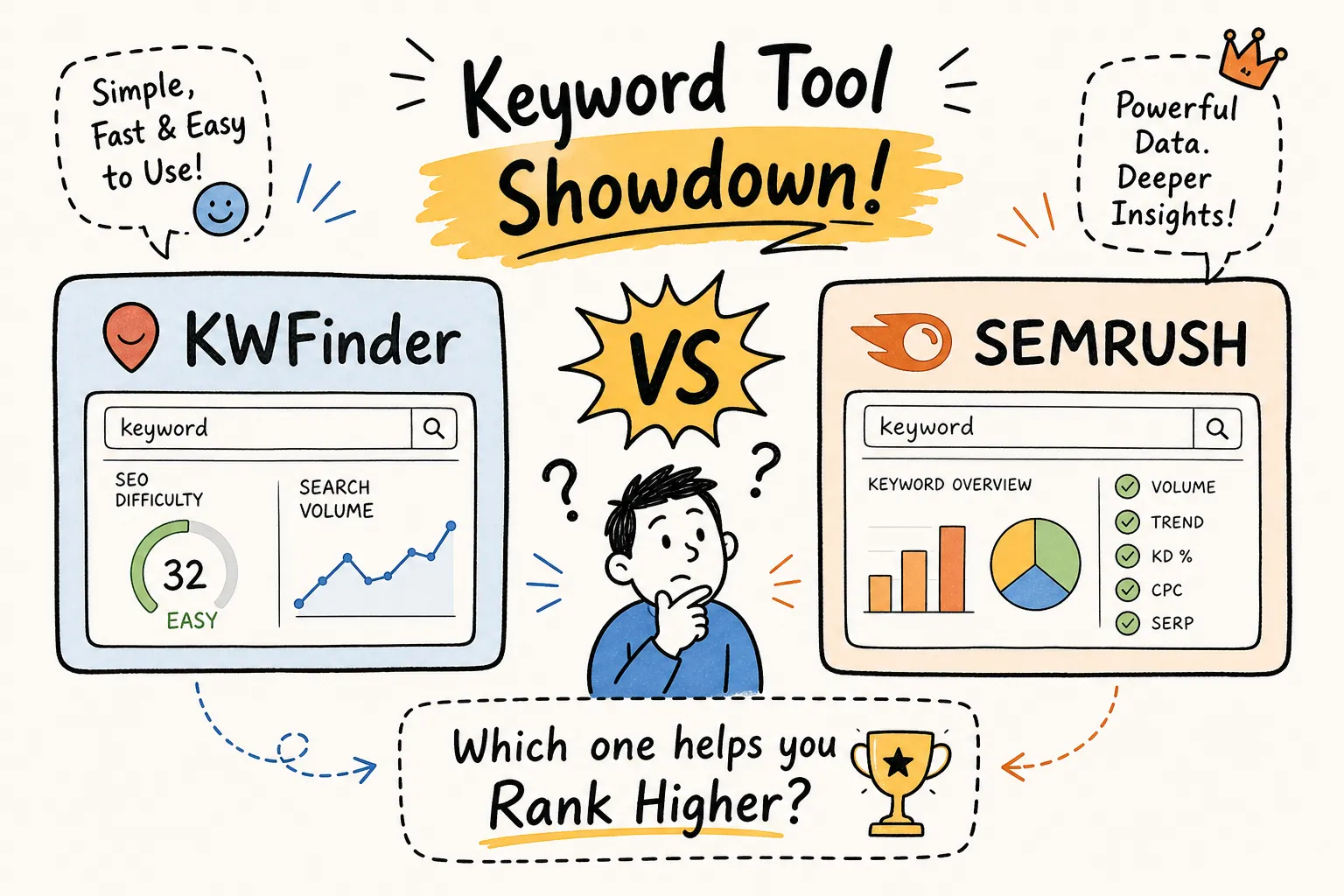
KWFinder vs SEMrush is one of the most common decisions solo bloggers and small site owners face when they’re ready to get serious about keyword research. SEMrush is widely recommended by many agencies and SEO professionals, but the price tag is hard to ignore when you’re bootstrapping a niche site or managing a single affiliate blog. KWFinder, part of the Mangools suite, costs roughly 25% of SEMrush’s Starter monthly price and handles keyword research without making you feel like you need a certification first. So which one is actually worth your money?
This comparison skips the feature-list marketing copy and focuses on what actually matters: pricing, data quality, usability, and the features that go beyond keyword discovery. The AISEO Round Table team has tested both platforms hands-on, our full KWFinder review covers features, limits, and real-session performance in detail, so the observations here come from real use rather than product screenshots. By the end, you’ll have a clear recommendation and a quick checklist to make the right call for your situation.
KWFinder vs SEMrush: What Each Tool Actually Costs in 2026
SEMrush runs three tiers in 2026. The Starter plan is $199 per month, Pro+ is $299 per month, and Advanced comes in at $549 per month. Annual billing brings those down to roughly $165, $248, and $456 per month respectively. Starter covers five websites and 500 daily tracked keywords, Pro+ bumps that to 15 websites and 1,500 tracked keywords with historical SEO data and content tools added in, and Advanced scales to 40 websites and 5,000 tracked keywords with API access. (See an independent breakdown of current SEMrush pricing plans for the latest promotional variations.)
Even the Starter tier is a serious monthly commitment. At $199 per month, you’re looking at nearly $2,400 per year before you even get to the features most growth-stage SEOs actually need. For a beginner blogger or a solo affiliate marketer running one or two sites, that entry point is hard to justify on its own.
Mangools pricing sits in a completely different range. The Basic plan runs about $49 per month (or roughly $29.90 per month on annual billing), Premium is around $69 per month ($39.90 to $44.90 annually), and Agency comes in at $129 per month (about $79.90 to $89.90 annually). Every tier includes the full Mangools suite: KWFinder, SERPChecker, SERPWatcher, LinkMiner, and SiteProfiler. At the Basic level, Mangools costs a small fraction of SEMrush’s monthly Starter price, check both official pricing pages before subscribing, as figures can shift with promotions.
The honest framing here is straightforward. SEMrush’s cost is justified when you’re running the full platform daily across multiple clients or properties. But if keyword research and basic SERP analysis cover 90% of your workflow, paying a premium for features you’ll never open isn’t smart budgeting. That’s the lens this comparison uses for the sections that follow.
KWFinder vs SEMrush: Data Accuracy and Keyword Difficulty
SEMrush reports a database of 25.7 billion keywords spanning 142 regions. KWFinder’s database sits around 2.5 billion. That’s roughly a 10x difference, and it’s worth putting in context. For most bloggers and niche site owners targeting English-language long-tail keywords, 2.5 billion keywords provides more coverage than you’ll realistically exhaust. The gap becomes meaningful when you’re doing large-scale competitive research across multiple markets or running international SEO campaigns.
On search volume accuracy, community discussions on forums like Reddit’s r/BigSEO and head-to-head comparisons published by SEO practitioners tend to favor SEMrush, particularly for high-competition and broad head terms. KWFinder reports exact figures rather than volume ranges, which many beginners find easier to work with and less ambiguous. In many practical scenarios, small volume differences between the two tools may not change content priorities for a typical blog or affiliate site. For agencies managing large campaigns where precise volume estimates drive budget allocation, SEMrush’s data depth is a real operational advantage.
Keyword difficulty scoring is where KWFinder genuinely stands out. KWFinder calculates its KD score from the Link Profile Strength of the pages currently ranking in Google’s top results, using a transparent 0 to 100 scale. It also offers Relative Keyword Difficulty, which recalculates the score against your own site’s backlink strength, so the same keyword shows different difficulty values depending on your domain’s authority. SEMrush uses a proprietary competitive model that’s less transparent in its methodology. Case studies from niche site builders and analyses published by SEO bloggers testing both tools have found KWFinder’s KD scores correlate well with actual ranking difficulty. For beginners trying to identify genuinely winnable keywords, the transparent scoring logic is easier to act on.
Ease of Use and Learning Curve
KWFinder’s interface is built around one workflow: type in a keyword, pick a location, and get a results page showing search volume, KD score, trend data, related keyword suggestions, and live SERP results all in a single view. There’s no multi-panel setup, no overwhelming metric count, and no need to understand a dozen different reports before making a content decision. A blogger who’s never used a keyword tool before can get to a usable list of keyword ideas within their first session.
SEMrush’s dashboard is built for power users. Competitor analysis, backlink data, site audit alerts, position tracking, and content tools all live across a multi-panel interface that rewards daily users who’ve put in the time to learn where everything is. The Keyword Magic Tool is one of the most capable keyword exploration interfaces available, but reaching the most actionable outputs requires navigation fluency that takes time to build. G2 reviews consistently flag the steep learning curve, and new users frequently report needing several weeks of regular use and multiple tutorial videos before they feel comfortable navigating the platform.
For time-to-insight, KWFinder wins for beginners and content creators. A blogger with 20 minutes to do keyword research before writing wants a clear answer fast. SEMrush rewards users who invest time upfront in learning the platform and have ongoing, complex research needs that justify the investment. Neither approach is wrong; they just serve different working styles and workflows.
Features Beyond Keyword Research: Where SEMrush Pulls Far Ahead
SEMrush, All-in-One SEO, Digital Marketing, and Competitive Research Platform, AISEO Round Table is not a keyword tool. It’s a full SEO and marketing intelligence platform. That distinction matters when you’re evaluating what you’re actually buying. SEMrush includes deep competitor gap analysis (organic keywords, top pages, traffic estimates, ad copy), a site audit that surfaces technical SEO issues, backlink analysis with link-building workflow tools, rank tracking, content optimization briefs, and PPC competitive data. KWFinder, even considered alongside the full Mangools suite, doesn’t match that depth or breadth.
What the Mangools Suite Does Cover
The Mangools suite closes more of the gap than you might expect. SERPChecker handles SERP and competitor analysis, SERPWatcher covers rank tracking, LinkMiner provides backlink lookup, and SiteProfiler gives you domain authority and competitive intelligence. Together, those five tools cover the core SEO workflow: keyword research, SERP evaluation, tracking, and backlink analysis. What’s missing is the deep technical SEO auditing, large-scale competitor intelligence, and reporting workflows that SEMrush handles as a platform built for teams.
When the Feature Gap Actually Matters
A solo blogger building a niche affiliate site around product reviews doesn’t need a weekly site audit or a PPC competitive dashboard. A freelance SEO managing five client accounts, running weekly audits, pulling rank reports for multiple domains, and tracking competitor content gaps, absolutely does. The question isn’t which tool has more features; it’s which features your actual workflow requires. The more of SEMrush’s expanded toolset your day-to-day work demands, the easier the price premium is to justify. If you need a middle-ground solution that includes robust tracking and audits without the full platform overhead, consider SE Ranking, Comprehensive SEO Platform for Keyword Tracking, Website Audits, and Competitor Analysis, AISEO Round Table.
Which Tool Is Right for You: A Clear, Honest Recommendation
KWFinder is the right choice if your profile looks like this: beginner blogger, affiliate marketer, small business owner, or niche site builder who primarily needs keyword discovery, KD scoring, and SERP analysis. You want a tool you can learn in an afternoon, you’re working within a tight budget, and you don’t need client reporting, technical SEO audits, or large-scale competitor intelligence. The Mangools suite covers the full core SEO workflow without locking you into a platform built for much larger operations.
If you’re leaning toward KWFinder and want a full walkthrough of its features, limits, and how it performs across different use cases, our hands-on Mangools SEO Tools Review: Features & Performance at AISEO Round Table covers everything you’d want to know before subscribing, including where the tool hits its ceiling and whether the broader Mangools suite fills those gaps. It’s worth reading before you commit to any plan.
SEMrush makes more sense when you’re a freelance SEO consultant, in-house content team, digital agency, or growth-focused marketer who needs keyword research connected to competitor gap analysis, backlink strategy, rank tracking, and client reporting. You’re already generating real revenue from organic traffic, you’re managing multiple sites or client accounts, and you need a platform that scales with the operation. The price premium makes sense when you’re using at least half the platform on a regular basis.
Run through this checklist before you subscribe to either tool:
- Do you need site audits and technical SEO diagnostics? SEMrush.
- Do you manage multiple client accounts or need reporting? SEMrush.
- Is your monthly tool budget under $50? KWFinder Basic (annual billing).
- Do you primarily write content and need keyword ideas and difficulty scores? KWFinder.
- Do you need PPC competitive data or ad copy research? SEMrush.
- Are you running one to two sites and learning SEO as you go? KWFinder.
The Bottom Line
KWFinder wins on price, simplicity, and focused keyword research for solo creators. It delivers accurate KD scores, a clean workflow, and enough database coverage for most English-language content strategies, all at a price point that doesn’t demand a full agency budget to justify. SEMrush wins on data depth, feature breadth, and scalability for teams, agencies, and professionals who need a full marketing intelligence platform under one login.
Neither tool is objectively better. The right choice depends on what your site actually needs right now, not what you might need someday. A niche blogger who pays for SEMrush when KWFinder would cover 90% of their workflow is spending money without getting value. In the KWFinder vs SEMrush debate, a freelance SEO managing client accounts with KWFinder is likely missing competitive gaps that cost real rankings.
If you’re budget-conscious and leaning toward Mangools, the AISEO Round Table KWFinder review gives you a complete look at how the tool performs in real keyword research sessions, where its limits show up, and whether the Mangools suite covers enough ground for your specific situation. Start there before opening your wallet for either platform.