If you’ve spent any time reading marketing newsletters in 2026, you’ve seen “AEO,” “GEO,” and “LLM SEO” thrown around like everyone already knows what they mean. The problem is that most articles stop at definitions and leave you with no idea what to actually do differently. This AEO vs GEO strategy guide closes that gap, walking you from clear definitions through concrete tactics to a decision framework you can use today.
Two newer strategies, answer engine optimization and generative engine optimization, are reshaping how content gets discovered. They don’t replace traditional SEO, they build on top of it, but they pull your content decisions in slightly different directions. If you don’t understand which one fits your goals, you’ll spread your effort thin and see results from neither.
By the end of this guide, you’ll know exactly what each strategy targets, where they overlap, and which one deserves your attention first. Think of this as your seat at the AISEO Round Table, where we cut through the noise so you can take action.
What AEO and GEO actually mean (and how they differ from traditional SEO)
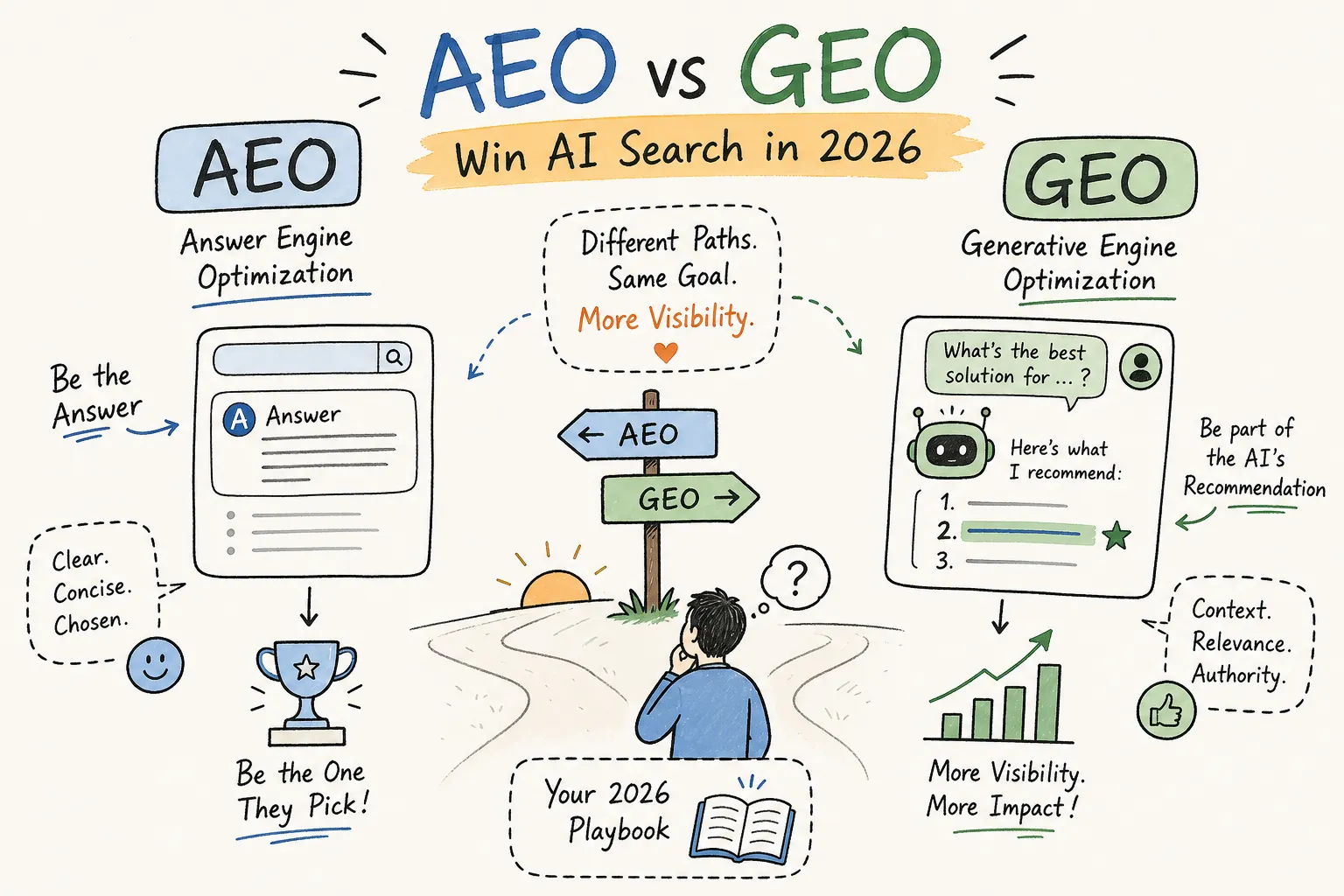
The cleanest way to separate these three strategies is by their unit of success. SEO ranks a page. Answer engine optimization wins a direct answer. Generative engine optimization gets you included inside a synthesized AI response. Once that framing clicks, the tactics behind each one make a lot more sense.
AEO: structured to be selected as the direct answer
Answer engine optimization is the practice of structuring content so AI-powered answer systems, voice assistants, and Google’s AI features can extract and cite it as the most direct response to a specific question. Success looks like your content appearing in a featured snippet, an AI Overview citation, or a voice assistant reading your paragraph aloud. The goal is selection, not synthesis. You’re competing to be the one answer, not one of many sources. For a deeper walkthrough of the AEO process, see What Is Answer Engine Optimization? A Complete Guide for 2026.
GEO: written to be synthesized inside an AI-generated response
Generative engine optimization takes a different angle. The goal is to have systems like ChatGPT, Perplexity, and Gemini retrieve your content, accurately represent it, and weave it into their multi-source answers. Success looks like your brand name or URL appearing as a cited source inside a longer AI-generated response. You’re not the only answer; you’re a trusted contributor to the answer. That’s a meaningful distinction.
AEO vs GEO strategy: how classic SEO still fits in this picture
Traditional SEO is not obsolete. Pages that rank well organically are more likely to be pulled into AI features, especially within Google’s ecosystem. Think of SEO as the foundation and AEO/GEO as the upper floors built on top of it. Skipping that foundation doesn’t just slow your progress, it makes the whole structure unstable. If you want a focused primer on the relationship between AEO and classical ranking signals, the Essential AEO vs SEO Differences for Smarter Optimization 2026 guide outlines practical distinctions and implementation priorities.
The signals AEO and GEO share
Before separating the two strategies by tactics, it’s worth understanding where they converge. The overlap is significant enough that work done for one almost always supports the other. You’re not running two separate campaigns; you’re running one smart campaign with two visibility goals.
E-E-A-T and entity clarity work for both
Both answer engines and generative models favor content that demonstrates expertise, consistent authorship, and factual precision. Entity clarity means consistent brand naming across your site and the wider web, schema that establishes who you are and what you cover, and third-party mentions that reinforce your credibility. The results from brands like Farringdons support this directly: a reported 140% increase in LLM-driven traffic and a 62% rise in AI mentions came largely from stronger entity reinforcement, not a complete content overhaul.
Technical foundations that help either strategy succeed
A few technical non-negotiables apply to both strategies. AI crawlers must not be blocked in your robots.txt file, page structure must be clean and machine-readable, and schema markup, such as Article, FAQ, and Organization, needs to be in place. An emerging recommendation among technical SEOs is adding an llms.txt file as an additional signal for AI systems. None of this requires a developer or an agency; it requires knowing what to check and then checking it. For practical guidance on schema and AI-focused markup, consult the Schema Markup & AI Generation Guide (2026).
How to win with AEO in 2026
AEO tactics are about making your content easy for answer engines to extract and present as the definitive response. If you’ve already been doing solid on-page SEO work, the content changes required are more manageable than you might expect.
Answer-first content structure that answer engines reward
The core principle is straightforward: lead with the direct answer, then expand into supporting detail. A concise definition or clear response in the first paragraph signals to the engine that this page answers the question. FAQ sections and question-based headings that mirror actual search queries raise the probability of selection even further. Simplified SEO Consulting documented this in practice, growing from one to 23 featured snippet rankings by restructuring content around question-based formatting and PAA-driven FAQ sections. One page alone ranked for more than 25 question keywords and began appearing regularly in AI Overviews after applying this approach. For a practical, tactical AEO playbook, see the Answer Engine Optimization: AEO, The Comprehensive Guide.
Schema and on-page markup that signal direct answerability
The most impactful schema types for AEO are FAQ, HowTo, Article, and Breadcrumb. FAQ schema tells the engine that your page directly addresses a specific question and provides a structured response. Article schema establishes authorship and content type, which supports trust signals. Breadcrumb schema helps engines understand your site structure and topical authority. Schema alone doesn’t guarantee selection, but it meaningfully improves machine comprehension of what your page is about and what question it answers.
How to get cited by generative AI in 2026
The GEO mindset shifts from “be the answer” to “be a trusted source inside the answer.” That shift changes how you write, how you structure sections, and what you do off your own site. In one documented campaign, a brand reached 1,500 or more monthly ChatGPT citations; in another, a focused GEO effort produced a reported 600% citation uplift. The underlying tactics driving those results are replicable even on a modest budget.
Writing for passage-level retrieval
Retrieval-augmented generation systems pull content at the passage level, not the page level. This means each section of your page needs to contain a self-contained claim, supporting evidence, and enough context to stand on its own. A simple test: can a reader understand this paragraph without reading the one before it? If not, revise. Generative models are more likely to incorporate sections that are internally complete, because they can be extracted cleanly without requiring additional context from surrounding content. Research on the content types most cited by LLMs can help you prioritize which formats to produce for higher citation likelihood.
Off-site trust signals and entity reinforcement that influence AI models
What happens off your site matters more for GEO than most people expect. Third-party mentions on authoritative sites, Reddit threads, industry directories, and partner publications all register as meaningful signals for generative models. In one legal client case study, LinkedIn visibility and earned media citations contributed directly to improved AI visibility and lead quality. For small budgets, the most realistic options are HARO pitches and guest posts on relevant industry blogs. Layering in active participation in community forums where your topic is discussed adds further reach. These efforts build the kind of distributed credibility that AI systems use to decide who to include.
AEO vs GEO strategy: which one should you focus on first?
This is the question most articles dodge with a vague “it depends.” Here’s a clearer framework based on who you are and what you’re trying to accomplish. For readers who want step-by-step implementation without a technical background or an agency budget, Answer Engine Optimization (AEO): The Proven Complete Guide for 2026, AISEO Round Table covers both strategies in dedicated beginner guides, check those out after you’ve worked through the framework below.
Start with AEO if you’re a blogger or affiliate marketer
AEO is the better first move for content-heavy sites because it builds directly on existing SEO habits. The required content changes, specifically answer-first structure and FAQ schema, are low-effort relative to the visibility gains they can produce. For affiliate marketers, the payoff is especially clear: AEO captures informational traffic from buyers in the research phase, exactly when they’re evaluating options and most likely to click through a recommendation. Results show up in trackable places like AI Overviews and featured snippets, so you can see progress without needing specialized tools.
Prioritize GEO if you’re a small business or service provider
Small businesses with a local or branded focus benefit more from GEO because generative AI is increasingly where users ask questions like “who is the best plumber in Austin” or “what’s a reliable accounting firm for freelancers.” The priority tactics are entity clarity, consistent NAP data, and off-site citations that reinforce your reputation across the web. An auto insurance brand reported a 447% increase in Google AI Overview mentions within six months using GEO-oriented content structure. That kind of visibility shift has a direct impact on branded search and lead quality, not just traffic volume.
How to measure whether your AEO and GEO efforts are working
Tactics without measurement are just guesswork. The good news is that tracking your AEO vs GEO strategy performance doesn’t require enterprise software. A focused stack of three or four tools covers most of what bloggers and small business owners need to see.
AEO vs GEO strategy KPIs: the four metrics that matter
Track four layers of performance across 30-, 90-, and 180-day windows: visibility (how often your content appears in AI answers), citation rate (how frequently your URL is cited versus a competitor’s), referral traffic from AI platforms (trackable in GA4 under traffic sources), and conversions from that traffic. AEO performance shows up in Google Search Console through impression data and featured snippet tracking, log your position-zero counts weekly and compare month over month. GEO performance requires dedicated AI monitoring tools or manual prompt testing, since Google Search Console doesn’t capture citations in ChatGPT or Perplexity. For manual spot-checking, maintain a simple spreadsheet: run your top ten target queries in Perplexity weekly, note whether your site appears as a source, and flag any changes.
Tools worth using to track AI visibility in 2026
Start with GA4 for referral traffic and engagement rates from AI platforms. Add Otterly.AI or Gauge for citation monitoring across generative AI systems. Google Search Console still catches a meaningful portion of AEO performance through position zero and AI Overview impression data, so don’t abandon it. That four-tool stack covers visibility, citations, traffic, and on-page performance without overwhelming your workflow or your budget. For broader reading on AEO and GEO measurement approaches, the Answer Engine Optimization guide provides practical measurement tips and examples.
Putting it all together
AEO and GEO are not competing strategies. AEO optimizes for being selected as the answer; GEO optimizes for being synthesized into the response. Both share a foundation in strong SEO, clear entity signals, and technically sound pages. The difference is where the visible result appears and how you measure it.
Most bloggers and small business owners should start with AEO. It builds on habits you already have, produces results in places you can already track, and requires changes you can make this week. Layer in GEO tactics as your content library grows and your off-site authority builds. The two sides of the AEO vs GEO strategy equation compound over time rather than competing for your attention.
Ready to put this into practice? Pick one page on your site today, rewrite the opening paragraph to lead with a direct answer to the page’s core question, add FAQ schema to two or three common follow-up questions, and check whether it appears in AI features within 30 days. That’s a complete AEO vs GEO strategy test you can run on your own, no agency required.