
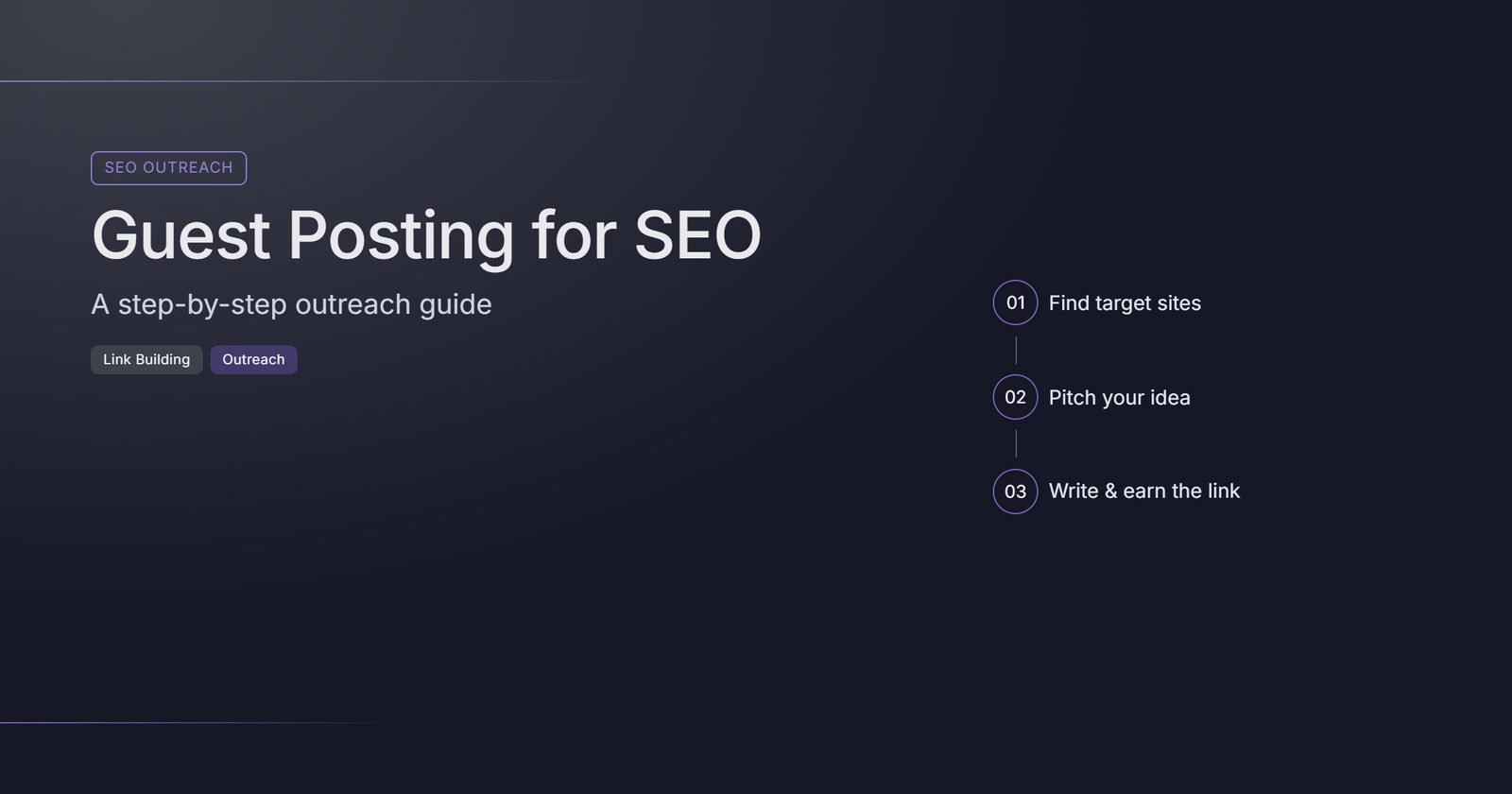
Guest posting still works. That single sentence causes more arguments in SEO circles than almost anything else, but the reason the debate never dies is simple. Most people are doing guest posting wrong, then blaming the tactic instead of the execution.
Done properly, a guest post earns you a relevant backlink, puts your brand in front of a new audience, and builds a relationship with a site owner who might link to you again later without being asked. Done poorly, it gets you a rejected pitch, a spammy footprint, or a link that Google quietly discounts.
This guide walks through the entire outreach process from finding the right sites to writing the pitch, delivering content an editor actually wants, and tracking whether the campaign moved the needle. If you are also working on your backlink profile more broadly, our off page SEO section covers the wider strategy that guest posting fits into.
What Guest Posting Actually Does for SEO
Guest posting is not a magic ranking button. What it actually does is threefold. It creates a contextual backlink from a page that already has some topical relevance to yours, it exposes your brand and offer to a new reader base, and it opens a door to a publisher relationship that can pay off in future coverage, co promotion, or additional links.
The mistake many site owners make is treating the backlink as the entire goal. Google’s algorithms, and increasingly the editors and readers behind the sites you are pitching, can tell the difference between a post written to serve readers and a post written purely to plant a link. The former earns trust. The latter earns a quiet removal request six months later.
If you are new to how search engines evaluate content and links together, our guide on keyword research is a useful starting point before you begin any outreach, since knowing which topics and terms matter to your audience will shape which sites are actually worth pitching.
Building a List of Realistic Target Sites
Before writing a single email, build a list of sites that make sense for your niche. Skip any generic list of high authority blogs you found through a Google search for guest post opportunities. Those lists are usually stale, oversaturated with pitches, or filled with sites that will publish almost anything for a fee, which defeats the purpose entirely.
Instead, look for:
- Sites your ideal customer already reads regularly
- Competitors’ backlink profiles, since a site linking to a competitor is likely open to your niche
- Niche communities, newsletters, and roundups that already cover your topic
- Sites with an active comments section or social following, since that signals a real audience rather than a content farm
Aim for a shortlist of twenty to forty sites rather than a spreadsheet of five hundred. Quality outreach depends on personalization, and no one can meaningfully personalize five hundred emails.
Vetting Sites Before You Pitch Them
Not every site with a “write for us” page deserves your time. Before adding a site to your active outreach list, check a few basics.
Traffic and engagement. A site can have a reasonable domain rating and still send almost no organic traffic. Look for evidence of real visitors, not just backlink metrics.
Topical relevance. A backlink from a site that is even loosely related to your industry carries more weight than one from an unrelated site with a bigger audience.
Editorial standards. Scan a handful of recent posts. Are they well researched and edited, or clearly templated content stuffed with affiliate links? The tone of existing content tells you what an editor expects from your draft.
Outbound link patterns. If every post on the site links out to five different unrelated businesses, that is usually a paid link farm, and a link from it may do more harm than good to your profile.
Writing an Outreach Email That Gets Opened
Editors and site owners receive dozens of generic guest post pitches every week. The subject line and first two sentences decide whether yours gets read or archived.
A pitch that works usually does four things. It shows you have actually read the site, not just skimmed the homepage. It proposes a specific, narrow topic rather than a vague offer to “write something for you.” It briefly proves you can write, either through a portfolio link or a short writing sample. It respects the reader’s time by staying under 150 words.
A workable template looks something like this.
Subject: A data backed piece for [Site Name] on [specific topic]
Hi [Name],
I read your recent piece on [specific article title] and noticed you have not yet covered [specific angle or gap]. I write about [your niche] at [your site], and I would like to pitch a piece titled “[working title]” that covers [one sentence on the unique angle].
Happy to share two recent samples if useful. No obligation either way, and thanks for your time.
[Your name]
Notice there is no mention of a link in the first email. Bringing up the backlink before an editor has even agreed to the topic is one of the fastest ways to get filtered straight into spam.
What to Do After They Say Yes
Once an editor responds with interest, ask about their specific requirements before writing anything. Word count expectations, formatting preferences, whether images are required, and how many outbound links they typically allow all vary by publication, and asking up front saves both sides a revision cycle later.
This is also the point to agree on a rough deadline. Editors are more likely to prioritize a contributor who delivers on time over one who needs three reminders.
Writing the Guest Post Itself
Write the piece as if you had no interest in the backlink at all. That mindset alone produces better content than any formula, because it forces you to actually answer the reader’s question instead of padding toward your anchor text.
A few practical habits help:
- Open with the reader’s problem, not your company’s background
- Use the publication’s existing tone and formatting conventions, not your own house style
- Back up claims with specific numbers, examples, or short case studies rather than vague statements
- Keep paragraphs short, since most readers skim before they commit to reading in full
- Suggest a natural place for your link rather than forcing it into an unrelated sentence
If the target site publishes technical SEO content, skimming a few of their recent posts on entity SEO or similar topics beforehand will help you match the depth and vocabulary their audience expects.
Placing the Link Without Looking Spammy
One contextual link to a genuinely relevant resource, placed where it naturally supports a point in the text, is almost always the right amount. Editors are increasingly wary of contributors who try to sneak in two or three links, or who use an anchor text that is obviously commercial, such as “best accounting software” instead of a brand name.
If you are linking to a product page rather than an informational resource, expect some editors to decline it or ask you to link to a blog post instead. Having a relevant, non salesy page ready as a backup keeps the conversation moving instead of stalling the whole placement.
Tracking Results and Building Long Term Relationships
A single guest post rarely moves rankings on its own, so track results across the whole campaign rather than judging each post in isolation. Keep a simple log of the site, publish date, anchor text, and referral traffic, then revisit it every few months to see which placements are actually sending visitors and which are sitting quietly with no engagement.
Just as important, do not disappear after the post goes live. Share it on your own channels, reply to comments, and thank the editor. Contributors who show up reliably and treat the relationship as ongoing are the ones who get invited back, sometimes without needing to pitch again at all.
Common Mistakes That Waste Outreach Effort
Even experienced marketers fall into a few repeatable traps.
Mass emailing unpersonalized pitches. A generic template pasted into fifty inboxes gets a fifty count of ignored emails, not fifty guest posts.
Chasing domain rating over relevance. A high authority link from a completely unrelated niche site often provides less real benefit than a moderate link from a site your actual audience reads.
Paying for placements on link farms. These sites can disappear overnight, and the links themselves rarely hold much weight once search engines flag the pattern.
Ignoring the editor’s guidelines. Submitting a draft that ignores stated word counts or formatting requirements signals that you did not actually read their page, which is a poor first impression.
Treating it as a one time transaction. The contributors who build real link equity over time are the ones who keep showing up, not the ones who vanish after the first post is live.
Conclusion
Guest posting still earns its place in a modern SEO strategy, but only when it is treated as genuine outreach rather than a numbers game. Building a focused list, vetting each site carefully, writing a pitch that respects the editor’s time, and delivering content that actually serves the reader will consistently outperform any volume based approach. The backlink is the byproduct of doing good outreach well, not the starting point.
Frequently Asked Questions
Is guest posting still effective for SEO? Yes, when it is done on relevant, editorially reviewed sites with genuinely useful content. Search engines have become better at discounting low quality or clearly paid placements, so the bar for what counts as effective has risen rather than disappeared.
How many guest posts should I aim for each month? There is no universal number. A handful of well placed, relevant posts on sites with real audiences will typically outperform a much larger volume of low quality placements.
Should I pay for guest post placements? Paying for a placement on a site with a real editorial process, real traffic, and a disclosed sponsorship policy can be reasonable. Paying a network that exists purely to sell links is a different situation and carries more risk to your site’s reputation.
What anchor text should I use in a guest post link? Favor branded or natural phrase anchors over exact match commercial keywords. A link that reads naturally within the sentence is less likely to raise flags with either the editor or a search engine.
How do I find sites that accept guest posts in my niche? Study competitor backlink profiles, look at who links to sites you already respect, and search for niche roundups or communities where your topic is actively discussed rather than relying solely on generic guest post directories.
Can guest posting hurt my SEO? It can, if the links come from low quality, unrelated, or clearly paid sites, or if the same exact match anchor text is repeated across many placements. Diversifying anchor text and sticking to relevant, reputable sites keeps the risk low.