You’ve done everything right. Your site ranks on page one. Your traffic is solid. But when someone asks ChatGPT, Gemini, or Perplexity a question you should own, your content doesn’t appear anywhere in the answer. If you’re trying to figure out how to do SEO for AI search engines, that invisible gap is exactly where this guide starts. It’s not a ranking problem, it’s a visibility format problem, and it’s catching a lot of experienced site owners completely off guard.
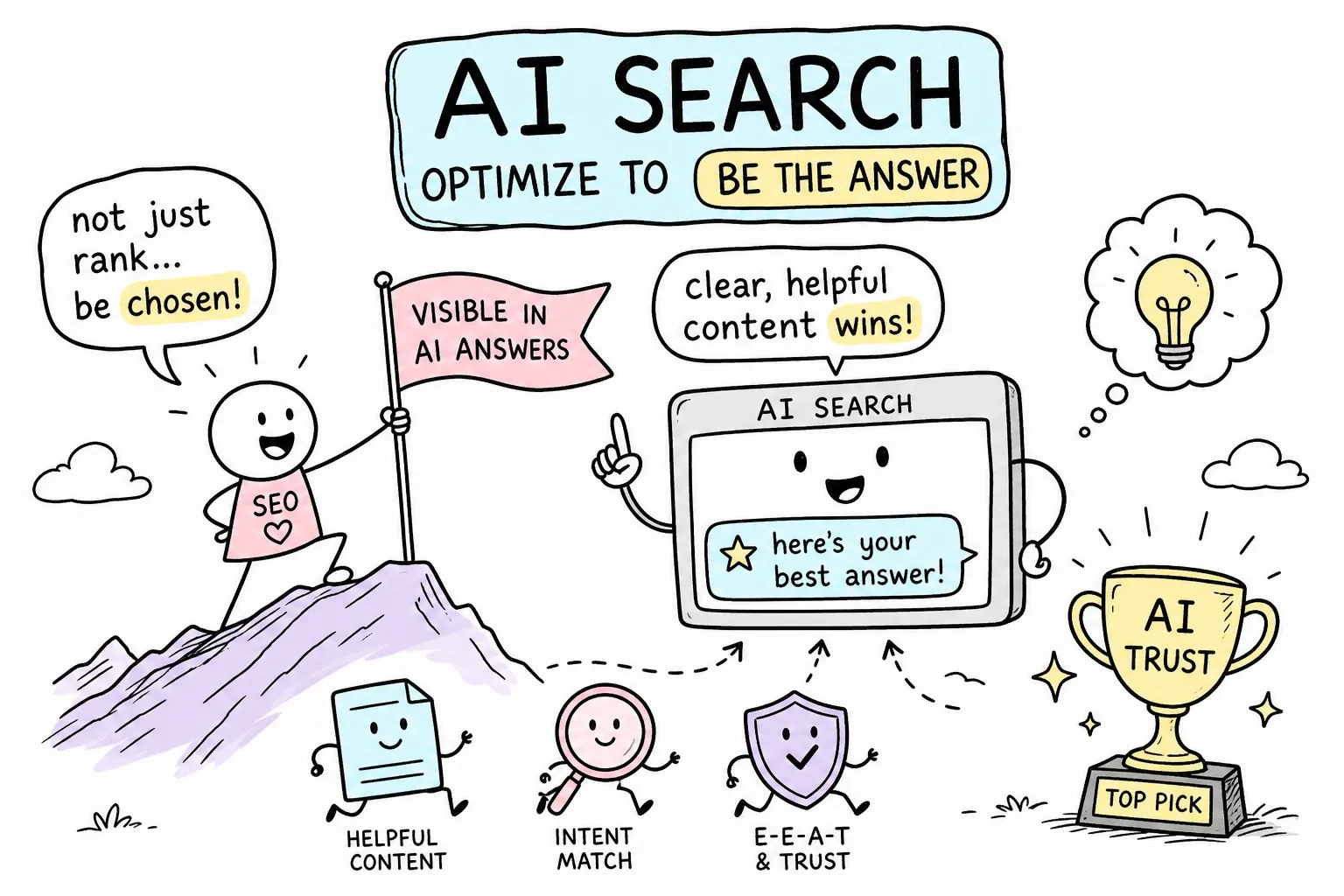
AI search engines don’t return a list of blue links and let users choose. They synthesize an answer and then select a handful of sources to cite. The sites that get cited aren’t always the ones with the highest domain authority or the most backlinks. They’re the ones that were crawlable, structured for extraction, and trusted enough to quote. That’s a different game than traditional SEO, and the gap between site owners who understand it and those who don’t is widening fast.
At AISEO Round Table, we track these AI search shifts as they happen and translate them into plain-language guidance for bloggers, freelancers, and small business owners who don’t have a technical team. This guide covers the core pillars you actually need: the technical setup to make your content discoverable, the content formats AI engines prefer to cite, and the tracking methods to know whether it’s working.
Why AI search engines work differently from traditional search
Traditional search returns a ranked list of pages and lets users pick. AI engines generate a synthesized answer and then attach sources. That shift sounds small, but what it means in practice is worth unpacking: citation eligibility is not the same as ranking position. A page sitting at position four on Google can appear as a cited source in a Perplexity answer, while a page at position one might get skipped entirely because the model couldn’t extract a clean answer from it.
AI systems apply several filters before citing a source. Discoverability comes first: can the page be crawled and indexed? Format clarity is next: is the answer extractable without requiring the model to parse a wall of prose? Then there’s authority: is the source credible enough to quote publicly? These filters are the framework for everything that follows in this guide, and they’re also the foundation of what’s sometimes called generative engine optimization (GEO) or LLM search optimization.
The good news is that foundational SEO still matters. Good content, clean internal linking, and proper indexing are prerequisites for AI visibility, not alternatives to it. AI search adds a layer on top of traditional SEO; it doesn’t replace it.
SEO for AI search engines: the technical setup crawlers need
AI crawlers, including GPTBot (OpenAI), PerplexityBot, ClaudeBot (Anthropic), and Google’s various bots, all respect robots.txt. If your robots.txt file is accidentally blocking key content sections or specific AI user agents, those engines simply can’t reach your pages. The fix is straightforward: pull up your robots.txt at your root domain and confirm that none of the content you want cited is sitting behind a Disallow rule. For a practical reference, consult this robots.txt guide. You can allow or block individual bots selectively using their specific user-agent tokens, which gives you precise control over which AI systems can access your content.
A clean XML sitemap is the second critical piece. Your sitemap should include only canonical, publicly accessible, non-noindex URLs with accurate lastmod dates. Remove redirect chains, duplicate URLs, and any blocked pages. If you publish frequently, set up a dynamic sitemap so the file updates automatically and crawlers always have a current picture of your content. For an explanation of why sitemaps still matter as AI search evolves, see why sitemaps still matter for SEO. A sitemap directive in your robots.txt pointing directly to the sitemap file speeds up discovery across all major bots.
One failure point sitemaps can’t solve is page renderability, AI systems need to read the content the moment they land on the page. Login walls that gate content and JavaScript-heavy pages that don’t serve clean HTML on load are both dead ends for crawlers. If a bot can’t read the content immediately, the sitemap entry doesn’t help. For broader context on crawling, indexing, and ranking mechanics, refer to this piece on How Search Engines Work: Crawling, Indexing, Ranking, AISEO Round Table.
Content formats that AI engines prefer to cite
The single most impactful formatting shift you can make is answering first. AI engines extract the most concise, direct answer available. A page that opens with a clear one-to-two sentence answer directly beneath the heading, and then supports it with context, tends to outperform a page that buries the same answer three paragraphs in. Restructure your most important pages so the conclusion comes first and the explanation follows.
FAQ sections and question-style headings
FAQ-style sections with question-style headings are among the most frequently selected formats for AI-generated answers. The practical implementation: identify the questions your article implicitly answers, turn those questions into explicit H2 or H3 headers, and follow each immediately with a direct response. This structure also aligns well with voice search and conversational queries, which are growing alongside AI search.
Lists and how-to formats
Format choice matters beyond headings. Bullet lists work best for discrete items, comparisons, or feature sets. Numbered lists suit procedural, step-by-step content. Flowing prose works for explanations and analysis. AI engines mirror these formats in their answers, so matching your content format to query intent raises extraction odds. A useful self-check: if a reader can scan the answer in under ten seconds, it’s probably formatted correctly for AI extraction. This kind of deliberate generative search optimization, structuring content so models can pull clean excerpts, is what separates pages that get cited from pages that don’t.
Authority signals that make AI systems trust your content
E-E-A-T isn’t just a ranking consideration anymore. AI engines use trust signals to decide which sources are safe to cite publicly, and the proof points that matter most are specific. Named authors with visible credentials, an About page that clearly identifies the organization, and transparent sourcing with links to primary references are the baseline. These aren’t optional polish items; they’re citation eligibility requirements.
Original evidence is one of the clearest differentiators. Recycled statistics and aggregated claims appear on thousands of pages. What stands out to AI systems is proprietary data, firsthand test results, and real case studies that contribute unique information. These systems are designed to cite sources that add something new, not sources that repeat what every other site already says. If your content is mostly synthesized from other sources, citation probability drops.
Third-party corroboration rounds out the authority picture. A site that only vouches for itself signals weak credibility. Backlinks from reputable sources, brand mentions in established publications, and citations from trusted entities all function as external validation. AI systems treat these corroboration signals similarly to how traditional search algorithms interpret PageRank: as a proxy for credibility from outside your own domain.
What structured data actually does for AI visibility
Schema markup is a clarity tool, not a citation trigger. At least one study found no statistically significant citation lift from schema alone, though naming that study publicly would be useful, and if your own testing tells a different story, that firsthand data matters more than any single outside report. Schema works as a supporting layer on top of strong content. It helps AI systems parse entities, relationships, and content type more accurately, which improves extraction odds, but it doesn’t override weak content or low authority.
The schema types worth implementing for most content sites come down to a practical handful. Article communicates authorship and publication date. FAQPage maps your Q&A sections directly to the extraction format AI engines prefer. Organization establishes brand and contact identity. HowTo marks up step-by-step procedural content in a format models can parse cleanly. Implement these in JSON-LD, which is Google’s recommended format, see Google’s structured data documentation for implementation details.
The deeper value of schema is entity consistency. AI systems build a picture of who you are across multiple sources. Schema that clearly identifies your brand name, author names, and subject area, combined with consistent information across your site and third-party platforms, makes your entity more recognizable and machine-readable. That recognition matters more than the schema markup itself. Think of it as introducing yourself clearly everywhere you show up online.
Measuring SEO for AI search engines: tracking what’s working
Most site owners have no idea how much traffic comes from AI surfaces because they never set up tracking for it. In GA4, create a segment filtered by referral source to isolate sessions from known AI tools. Traffic from Perplexity, ChatGPT’s browsing mode, and similar platforms shows up as referral traffic when you configure it correctly. Build that segment now, before you need the data, so you have a baseline to compare against.
The most direct check for citation status is a fixed prompt test. Choose ten to fifteen queries directly relevant to your content. Run them on ChatGPT, Perplexity, and Gemini. Record whether your site or brand appears as a cited source. Do this monthly with the exact same prompt set so you can track changes over time. One 2026 analysis found that Perplexity shows a 15.43% citation rate versus 2.78% for ChatGPT, though that figure comes from a single unnamed source, so treat it as directional rather than definitive. If you want to understand Perplexity’s answer model and extraction behavior in more detail, read an explainer on how Perplexity AI answers work. Results vary by platform regardless, and your own prompt testing will tell you more than any industry average.
Branded query lift is one of the most reliable downstream indicators of AI visibility. When AI engines mention your brand in answers, some of those users search for your brand name directly afterward. A rising trend in branded search volume, visible in Google Search Console under branded queries, signals that AI exposure is generating awareness. Set a monthly tracking reminder and compare period over period. This indirect signal often surfaces before referral traffic does, which makes it especially useful for early-stage visibility tracking.
Where to go from here
The pillars this guide covered, technical accessibility, content format clarity, and authority signals, work together. Nail all of them and you’re genuinely competitive for AI citation. Neglect one and the others can’t compensate. SEO for AI search engines isn’t replacing traditional SEO; it’s raising the bar for what qualifies as useful, trustworthy content worth citing.
These platforms change faster than annual guides can keep up with. Google AI Overviews, Perplexity’s ranking model, and ChatGPT’s browsing behavior all update on their own timelines. AISEO Round Table monitors those changes as they happen and publishes plain-language breakdowns for non-technical site owners, see Google’s AI Search Experiments: What Your C-Suite Needs to Know, AISEO Round Table for one recent example. Bookmark the site as a standing resource, not a one-time read; for a deeper strategic primer, check out Mastering AI Overviews and Generative SEO: The Future of Search Optimization.
Your single next action: open your robots.txt and confirm no AI crawlers are accidentally blocked. Then pull your sitemap and remove any redirected or noindex URLs. Finally, run one prompt test on Perplexity for a query you should own and see whether your brand appears. These steps are a fast starting point and give you a clear picture of where you actually stand. For ongoing guidance and technical breakdowns, explore more at Mastering AI Overviews and Generative SEO: The Future of Search Optimization.