
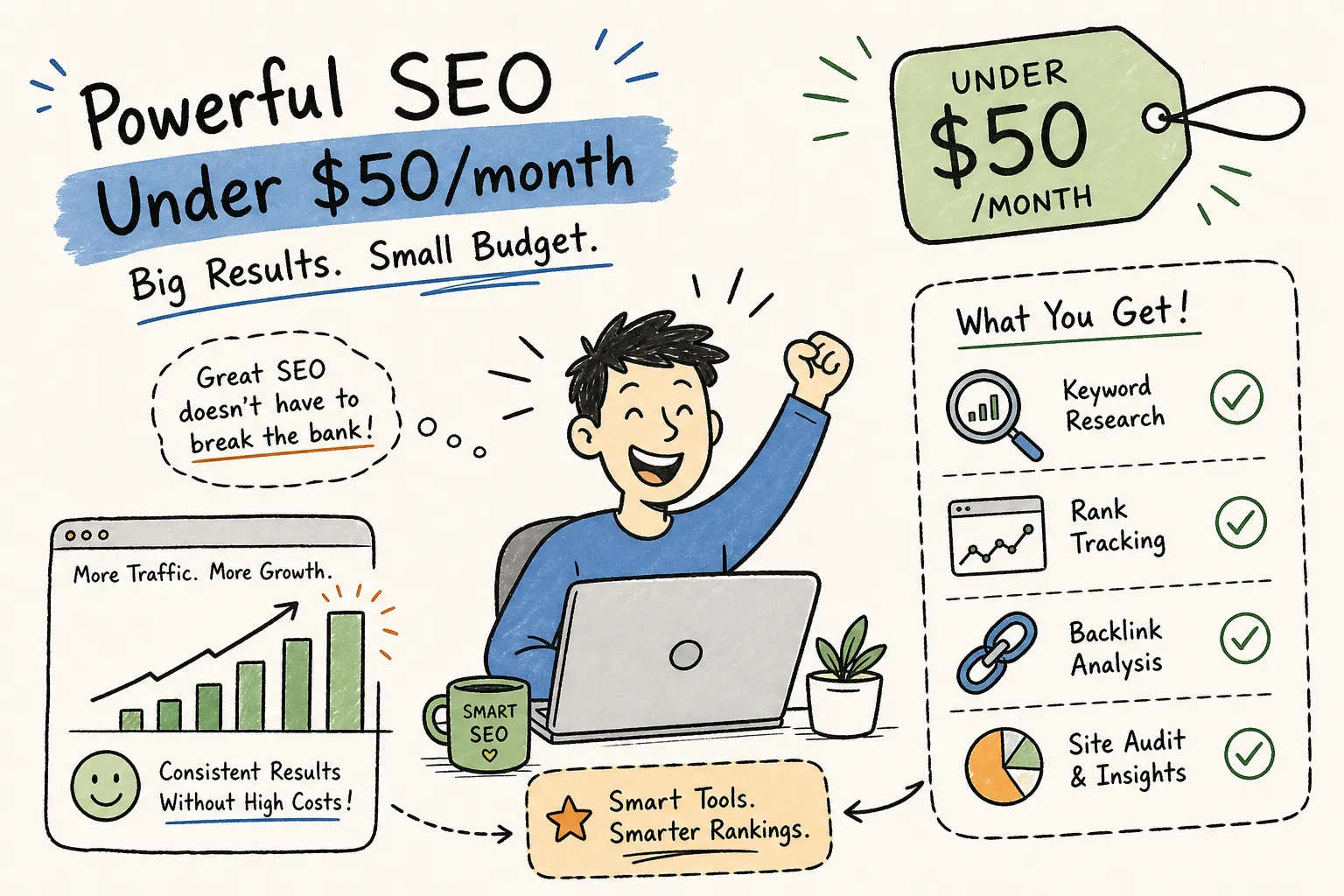
If you’re asking what are the best SEO tools for under $50 a month, the short answer in 2026 is: you have more solid options than most people realize. The idea that serious results require a $100+ monthly subscription is outdated. A handful of tools, and smart tool combinations, deliver real keyword research, rank tracking, site audits, and SERP analysis for well under $50 a month. They work for bloggers, freelancers, and small business owners who need results without the agency price tag.
Here at AISEO Round Table, we’ve tested these platforms across real sites and projects, you can find our methodology and individual tool reviews linked throughout this piece. What you’ll find below is an honest comparison of the top options by price, feature set, and use case. By the time you finish reading, you’ll know exactly which tool (or combination of tools) fits your situation and how to set it up without wasting a subscription cycle figuring it out.
What to look for in an affordable SEO tool before you spend anything
Cheap doesn’t automatically mean useful, and useful doesn’t require expensive. Before comparing specific tools, it helps to know which features actually matter at this price point so you can filter options by what you need rather than by what sounds impressive on a sales page.
The three core functions worth paying for
Any sub-$50 SEO tool worth subscribing to should cover keyword research with difficulty scoring, rank tracking with scheduled reporting (at minimum weekly), and a basic site audit that catches broken links, redirect chains, and missing metadata. These three functions form the operational backbone of an SEO workflow for a solo operator or small team. If a tool skips one of them, you’ll need a second tool to patch the gap, and that second tool eats into the budget you were trying to protect.
Features you can realistically skip at this price point
A deep backlink index, white-label reporting, and agency-level API access are premium-tier features that most bloggers and small business owners will never use. Don’t let an impressive feature list on a higher-tier plan distract you from evaluating whether the entry-level plan covers your actual workflow. Know what you need, match it to what the plan delivers, and ignore everything else.
What are the best SEO tools for under $50 a month? The top paid options, compared honestly
The following tools represent the strongest cheap SEO tools for small business owners and solo operators in this price range right now. Pricing and feature limits are based on current 2026 plan data drawn from each tool’s published pricing page, verify current limits directly with each provider before subscribing, as plans can change. Each tool has real strengths and genuine trade-offs worth understanding before you commit. For other curated lists and comparisons of SEO tools under $50 a month, check the roundups that aggregate current plan pricing and feature limits.
Mangools ($29.90/month Basic): best for keyword research and rank tracking
Mangools packages five tools into one subscription, but KWFinder and SERPWatcher are the headline features at this price. KWFinder delivers reliable keyword difficulty scores built around first-page competitiveness, making it especially strong for long-tail keyword discovery. SERPWatcher handles daily rank tracking for up to 200 keywords on the Basic plan, and the reporting interface is clean enough that you don’t need a tutorial to read it.
The limitations to know upfront: the Basic plan caps you at 100 keyword lookups per 24-hour period and 100 SERP lookups per 24-hour period. For a single blog or small site, that’s workable. For anyone managing three or more client sites simultaneously, the daily caps create friction fast. The backlink analysis through LinkMiner is functional but sits behind the tool’s stronger keyword features. For a head-to-head comparison that highlights the differences between Mangools and its all-in-one rivals, see the Mangools vs SE Ranking comparison.
SE Ranking (~$44/month): best all-in-one platform under $50
SE Ranking is the closest thing to a true all-in-one SEO suite at this price. A single dashboard covers rank tracking, site audits, competitor analysis, and a backlink overview. Page audit limits vary by plan tier, so check SE Ranking’s current pricing page for the exact cap on the entry-level plan before subscribing. The backlink database updates regularly, roughly 58% of links refreshed within 90 days, which is adequate for most use cases even if it doesn’t match the freshness rates of Ahrefs or Semrush.
The trade-off is backlink index size. SE Ranking’s database is meaningfully smaller than the premium players, so for deep backlink research or competitive link analysis in a tough niche, you’ll feel the gap. For a freelancer managing multiple client sites, or a small business owner who wants one tool that covers everything without switching between dashboards, SE Ranking is the most complete low-cost keyword research and site management setup in this price range. Read our detailed SE Ranking, Comprehensive SEO Platform for Keyword Tracking, Website Audits, and Competitor Analysis, AISEO Round Table review for a step-by-step walkthrough of the interface and limits.
Ubersuggest ($29/month): best entry point for beginners
Ubersuggest covers keyword research, a basic site audit, simple backlink analysis, and competitor tracking for up to three domains in its Individual plan. Volume and difficulty data generally clusters close to mainstream SEO tools, since the underlying data traces back to Google Keyword Planner with additional refinements. The AI content suggestions are a genuine bonus for content-focused bloggers who want topic ideas alongside keyword data.
Ubersuggest’s keyword difficulty scores are the weakest of the three tools compared here, particularly for low-competition terms where accuracy matters most. User reviews consistently flag that Ubersuggest can label competitive keywords as easier than they really are at the low end of the scale. Use it for directional research and treat the difficulty scores as a starting point, not a final judgment.
KeySearch and SpyFu: worth a look for specific needs
KeySearch Starter runs about $24/month and gives you the full keyword research toolkit including live SERP analysis, competitor analysis, rank tracking for 80 keywords, and YouTube keyword research. It’s the most affordable fully featured option in this roundup. The trade-off is data accuracy: KeySearch volume estimates diverge more noticeably from Ubersuggest, Mangools, and SE Ranking than those three tools diverge from each other. Use it for relative comparisons between keywords in a niche rather than treating absolute volume numbers as precise figures. For an independent take on KeySearch’s strengths and limits, see this KeySearch review.
SpyFu runs around $33/month on an annual billing cycle and specializes in competitive intelligence for both paid and organic search. It’s a strong choice if competitor keyword analysis is your primary need, but it’s less complete as a standalone SEO platform for someone who also needs rank tracking and site audits as part of a daily workflow.
Free tools that make any budget stack stronger
No sub-$50 stack is complete without layering in the free tools that fill genuine gaps. These aren’t fallback options for people who can’t afford more, they’re legitimate SEO assets that professional operators use at every budget level.
Google Search Console and GA4: your ranking and traffic baseline
Google Search Console is the ground truth for impressions, clicks, click-through rate, and average ranking position for every page on your site. No paid tool replicates it because the data comes directly from Google. GA4 adds user behavior and conversion context on top of that performance data. Together, they give you the organic traffic picture that every other tool in your stack should be measured against. Both are free and should be the first thing you set up on any site.
Screaming Frog’s free crawl tier: technical audits on 500 URLs
The free version of Screaming Frog crawls up to 500 URLs and surfaces broken links, missing title tags, duplicate content issues, and redirect chains. For most bloggers and small sites, 500 URLs is enough to run a meaningful technical audit each month. Pair it with any paid tool in this roundup and you’ve covered the technical SEO gap that most entry-level plans leave open. If you need quick, no-cost backlink checkers and other free tools to complement these crawlers, see curated lists of free backlink checker tools that are useful additions to a budget stack.
Smart tool stacks that stay comfortably under $50/month
Rather than picking a tool in isolation, think in terms of a stack that covers all four core functions together. These three configurations are practical and deployable today.
The $29.90/month complete starter stack
Mangools Basic plus Google Search Console plus Screaming Frog free comes to $29.90/month total. KWFinder handles keyword research, SERPWatcher handles rank tracking, Google Search Console provides performance and indexing data, and Screaming Frog covers technical crawls up to 500 URLs. Backlink analysis is limited on this setup, but for a new or growing site building its first 50 pages of content, the gap isn’t urgent. This is the right stack for bloggers and affiliate marketers who want solid keyword and ranking coverage without overcomplicating the workflow.
The $44/month all-in-one stack for freelancers
SE Ranking at $44/month plus Google Search Console plus GA4 equals $44/month total. SE Ranking handles rank tracking, site audits, and competitor analysis inside a single dashboard, which matters when you’re switching between multiple client accounts. Google Search Console and GA4 layer in traffic and indexing data that no paid tool at this price fully replicates. For anyone managing more than one site, the reduced context-switching alone justifies the extra $14 per month compared to the Mangools stack.
When a two-tool paid stack makes sense
Combining Mangools at $29.90 with a free crawler gives you strong keyword and rank tracking at a lower cost, but it means tolerating a separate login and workflow for technical audits. Stepping up to SE Ranking at $44 eliminates that split. The deciding question is how many sites you manage and how often you run audits. One site with monthly audits tilts toward Mangools plus free tools. Multiple sites with regular audit cycles tilt toward SE Ranking as the single-platform solution.
Real trade-offs to understand before you subscribe
Budget SEO tools deliver genuine value, and they come with real limitations worth naming directly so you don’t end up switching tools every three months.
Data accuracy and index size at budget price points
Most tools in this price range refine Google Keyword Planner data or pull from third-party sources rather than building an independent crawling infrastructure from scratch. Volume estimates across Mangools, SE Ranking, and Ubersuggest tend to cluster together because of this shared data lineage. KeySearch is the most likely outlier, sometimes diverging on both volume and difficulty more than the others do. Treat absolute volume numbers as directional signals for prioritization, not precise forecasts. The relative ranking of keywords within a niche set is far more reliable than any single number.
When a sub-$50 plan becomes a ceiling
Rank tracking keyword limits, daily search caps, and single-user restrictions appear on lower-tier plans across nearly every tool in this roundup. Mangools Basic caps rank tracking at 200 keywords. KeySearch Starter allows 80 tracked keywords. SE Ranking’s entry-level plan also enforces keyword tracking limits that grow with higher tiers. If your site grows past those thresholds or you add three or more client accounts, the math on upgrading a single tool’s plan tier often beats adding a second tool to patch the gap. Revisit your plan choice every six months as your site or client roster grows.
How to choose the best SEO tools for under $50 a month based on your situation
The right pick depends on what you’re managing and how often you need each core function, not on which option has the longest feature list.
If you’re a blogger or affiliate marketer
Mangools Basic is the natural fit. Keyword research and rank tracking are the top priorities at this stage, and KWFinder plus SERPWatcher handle both well within the $29.90/month Basic plan. Pair with Google Search Console and Screaming Frog free for zero-cost coverage of traffic data and technical crawls, and you have a complete operational stack for under $30 a month.
If you’re a freelancer or small business owner managing multiple sites
SE Ranking at $44/month is the right call. The all-in-one setup reduces context-switching, covers auditing, competitor tracking, and rank monitoring in one place, and stays comfortably under the $50 ceiling even after layering in free tools. AISEO Round Table’s individual tool reviews go deeper on each platform if you want a step-by-step breakdown before committing to a plan. Also see our analysis of Free vs Paid Keyword Research Tools Compared, AISEO Round Table for guidance on when to upgrade from free data sources to a paid plan.
The bottom line on affordable SEO tools in 2026
So, what are the best SEO tools for under $50 a month? The three strongest options each serve a distinct profile. Mangools suits keyword-focused operators who want clean research and rank tracking at $29.90/month. SE Ranking fits freelancers and multi-site operators who need one dashboard that handles everything at $44/month. Ubersuggest works for beginners who want a gentle on-ramp with a familiar interface at $29/month. Layer in free tools like Google Search Console and Screaming Frog and you raise the value ceiling of any of these paid plans significantly, they should be part of every stack from day one.
The best SEO tools for under $50 a month are not a compromise you make while waiting to afford something better. They’re a smart starting point that covers the core workflow for most sites at most stages. Pick one tool from this list, run it on a real project for 30 days, and measure what moves. When you’re ready for the full breakdown on any specific tool, AISEO Round Table’s in-depth reviews are the next stop, start there before your next subscription decision. For independent third-party perspectives and further reading on affordable SEO tools and reviews, consult a few additional reviews and comparisons to validate your decision.