If your organic traffic dropped somewhere between February and June 2026, you were not imagining it. The Google algorithm update 2026 cycle pushed through four distinct update events in that window, and the impact was uneven across verticals, sharp in some, barely noticeable in others. The sites that got hit hardest are still trying to make sense of what happened and why.
At AISEO Round Table, we track every confirmed Google update as it rolls out, monitor the data as it matures, and translate the findings into plain-language guidance for bloggers, freelancers, and small business owners. This article covers all four 2026 update events: official dates, what changed in the ranking signals, which site types won and lost, and a sequenced recovery plan you can act on today.
This is not a scare piece. By the time you finish reading, you’ll know whether a specific update is actually responsible for your traffic change, and if it is, you’ll have a clear, prioritized path forward.
Google algorithm update 2026: the full timeline of four confirmed changes
Before getting into causes and fixes, here is the full map of what rolled out and when. Having these dates in front of you matters because the first step in any recovery is confirming whether a 2026 search algorithm change actually caused your drop. Note that the February Discover update and the March spam update are confirmed via Google’s official blog post and the Search Status Dashboard, while the March and May core updates are the two events with full start-and-end rollout timestamps on record.
February 2026 Discover core update (Feb 5, Feb 27)
Google launched this update on February 5 and finished rolling it out on February 27. Critically, this was not a general Search core update. It targeted Google Discover specifically, the content feed that surfaces articles outside of traditional search queries. Google stated publicly that the update aimed to show more locally relevant content, reduce sensational and clickbait articles, and surface more in-depth, original, topic-specific content. It started with English-language users in the U.S. before expanding to other languages and regions. Industry coverage and early analysis of the rollout are available from independent reporting and news sites like coverage of the February 2026 Discover update.
March 2026 spam and core updates (March 24, March 27, and April 8)
Two separate updates fired within days of each other here, which made diagnosing traffic changes unusually difficult. The spam update landed March 24 and targeted manipulative, low-quality content. The broader core update began March 27 and finished on April 8, a 12-day rollout. If your traffic shifted in late March or early April, you may have been caught by one update, the other, or both simultaneously.
May 2026 core update (May 21, June 2)
This global core update began May 21 and completed its rollout on June 2, 2026, so the full data picture is still developing as of this writing. Early patterns are consistent with what we observed after the March core update, so the analysis and recovery principles in this article apply to both.
How the Google algorithm update 2026 shifted ranking signals
Knowing when the updates happened gets you to the door. Understanding what changed inside the algorithm tells you what to do about it. Industry analysis across the four 2026 update events points to three consistent signal shifts, though we’ll flag below where the evidence is still developing.
AI readability and passage-level content evaluation
Google’s AI systems now evaluate content in chunks and passages, matching sub-questions and specific intent rather than scoring a page as a single ranking unit. This means a well-written section inside a longer article can rank independently for a sub-topic, but it also means poorly structured or generic sections drag the whole page down. Semantic clarity, logical flow, and scannable formatting carry real ranking weight. Industry analysis suggests that simple keyword signals and domain-age signals carry less weight than they did in prior years (see our analysis of the Google Core Update December 2025), though the exact degree of that shift continues to be studied.
E-E-A-T with heavier weight on firsthand experience
Within Google’s E-E-A-T framework, Experience has pulled ahead in practical impact. Google has gotten measurably better at detecting real, hands-on knowledge versus assembled, generic writing. Author credibility, transparent sourcing, and practical examples based on actual use are active ranking signals. For guidance on writing that prioritizes real user experience, see our piece on People First Content: Lessons from the Helpful Content Update. YMYL categories, health, finance, and legal, saw the sharpest E-E-A-T enforcement in the March update data, but the pattern held across most verticals.
Brand trust and cross-web authority signals
First-party authority gained weight across the analyzed 2026 updates (February Discover, March spam, March core, and May core). Google is checking how consistently a brand’s expertise appears across the web, not just on its own pages. Review volume and quality, brand mentions on authoritative sources, and a consistent entity presence all factor in. Sites that exist only as a collection of optimized pages, with no identifiable brand voice or external presence, got filtered out more aggressively with each successive update.
Winners and losers: which sites Google rewarded and which it penalized
The March 2026 core update produced the most complete dataset, so that’s the primary reference here. The May 2026 data is still maturing, but early signals from the Google update impact analysis point in the same direction.
Site types that gained the most visibility
Official brand-owned pages, government sources, and original-research publishers were the clear winners across multiple verticals. In travel, hotel brands and airlines saw significant visibility gains (Spirit Airlines +69.8%, Accor +39.6%), while third-party aggregator content fell sharply. These figures come from a SISTRIX dataset analysis of the March 2026 core update. In healthcare and finance, credentialed, expert-authored content won. Job boards with direct employer listings outperformed generalist aggregators. The pattern is consistent: sites with a real brand identity and genuine first-party authority held or improved rankings.
Site types that got hit hardest
Thin affiliate sites, templated content, and aggregator pages took the worst of it. In travel, TripAdvisor lost 44.8% of visibility and Skyscanner dropped 39.3%, according to the same SISTRIX analysis. Recipe portals, UGC platforms, and language-tool sites also fell significantly. The same dataset found roughly four losing domains for every winner across the analyzed set. YouTube appeared as one of the single largest visibility losers in the March update data, a sign that even large platforms are not immune when their content matches the patterns Google is filtering out.
The common thread across losers
Scaled, interchangeable content that lacked original data, firsthand experience, or a genuine brand identity performed worst, regardless of industry vertical or domain age. The update did not target a specific niche; it targeted a content model. If your site built traffic on content that could have been written by anyone about anything, that model is under real pressure in these 2026 search algorithm changes.
How to tell if the Google algorithm update 2026 actually caused your traffic drop
Many sites see traffic drops that have nothing to do with algorithm changes: seasonal shifts, technical regressions, competitor gains, or crawl issues all cause organic dips. Before you start rewriting content, confirm that a 2026 Google core update is actually the cause.
Match your traffic drop date to the official update windows
Pull up your analytics and find the date your traffic started declining. If it aligns with February 5, March 24, March 27, or May 21, an algorithm update is a strong candidate. If your drop predates or falls well outside these windows, the cause is likely something else. Start with a technical health audit before touching your content.
Read your Google Search Console data the right way
Filter Search Console’s Performance report by a date range that brackets each update window. Use the Compare feature to set a pre-update period against a post-update period of equal length. Look at which pages lost the most clicks and impressions, then cross-reference with the queries driving traffic to those pages. A broad drop across many unrelated queries usually signals a core update. Drops concentrated on specific page types, like product reviews or aggregator pages, often point to a spam or signal-specific change.
Use a rank tracker to spot the fluctuation pattern
A rank-tracking tool gives you a clear visual timeline of when specific keyword rankings moved and by how much. If your tracked keywords dropped in lock-step with a confirmed update date, that confirms the cause. Monitoring rank volatility in real time also means you catch future shifts before they show up as traffic loss in your analytics, which is why setting up rank tracking before the next update is worth doing now.
A prioritized recovery plan: what to fix first and in what order
Recovering from a Google ranking change is a process, not a patch. The sequence matters as much as the individual steps, so resist the urge to change everything at once before you have clean data.
Start your diagnosis before you touch anything
Google’s own guidance is clear on this: wait at least a week after a rollout finishes before drawing conclusions from Search Console data. Mid-rollout numbers are unstable and can lead you to fix the wrong things. Once the rollout is confirmed complete, identify the pages with the sharpest click and impression drops. Focus your effort on those pages first, not the whole site at once.
Improve content quality and E-E-A-T on affected pages
Compare your losing pages against the current SERP winners for those same queries. What do the ranking pages do better in terms of depth, firsthand detail, sourcing, and intent match? Rewrite or restructure your pages to be more helpful, more current, and easier to read. Strengthen author bios so editorial credibility is visible. Add practical examples, cite real sources, and make sure each page answers a specific question better than anyone else does.
- Add a clear author byline with relevant credentials or demonstrated experience
- Replace generic claims with specific examples, data points, or firsthand observations
- Restructure long sections so each sub-topic answers a clear, distinct question
- Update outdated references, statistics, and product mentions
- Make your editorial stance and site identity visible, who runs this, and why should a reader trust it?
Fix technical issues only after content is addressed
Core Web Vitals, mobile usability, and internal linking all matter, but they amplify good content, they do not rescue weak content. Once you’ve dealt with the content gaps on your hardest-hit pages, audit your page experience signals and fix what’s genuinely broken. We recommend a 30-to-60-day monitoring window after making changes; compare pre- and post-update performance in Search Console before deciding whether further adjustments are needed. Recovery is not instant, and reacting to every data fluctuation inside that window will send you in circles.
For a practical primer on how Google core updates operate and what that means for recovery sequencing, see this guide to Google core updates.
What comes next: staying ahead of the update cycle
The Google algorithm update 2026 cycle is not the last one, and the pattern it established is readable. Sites with genuine authority, firsthand content, and a clear brand identity are the ones holding or recovering rankings. Sites built on scaled, interchangeable content are getting filtered out more aggressively with each update, and that trajectory is not reversing.
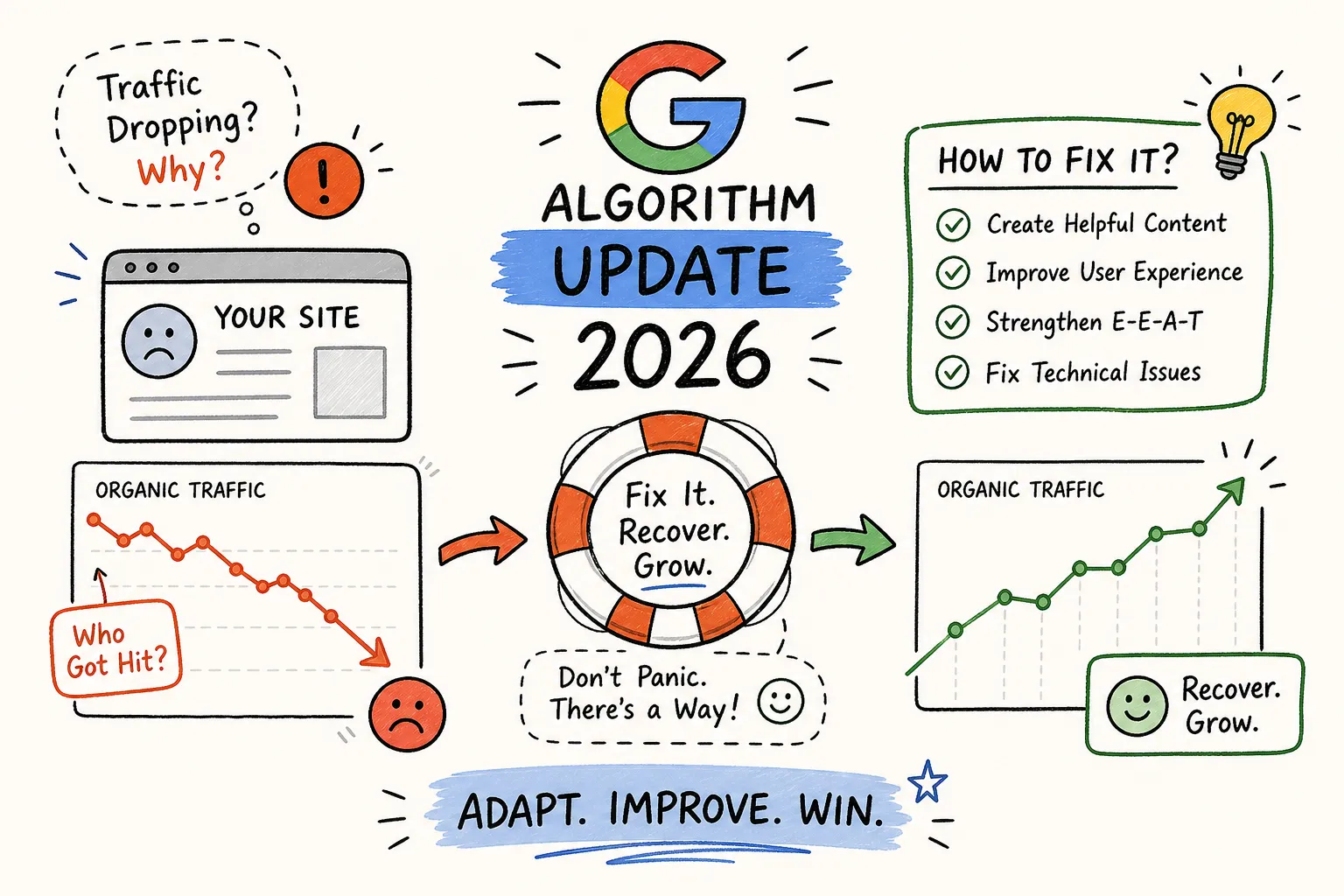
Here’s the recovery sequence in plain terms: confirm the update caused your drop, identify your worst-hit pages in Search Console, improve content quality and E-E-A-T signals on those pages, then monitor results over time. There’s no need to panic, and no shortcuts worth taking. The recovery path is slower than the drop, but it’s durable when you follow it properly.
The team at AISEO Round Table will continue tracking the May 2026 data as it matures, the picture is still forming, and we’ll update our analysis as clearer patterns emerge. The recovery principles covered here apply to whatever Google pushes next, because the underlying direction of these 2026 Google Search AI updates has been consistent all year. Bookmark this page, run your Search Console comparison today, and start with the one or two pages that lost the most traffic. That’s where the work begins. For more ongoing coverage see our Google Search Updates, Algorithms & SEO News | AI SEO Roundtable category.