
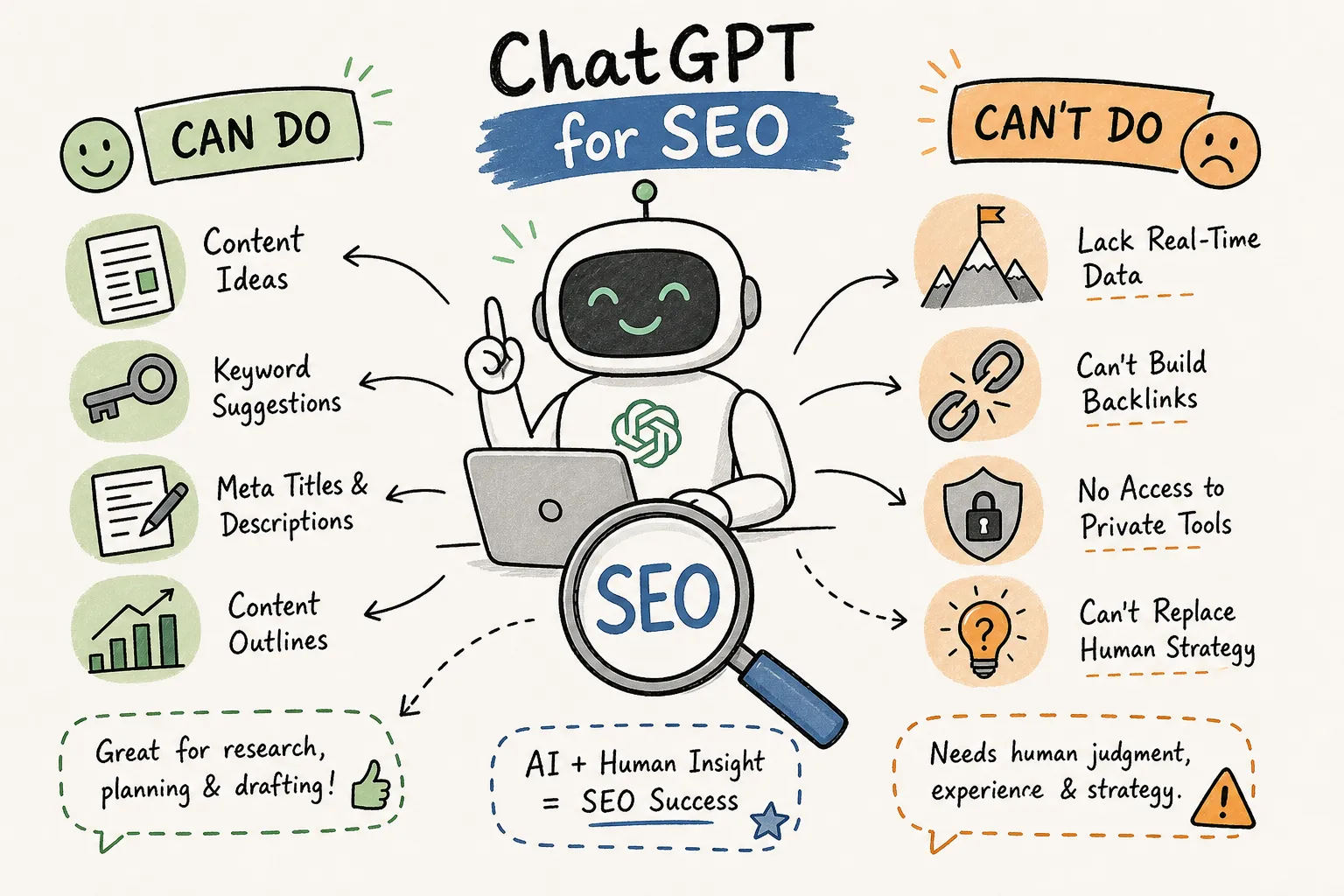
Every week, someone asks some version of the same question: “Can I just use ChatGPT for my SEO and skip the expensive tools?” It’s a fair question, and if you’re wondering is ChatGPT good for SEO, the honest answer depends entirely on the task. ChatGPT is genuinely useful for some SEO work. For other tasks, it will confidently lead you in the wrong direction.
At AISEO Round Table, we test these tools against real-world SEO workflows, not theoretical use cases. Our hands-on evaluations cover how each tool performs across common content production tasks, from keyword clustering to meta tag drafting, so you can see exactly where AI-assisted workflows hold up and where they break down. Instead of a blanket “yes” or “no,” this article walks through the specific tasks where ChatGPT earns its place, the ones where it falls apart, the prompts that actually work, and the tools you still need alongside it. By the end, you’ll know exactly how to use ChatGPT in your content workflow without getting burned.
Is ChatGPT Good for SEO? Tasks Where It Delivers
ChatGPT earns its place in an SEO workflow when the task is structured, repetitive, and built from inputs you already have. This pattern holds across specific content production tasks, especially the ones that slow bloggers and small business owners down the most.
Writing meta descriptions and title tag variations
Meta tags are one of the strongest ChatGPT use cases because the output is short, constrained by character limits, and easy to evaluate in seconds. When you give it a page summary, a target keyword, a tone, and hard limits (60 characters for titles, 155 for descriptions), it produces usable first drafts fast. A prompt like “Write five title tags under 60 characters for a page about [topic]. Use [keyword], keep the tone [conversational/professional], and make each one click-worthy for [audience]” consistently returns options worth editing, even if you don’t publish any verbatim. Teams that build this step into their generative AI SEO best practices report cutting meta-tag drafting time significantly, the value isn’t perfection on the first pass, it’s having a strong starting point to react to rather than a blank field.
Building content outlines and topic briefs
ChatGPT is reliable at turning a target keyword into a structured page outline, complete with H2s, H3s, FAQ ideas, and audience framing. The key is specificity in your prompt. Specify the search intent (informational, commercial, transactional), the audience type, and the approximate word count. With those inputs, the model produces a content brief that gives you a solid starting skeleton, exactly what you need before you start writing or outsourcing to a writer. For deeper guidance on optimizing content for modern answer surfaces, see our Answer Engine Optimization (AEO): The Proven Complete Guide for 2026, AISEO Round Table.
Grouping keywords by search intent
Give ChatGPT a seed topic and it can return clusters of related keywords sorted by informational, commercial, and transactional intent. For a beginner blogger who doesn’t yet have a clear picture of their topical landscape, this is genuinely useful for early-stage AI-assisted content optimization. The critical limitation to understand upfront: ChatGPT generates plausible groupings, but it cannot confirm search volume or keyword difficulty. That keyword list is a creative starting point, not a strategy you can act on without validation.
Is ChatGPT Good for SEO? Where It Falls Short
ChatGPT is a language model, not a search engine. It has no access to live data, no connection to Google’s index, and no way to measure real keyword competition. That gap matters more than most users realize when they first start treating it as an SEO tool.
The live keyword data problem
ChatGPT cannot tell you actual search volume, keyword difficulty, click-through rates, or SERP competition for any keyword. It can generate keyword ideas, but it cannot validate them. Any keyword list it produces is brainstormed, not measured. Without real metrics, you cannot prioritize your content calendar, allocate your writing budget, or predict whether a keyword is even worth targeting. A common mistake beginner bloggers make when using AI for SEO is treating a ChatGPT keyword list as a finished research document, and then building a content calendar around guesses instead of data.
Hallucinations, thin content, and the confidence problem
ChatGPT’s failure modes in SEO content are well-documented: invented statistics, fabricated sources, overconfident answers, and generic filler that sounds authoritative but adds no real value. These are not rare edge cases. The model fills gaps with plausible-sounding guesses instead of flagging uncertainty, which means a published post can contain errors that look authoritative on the surface. For affiliate and review content especially, one fabricated statistic or invented study can destroy reader trust the moment someone checks your source. For additional reading on why models hallucinate and how that affects content reliability, see this overview of ChatGPT hallucinations explained.
ChatGPT SEO Prompts That Actually Work
Vague prompts produce vague output. Specific prompts with hard limits, tone direction, and example formats produce drafts worth editing. The following templates are built around that principle, each one gives the model constrained inputs so it has less room to improvise and more reason to deliver something usable. For a deeper dive into prompt engineering and advanced prompt patterns, check out ChatGPT for SEOs: A Master Class in Prompt Engineering, AISEO Round Table.
Prompts for meta descriptions and title tags
Here are three templates you can copy and customize right now:
- “Write 5 meta descriptions for [page topic]. Include [keyword], keep each under 155 characters, use active voice, and add a clear CTA. Tone: [conversational/direct]. Audience: [beginner bloggers/small business owners].”
- “Generate 5 SEO title tag options for [topic]. Use [keyword], keep each under 60 characters, and write one conservative, one benefit-led, and one curiosity-led option.”
- “Rewrite this existing title tag to fit under 60 characters while keeping the primary keyword: [paste your title].”
What makes these work is the combination of clear inputs, hard character limits, and a specified tone. The model isn’t guessing what you want because you’ve told it exactly what you need.
Prompts for content outlines and internal linking
For outlines, the most effective prompt structure includes the target keyword, audience type, search intent, and required section types. Try: “Create a detailed SEO content outline for [topic]. Primary keyword: [keyword]. Audience: [audience]. Intent: [informational/commercial]. Include H2s, H3s, FAQ ideas, and the key subtopics needed to fully satisfy the query.”
For internal linking, provide your actual URL inventory rather than letting the model guess at your site structure. A prompt like “Here is my list of page titles and URLs. Recommend the best internal link opportunities, anchor text, and placement for each page” produces noticeably more relevant suggestions than a generic request, because the model is working from your real site architecture instead of imagining what you might have published. In our testing, providing the URL list roughly doubled the proportion of suggestions that were directly usable without manual revision.
What Google Actually Says About AI Content in 2026
A lot of non-technical website owners carry real anxiety about whether using AI will get their site penalized. The short answer, grounded in Google’s actual public guidance, is: AI-generated content is allowed, but it has to be helpful, original, and not produced primarily to game rankings. Google has stated this position across its Search Central documentation and spam policy updates through 2024 and 2025, the standard hasn’t shifted. For a consolidated reference to the evolving rules, see the Google AI content guidelines (complete 2026 guide).
Quality-first, not origin-first
Google’s consistent position is that content is evaluated on usefulness and quality regardless of how it was created. There is no special ranking boost for AI content, and no blanket demotion either. Google evaluates whether a page genuinely helps users, not whether a human or a language model drafted the sentences. If your AI-assisted post is accurate, complete, and satisfies the search intent better than competing pages, it can rank. If it’s thin, generic, or misleading, it won’t, regardless of how it was written.
When AI content crosses into spam
Google’s enforcement targets scaled content abuse: pages produced at volume without added value, primarily to manipulate search rankings. This is about intent and quality, not about the tool used to write the first draft. A single AI-assisted blog post, reviewed by a human editor and enriched with original insight, is not spam. A thousand pages of generic AI output pushed live without editorial review, targeting keyword variations nobody actually searches, is exactly what Google’s spam policies are designed to catch. For context on how AI-driven strategies are being measured across the industry, industry surveys like these AI SEO statistics can help you set realistic expectations.
How to Fact-Check ChatGPT Output Before It Goes Live
The edit-and-verify step is not optional. AI output is a draft, not a finished product. Treating it as publish-ready is the fastest way to earn thin-content penalties or damage the trust you’ve built with your audience.
A practical pre-publish checklist
Run every ChatGPT-generated draft through these checks before publication:
- Trace every factual claim to a primary source you can link to.
- Confirm that every cited study, statistic, or named source actually exists and supports the specific claim being made.
- Remove anything that cannot be verified rather than leaving it in because it sounds plausible.
- Check for generic filler: if a section could apply to any competitor’s post on the same topic, rewrite it with specific examples, data, or your own experience.
In practice, a thorough section review takes somewhere in the range of five to ten minutes depending on how claim-heavy the draft is, though that will vary based on topic complexity and how much the model improvised. It’s not a burdensome audit; it’s a habit that separates content worth publishing from content that erodes your site’s credibility over time.
Why human editorial review still matters
No AI detector is reliable enough to use as a quality gate in 2026. According to published independent evaluations of major detection tools, the best-performing detectors top out around 84% accuracy, and they still produce false positives on edited or non-native English writing, which means they penalize careful revision as much as they flag genuine AI output. The better safeguard is a human reviewer who knows the topic, not a detection tool that guesses at authorship. This is especially true for affiliate and review content, where trust is the conversion engine and one fabricated claim can cost you far more than the time saved by skipping a careful edit. For independent comparisons of detection tools, see this roundup of best AI detector reviews.
The SEO Data Gap ChatGPT Can’t Close
The picture so far is mostly positive, but there is a structural limit that matters. ChatGPT supports content creation well. It has no access to keyword metrics, SERP data, or competitive analysis. That gap is not minor. It is the foundation of any real SEO strategy.
What dedicated keyword tools do differently
A tool like KWFinder from Mangools provides actual search volume, keyword difficulty scores based on real backlink data, SERP snapshots, and competitor traffic estimates. A keyword list from ChatGPT and a keyword list from KWFinder are not the same thing: one is brainstormed from language patterns, the other is measured from live search data. When you need to decide which keywords are realistic to target with a new blog, which content gap represents a real opportunity, and how competitive the existing SERP is, ChatGPT simply cannot give you that information accurately.
Where AISEO Round Table’s reviews fill the gap
At AISEO Round Table, we review tools like KWFinder and Mangools specifically for non-technical users who need real keyword data without a steep learning curve or an agency-level budget. Our reviews include hands-on walkthroughs, plan comparisons, and plain-English summaries of what each tool actually shows you, so you can evaluate them against your own workflow before spending anything. If you’ve been relying on ChatGPT alone to guide your keyword decisions, our hands-on tool reviews are the practical next step. ChatGPT starts the workflow. A dedicated keyword tool is what lets you finish it with confidence.
Is ChatGPT Good for SEO? The Honest Verdict
So is ChatGPT good for SEO? Yes, for the right half of the job. It handles content tasks well: building outlines, writing meta descriptions, clustering keyword ideas, and generating internal linking suggestions. It is not good for keyword validation, search volume data, SERP analysis, or any task that requires live search metrics. Those two statements can both be true at the same time.
The two-tool approach works in practice: ChatGPT handles the writing layer, a dedicated keyword tool handles the data layer. Neither replaces the other, and together they cover far more ground than either does alone. Use ChatGPT to draft faster and structure smarter. Use real keyword data to make sure you’re targeting the right topics in the first place. For practical examples of advanced prompt workflows, see our ChatGPT for SEOs: A Master Class in Prompt Engineering, AISEO Round Table, and consult industry trend data like these AI SEO statistics when you plan resources.
Ready to close the data gap? Check out AISEO Round Table’s reviews of KWFinder and Mangools for a plain-English breakdown of which plan fits your budget and how to run your first keyword research session without an agency holding your hand. Also see this piece on AI-Powered Snippets: Google Tests AI-Generated Descriptions, AISEO Round Table for how search surfaces may display AI-generated summaries in results.