
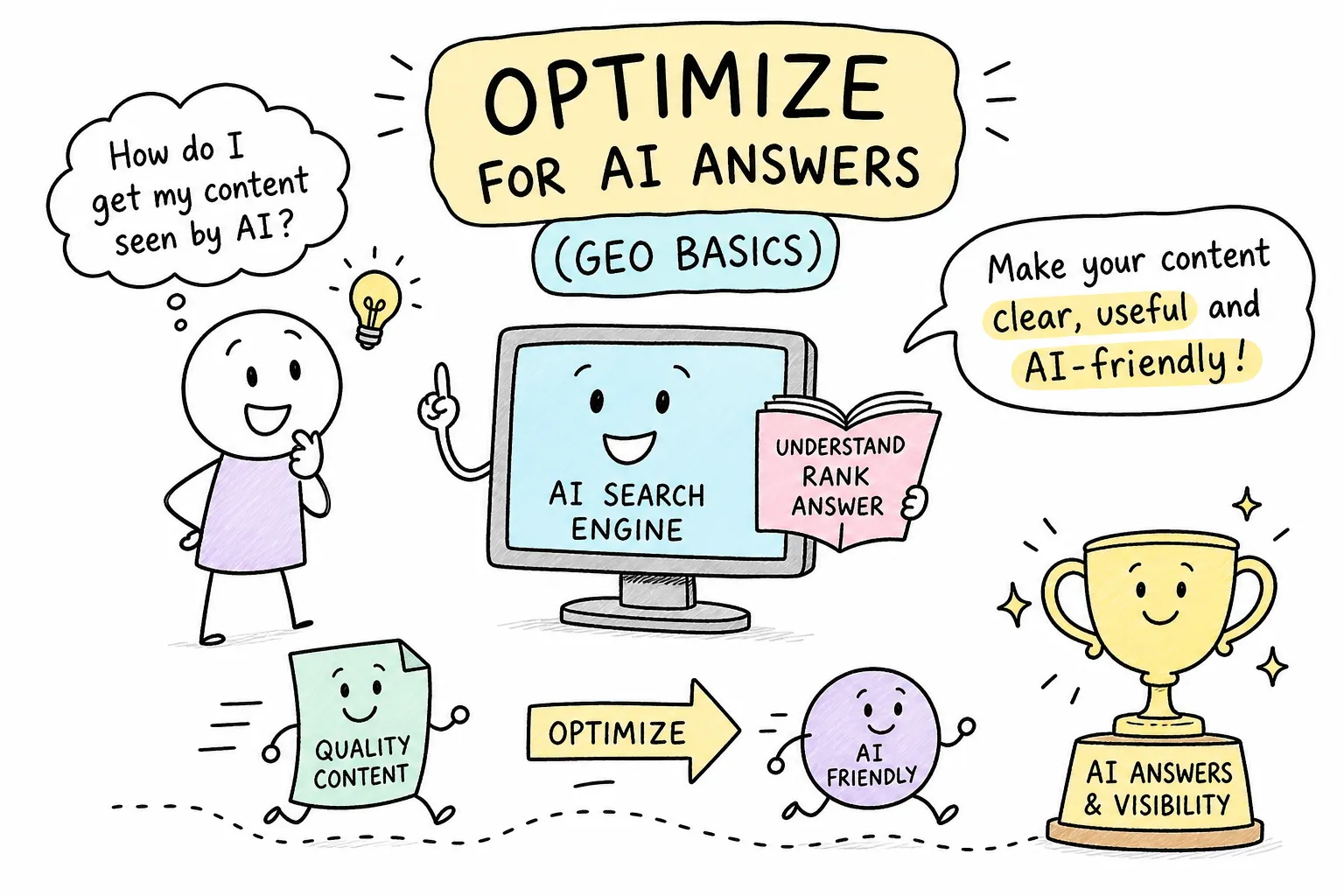
Something has quietly shifted in how people get answers online. Generative engine optimization is changing what “getting found” actually means, a growing share of searches now end with the user reading a response generated by an AI system, without ever clicking a link. Google AI Overviews, Perplexity, and Bing Copilot are surfacing complete answers built from multiple sources, and for content creators, that shift changes the game. The strategy built around ranking a blue link still matters, but there’s a new layer on top of it: making sure AI systems understand your content well enough to quote it, cite it, and include it in the answer they generate.
That new layer has a name: GEO. At AISEO Round Table, we track exactly these kinds of shifts alongside the foundational SEO tactics that never go out of style. This guide walks you through what generative engine optimization is, how it differs from traditional SEO, what signals actually move the needle, and how to start measuring whether your efforts are working.
What generative engine optimization actually means
Generative engine optimization is the practice of shaping your content so AI-powered search systems are more likely to understand it, use it, and surface it inside a generated response, not just as a ranked link beneath one. The old goal was to claim a spot in a list of results. The new goal is to be the answer the AI synthesizes when a user asks a question. Those are meaningfully different targets, and they call for different thinking about how content is written and structured.
The AI surfaces you need to care about include Google AI Overviews, Perplexity, and Bing Copilot. All three pull from web content, generate a response, and may or may not display a clickable citation alongside it. Being “cited” in this context means the AI used your page as a source and referenced it inside the generated answer. Sometimes that comes with a link; sometimes it’s just the information being absorbed into the response. Either way, your content influenced what the user read.
GEO emerged as its own conversation because content that ranks well doesn’t automatically get cited. Generative systems read pages differently than a traditional crawler does. They’re looking for content they can extract, paraphrase, and synthesize into a confident answer. A page can sit at position two in Google and still never show up in an AI Overview if the content isn’t structured in a way the model can easily parse.
How GEO differs from traditional SEO
The goals, outputs, and metrics are different enough to be worth laying out side by side. The table below captures the key contrasts, pay particular attention to the “output” row, since that single difference drives most of the tactical changes GEO requires.
| Aspect | Traditional SEO | GEO |
|---|---|---|
| Primary goal | Rank higher in search results | Appear in AI-generated answers |
| Main output | Clickable links, blue-link traffic | AI citations, mention inside response |
| Key tactics | Keywords, backlinks, crawlability | Clear structure, extractability, authority signals |
| Core metrics | Rankings, organic traffic, clicks | AI mention rate, citation rate, AI referral traffic |
The distinction that matters most is the output: a ranked page versus being quoted by an AI. Those require different content decisions, even though the underlying quality signals overlap significantly. Authority, relevance, and helpfulness still drive both outcomes. Your existing SEO work isn’t wasted.
GEO vs. SEO: what actually changes
GEO doesn’t replace SEO. Google has stated directly that optimizing for AI features is still SEO. For beginners, that’s reassuring: you don’t start over. You build on what you already have and add new priorities around how content is structured and how easy it is for a model to extract clean answers from it. The overlap includes quality content, technical accessibility, and E-E-A-T signals. What shifts is the emphasis: GEO puts more weight on extractability than on keywords and backlinks alone. (See Generative Engine Optimization: SGE Tactics Guide.)
What signals generative engines use to surface your content
Google’s AI Overviews inherit signals from its broader ranking systems, which means helpfulness, freshness, link analysis, and spam detection all feed into which pages get cited. A 2024 analysis by Seer Interactive found that 92% of AI Overview citations come from domains already in Google’s top 10. A strong SEO foundation feeds GEO performance directly.
Beyond rank, the signals that matter for AI citation include E-E-A-T quality cues, topical completeness, and how directly the page answers the user’s intent. Generative engines favor pages that satisfy the main question and address related sub-questions in depth. A page that covers one topic thoroughly beats a page that touches ten topics lightly.
The concept of extractability is central to AI search optimization. AI systems need to read, parse, and quote your content cleanly. Pages with clear headings, short paragraphs, lists, and question-and-answer blocks are far easier for a model to work with than dense, unbroken prose. Entity clarity also helps: AI systems use knowledge graphs to map your content to recognized people, places, products, and concepts. The clearer your entity signals, the more easily your page gets connected to the right queries.
On-page content changes that get you cited in AI answers
The single highest-impact change you can make is rewriting key H2 and H3 headings as actual questions your audience asks. Immediately below each question heading, write a concise, plain-language answer of roughly 40 to 60 words. AI systems read the heading, match it to the user’s query, then pull the answer directly below it. A heading that reads “On-page SEO basics” is less useful to a generative engine than “What is on-page SEO and why does it matter?” The second version signals intent alignment before the model reads a single sentence of the body copy.
In our experience at AISEO Round Table, adding a visible FAQ section to your core pages is one of the highest-impact GEO changes you can make. Use real questions sourced from your audience, from Google autocomplete, or from the “People Also Ask” boxes that appear in search results. Keep each answer short and self-contained so it can be extracted without context from surrounding paragraphs. A short key-takeaways box near the top of the article works the same way: it surfaces your main points for both the reader and the AI extraction layer simultaneously.
Fresh data and updated examples also pull weight. AI content optimization favors pages that look current and useful for summarization. Embedding recent statistics, timely case study references, or specific examples throughout your content signals that the page is worth quoting on fast-moving topics. Older, static pages that haven’t been updated in a year are less likely to show up in AI-generated responses, especially in categories where information changes frequently. Keeping content current is both a GEO tactic and just good practice.
Structured data and content formats that boost AI visibility
FAQPage schema is the highest-priority markup type for generative engine optimization because it mirrors exactly how AI systems retrieve answers: question in, answer out. Implemented in JSON-LD, it tells the AI that your page contains structured question-and-answer content and labels each pair cleanly. For any page where you’ve added a real FAQ section, FAQPage schema is a direct follow-on step.
Article or BlogPosting schema marks your content as editorial content with a defined topic, author, and publication date. The fields that matter most for AI citation trust are author name, publisher or organization name, datePublished, and dateModified. These fields tell the AI who wrote it, where it came from, and how current it is, the same evaluation a human reader makes when deciding whether to trust a source. Adding Organization and Person schema with sameAs links pointing to LinkedIn profiles or verified social accounts strengthens entity authority further. For a focused walkthrough on structuring content for AI features, see How to Optimize for Google’s Search Generative Experience, AISEO Round Table.
The alignment principle is worth stressing: schema markup only helps when it accurately reflects what’s on the page. Mismatched or exaggerated markup can undermine trust signals rather than boost them. Keep it simple. Mark up what’s actually there, in the format it’s actually presented. A well-aligned FAQPage schema on a page with a real FAQ section outperforms elaborate schema on a page that doesn’t match it.
How to measure GEO performance and prove it’s working
Start in GA4 by creating a custom channel group that captures sessions from known AI referrer domains: ChatGPT, Perplexity, Gemini, Claude, and Copilot. Name it “AI Referral Traffic” and place it above the generic Referral channel in your channel order, since GA4 evaluates rules top-down. Then monitor sessions, engagement rate, and goal completions from that channel over time. Not all AI platforms pass clean referrer data consistently, so treat these numbers as directional rather than exact. (See reporting notes on how GA4 treats AI channels in Google Analytics adds AI assistant as default channel group.)
Prompt testing is the most direct way to track your share of AI answers before referral traffic shows up in analytics. Define 10 to 30 questions your audience asks, run those prompts through the AI platforms you care about, and log whether your content or brand appears in the response. Track this weekly or monthly. That log becomes your “AI mention rate,” and it’s the clearest early indicator of whether your GEO work is gaining ground.
For KPIs, the core set to track includes AI visibility or mention rate, citation rate, AI referral traffic, AI-assisted conversions captured through post-conversion surveys or CRM first-touch data, and share of voice in AI answers compared to competitors. Connect these metrics to actual business outcomes rather than treating them as a separate vanity scorecard. GEO measurement is still maturing across the industry, so directional trends over time matter more than point-in-time precision.
Getting started with generative engine optimization
GEO isn’t a reason to abandon what you know about SEO. It rewards the same fundamentals, helpful content, clear structure, and real authority, while adding new priorities around extractability, schema markup, and making your pages easy for AI systems to quote. Content creators and site owners who act on these changes now are building a genuine head start as search continues to evolve quickly. For a concise primer on generative engine optimization, see this practical overview from industry writers at generative engine optimization.
The overlap between good SEO and good GEO is large enough that most of the work you’ve already done still counts. The adjustment is a layer on top: more intentional heading structure, real FAQ sections, updated data, and schema that accurately reflects the page. None of that requires a big budget or a technical background to get started.
AISEO Round Table covers both the foundational SEO tactics and the newer shifts in AI-driven search, so you don’t have to piece it together from a dozen different sources. Bookmark this blog and check back as the tactics around generative engine optimization continue to develop, and subscribe to our newsletter so you never miss a practical update you can put to work right away. Read more in A Modern GEO Strategy for AI Search Visibility, AISEO Round Table.