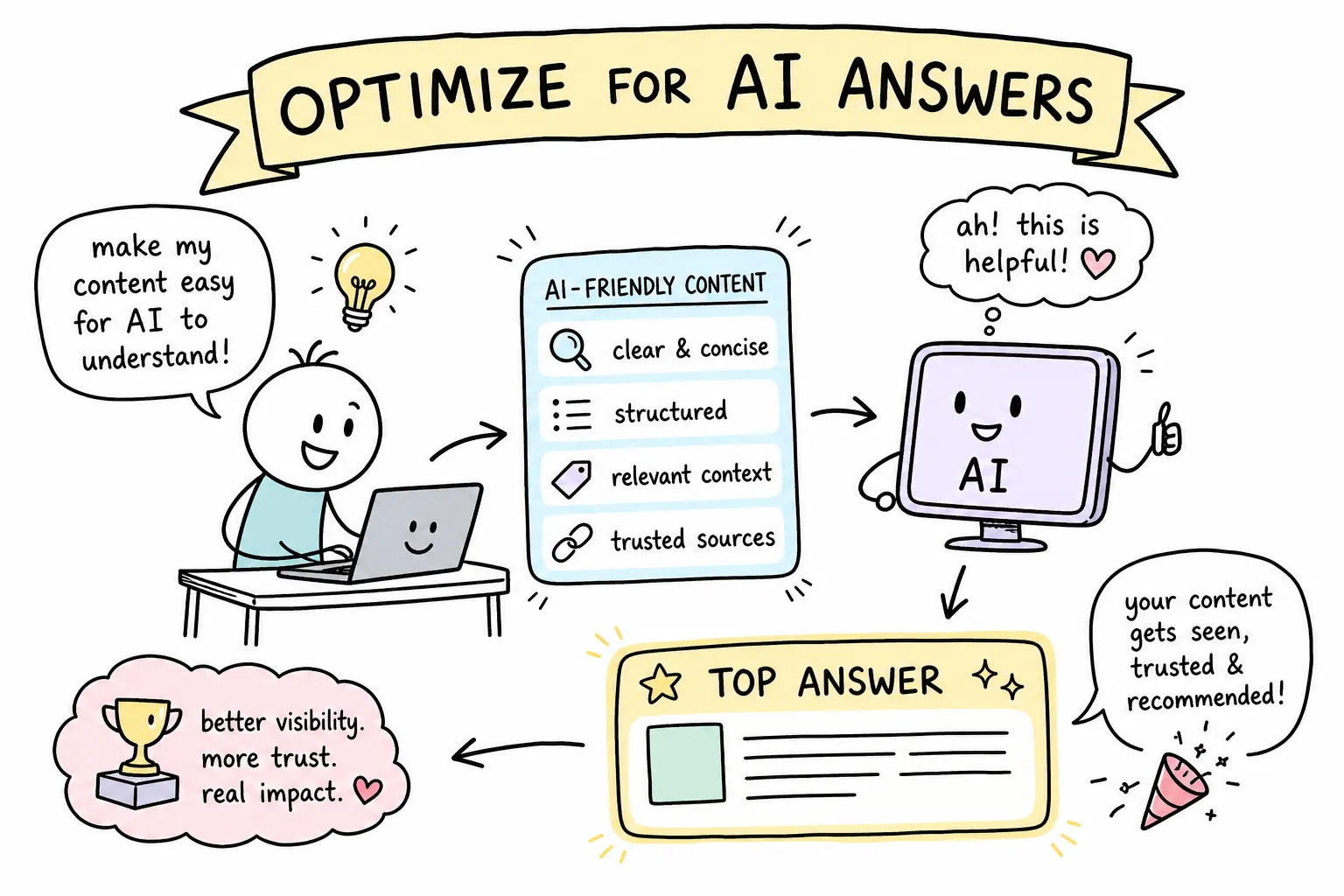
To optimize for AI answers, start with a single, direct response in your opening sentence, before any context, backstory, or preamble. AI answer engines like Google AI Overviews, ChatGPT Search, and Perplexity now handle a significant share of search queries without sending users anywhere. Estimates vary widely depending on query type and measurement method, ranging from 25% to 60% of Google results in 2026 across published studies. That’s a massive slice of search real estate where only the cited source wins. Every other page gets nothing.
The sites earning those citations aren’t always the biggest or most authoritative. The gap between getting referenced and getting skipped comes down to two things: whether AI systems trust the source, and whether the content is formatted so they can actually extract it. Those two factors operate as separate gates, and most sites are failing at least one of them.
The good news is that the fundamentals we’ve covered at AISEO Round Table for years, clean semantic structure, E-E-A-T signals, and well-formatted headings, are exactly what AI systems are built to parse. Getting cited is not a separate discipline from good SEO. It’s the next layer on top of it. This guide gives you the specific formatting techniques, schema tactics, authority checkpoints, and monitoring approach you need to start earning AI citations from content you already have.
Why AI engines pick some pages and skip others
The clearest mental model for how AI answer engines choose sources is a two-gate system. The first gate is authority: a page needs enough trust signals to enter the candidate pool at all. The second gate is structure: once a page is eligible, its formatting determines whether it gets extracted and cited or passed over for a cleaner source. Weak trust signals knock a page out before structure even matters. Strong authority with poor structure means the engine may still prefer a less authoritative competitor that’s easier to parse.
On the authority side, the signals AI systems evaluate look a lot like what Google’s quality raters assess under E-E-A-T: named authors with verifiable credentials, transparent sourcing, consistent domain reputation, and cross-site mentions from already-trusted sources in the niche. Quality backlinks and clear authorship act as threshold filters. AI systems are essentially asking whether a source is credible enough to put their name behind. If the answer is no, nothing else matters. For practical guidance on how expertise and attribution map to AI-era ranking, see our piece on AI-Generated Content vs. E-E-A-T.
Once a page clears the authority gate, structure decides who gets cited. AI systems favor content that is easy to parse: answer-first paragraphs, question-based headings, and self-contained passages that don’t require full-page context to make sense. Content buried in long introductions, passive constructions, or vague section titles gets passed over in favor of pages that surface the answer immediately. Patterns in how platforms cite sources help explain why ease-of-parsing often trumps raw authority in the extraction stage, see research on AI platform citation patterns for examples.
Before touching your formatting, run two quick checks on any page you’re planning to optimize. First: does this page have a visible author bio with credentials, cited sources, and clear signals of who produced the content? Second: does the domain have enough topical authority and backlinks that a credible AI system would reasonably cite it? If either answer is no, start there. Formatting changes layered on top of weak authority won’t move the needle.
How to optimize for AI answers with lead-answer copy
The single highest-impact change you can make to most existing pages is to answer the question in the first one or two sentences, before any context, backstory, or preamble. CXL found that 55% of AI Overview citations come from the first 30% of a page. That data alone should tell you where to focus your rewriting effort.
The answer-first paragraph technique
The format works like this: lead with one declarative sentence that directly answers the query, then follow with two to three supporting sentences that add necessary context. The entire paragraph should be self-contained. If someone lifted just that block, it would still make complete sense as a standalone answer.
Here’s what that looks like in practice. A buried answer reads: “Before we get into how answer-first writing works, it’s helpful to understand why traditional content structures often fail to surface key information in ways that AI systems can easily extract…” A lead answer reads: “Answer-first writing places the direct response to a question in the opening sentence, followed by two to three sentences of supporting detail. This format allows AI engines to extract a complete, citable answer without reading the full page.” One version makes the reader work. The other does the work for the AI engine.
Keep lead answers tight. A widely cited target for answer blocks most likely to be pulled verbatim is 40 to 60 words, with 75 words as a practical ceiling. Longer answers are more likely to be paraphrased or truncated rather than extracted cleanly, a small adjustment that pays off in AI answer snippets.
Phrasing that mirrors how people actually search
Conversational phrasing consistently outperforms formal or academic language for AI citation purposes. AI engines match query phrasing, so writing the way people ask questions is a structural advantage, not just a style preference. If someone searches “what is answer-first writing,” the page that opens with “Answer-first writing is…” has a structural edge over the page that opens with “The concept of answer-first content strategy refers to…”
How to optimize for AI answers with FAQPage schema and structured data
Beyond the lead paragraph, the rest of your page needs to be structured so AI systems can navigate and extract individual sections without reading the whole article. Three formats consistently outperform alternatives in AI citation research.
Use question-based headings that mirror real queries
When H2 and H3 headings are phrased as questions, AI engines can match them directly to user queries and treat the section beneath as a complete answer unit. Pull exact phrasing from Google Search Console, autocomplete suggestions, and People Also Ask results. A heading like “Benefits of answer-first writing” is descriptive but invisible to AI matching. A heading like “What is answer-first writing and why does it matter?” maps directly to how someone would type the question.
When bullets help and when they hurt your chances
Bullets perform well for “best,” “how-to,” and comparison queries where the answer genuinely breaks into three or more discrete items or steps. They’re easy for AI engines to extract into summaries. However, writing everything in bullet format signals low editorial quality and can actually reduce citation probability. Bullets belong on enumerable content. Explanation and argument belong in prose. If you’re bulleting content that would read better as two connected sentences, convert it back to a paragraph.
FAQ blocks as standalone citation magnets
An FAQ section at the bottom of a page gives AI engines a set of pre-packaged question-and-answer pairs to extract. Each FAQ item should be written as a complete, self-contained answer of two to four sentences. FAQ formats are among the most frequently cited structures in AI Overviews, and they do double duty: the same content that serves as readable FAQ entries can also power your FAQPage schema markup. Write each FAQ answer as if it needs to stand alone, for AI citation and answer engine optimization (AEO) purposes, it does. For a broader view of AEO strategies and why FAQ content performs, see this complete guide to answer engine optimization.
Add structured data to signal you’re a preferred source
Schema markup doesn’t guarantee a citation, but it removes friction for AI systems trying to understand what a page is, who wrote it, and what questions it answers. The right schema types make your content explicitly machine-readable in the format AI answer engines prefer.
FAQPage and HowTo schema for direct-answer queries
FAQPage schema is the most consistently recommended type for AI citation because its question-answer structure maps directly to how answer engines generate responses. The core properties you need are straightforward: @type: FAQPage, mainEntity, each Question‘s name, and each acceptedAnswer‘s text. HowTo schema performs similarly well for process-based queries, using @type: HowTo, the step list, and each HowToStep‘s text or name.
One rule applies to both: the markup must match what’s visible on the page. AI systems cross-check structured data against rendered content. Markup that doesn’t align with the visible text looks like manipulation, not a signal, and can backfire. If you need a hands-on walkthrough for implementing FAQPage markup, this guide on creating FAQPage schema markup is practical and step-by-step.
Article, Organization, and Person schema for trust signals
These schema types address the authority gate rather than the structure layer. Article schema communicates content type, publication date, and modification date. Organization and Person schema establish who is behind the page and link to verifiable entities. The key properties to include are author, publisher, sameAs, dateModified, and @id. These are the signals that tell AI systems the source is trustworthy enough to cite, not just well-formatted enough to extract.
Build the authority signals that earn AI citation eligibility
Schema and formatting carry a page far, but AI systems also evaluate domain-level and author-level trust before pulling from any source. The SEO fundamentals that have always mattered remain the foundation here.
E-E-A-T signals AI systems actually evaluate
Move past the abstract definition and get specific. Author bios with verifiable credentials, links to the author’s other published work, citations within the article, and named sources for any factual claims are the practical signals AI systems evaluate. Both Perplexity and Google AI Overviews explicitly favor sources with named authors, topical consistency, and cross-platform identity. AI systems evaluate these signals similarly to how Google’s quality raters do: they’re looking for evidence that a real, qualified person produced the content. This is what meaningful AI source attribution looks like from the engine’s perspective.
If your pages are missing author bios or attributing content to a generic site name, fix that before any formatting work. A well-structured page attributed to “Admin” is still missing a core eligibility signal.
Backlinks and cross-site mentions as citation credibility
Link quality and relevance matter more than raw volume for AI citation eligibility. Being mentioned or cited by already-trusted sources in your niche signals to AI systems that your source community has already vetted your content. The SEO work covered throughout AISEO Round Table, earning topical backlinks and building domain authority through consistent expertise, directly addresses these signals. That mapping is deliberate: what AI engines look for when vetting sources is exactly what strong SEO has always built. This investment compounds, improving traditional rankings and AI citation eligibility at the same time.
Track whether AI engines are actually citing you
Optimizing without measuring is guesswork. There are now practical ways to monitor whether AI answer engines are referencing your content, and that data should directly inform where you focus next.
Tools and methods for monitoring AI citations
Track branded and keyword mentions using tools like Google Alerts, Brand24, or Semrush’s brand monitoring features. For Google AI Overviews specifically, query your core topics directly in Google Search and review the source links displayed. Perplexity and ChatGPT Search both surface source links in their responses, making manual spot-checking feasible even without a dedicated tool. Run checks on your five to ten most important topics at least once a month. You can also review our curated list of best answer engine optimization tools to choose monitoring platforms and AEO-focused features.
What to adjust when your content isn’t getting cited
When a page isn’t earning citations, run through this diagnostic before rewriting anything. Is the lead answer buried? Does the page have FAQPage schema? Is there a visible author bio? Are the headings phrased as questions? Most pages need two or three targeted adjustments rather than full rewrites. Check the same queries monthly after making changes to see whether citations appear. This is an audit loop, not a one-time checklist. For broader data on which domains tend to be cited by overview systems, see the analysis of Google AI Overviews top-cited domains (2025).
Apply this to one page this week
The two-gate model holds across every AI answer engine covered here: authority gets you eligible, structure gets you cited. The five areas in this guide are not a separate discipline from SEO, they are SEO, applied to a new surface. The same practices that have always helped pages rank, including clear structure, demonstrated expertise, and well-sourced content, are exactly what AI engines optimize for when choosing which sources to reference.
Start with one existing page that already ranks for a target query. Rewrite the opening paragraph as a direct lead answer, add FAQPage schema, and make sure there’s a visible author bio with credentials. Once you see that working, apply the same approach to your next highest-traffic page. If you want a step-by-step walkthrough for the practical edits, follow our How to Optimize for Answer Engines (6 proven Step-by-Step Guide).
Optimizing for AI answers is an ongoing process, not a box to check once. Formats evolve, AI systems update their source-selection behavior, and what gets cited today may need adjustment next quarter. Stay in the habit of auditing, adjusting, and measuring, that cadence is what separates sites that keep earning citations from those that plateau after the first pass. Pick one page, make the changes, and check the same queries in 30 days.