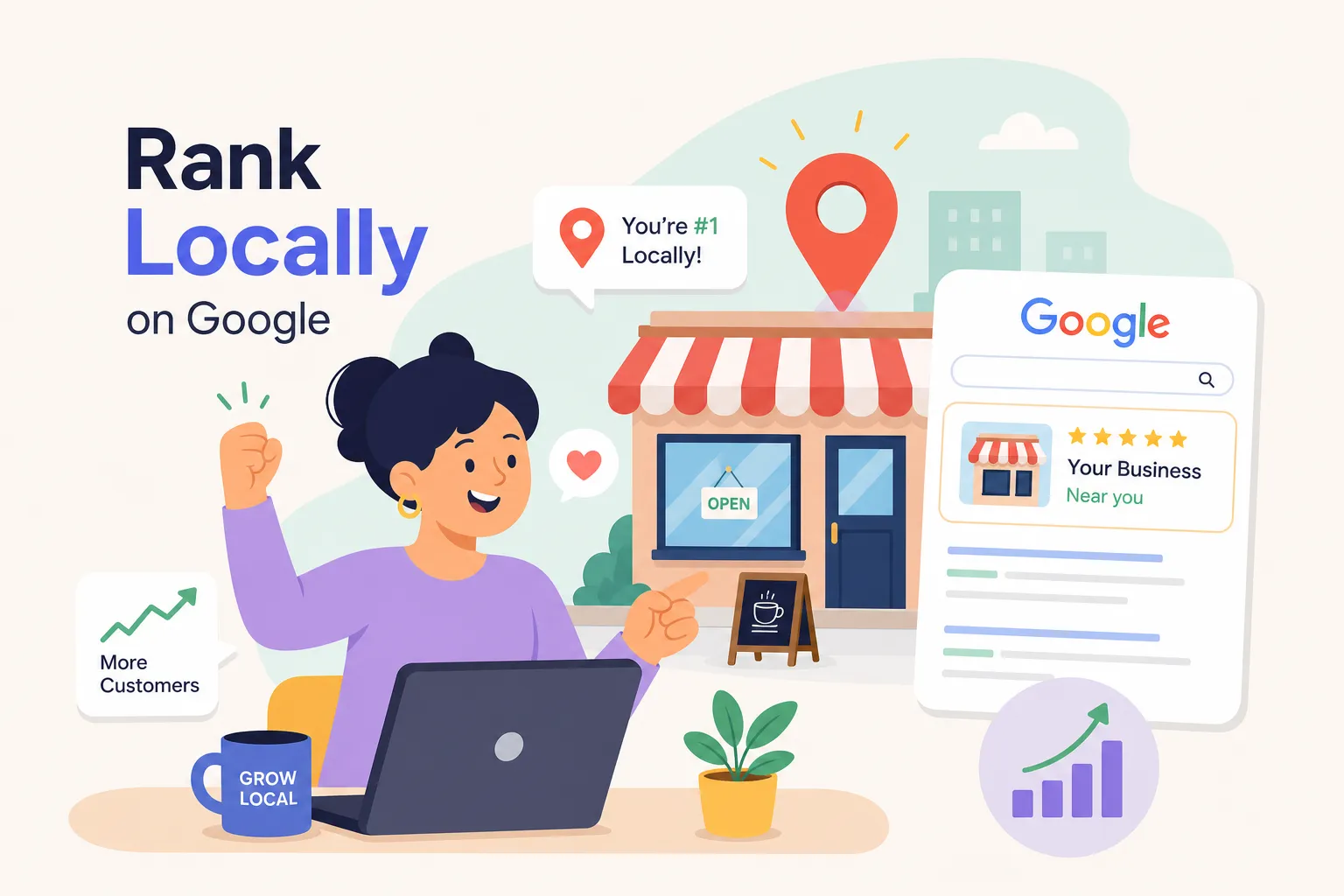
Picture this: a competitor down the street, with fewer reviews and a mediocre website, shows up in the local pack every time someone searches for your service. Meanwhile, your business is invisible. This is one of the most frustrating experiences a small business owner can have, and the cause is almost never the quality of the business itself. It’s the quality of the signals Google can read about it.
If you’ve ever asked what is the best way to rank locally on Google, the honest answer is: there’s no single magic tactic. There’s a prioritized order of operations. Most small business owners have heard of local SEO but struggle with where to begin. The internet is full of 50-point checklists with no sense of priority. At AISEO Round Table, we dig into exactly these workflows so bloggers, freelancers, and small business owners can act without needing an agency. This guide gives you that prioritized plan, from the first thing to fix to the monthly routine that keeps results building over time.
Understand how Google scores local results before you act
Before you touch a single setting, understand the framework Google uses to decide which businesses show up in the local pack. Google has stated clearly that local results are based on three factors: relevance, distance, and prominence. Relevance is how well your business profile matches what someone searched. Distance is how close your location is to the searcher. Prominence is how well-known and trusted your business appears across the web.
Distance is largely out of your hands. You can’t move your business to be closer to every potential customer. What you can control is relevance and prominence, and that’s where your energy belongs. A fully completed, category-accurate Google Business Profile directly improves relevance. Reviews, citations, and links build prominence. Both are levers you can pull starting today.
Why scoping the local SERP saves you wasted effort
Before committing time to any specific tactic, check what you’re actually competing against. The businesses already occupying the local pack for your target terms tell you a lot about the gap you need to close. If the top competitors have substantially more reviews, higher ratings, and highly complete profiles, you know review acquisition needs to be a priority. If their profiles are thin but they’re ranking, a polished GBP alone may get you into the pack quickly.
This kind of competitive intelligence also helps you understand “near me” search ranking dynamics. When someone types “plumber near me,” Google weighs distance heavily, but relevance and prominence still decide who wins the top three spots when multiple businesses are nearby. Tools such as Mangools SERPChecker, Whitespark, and BrightLocal let you see how strong the current local results are before you invest weeks in a strategy that may not be the highest priority. AISEO Round Table has covered SERPChecker as part of our ongoing Mangools series, and tools in this category give small business owners a practical way to assess local competition without an agency-level budget. Think of it as knowing your battlefield before you start.
What is the best way to rank locally on Google? Start with your Google Business Profile
Optimizing your Google Business Profile is widely regarded as the highest-leverage starting point for local SEO. GBP optimization directly affects both relevance and prominence simultaneously, which is why most practitioners treat it as the first priority. An incomplete or stale profile sends weak signals. A complete, accurate, and regularly updated profile tells Google exactly what you are, where you are, and why you deserve visibility.
Categories, services, and attributes: get the foundation right
Your primary category is the most important field in your entire profile. Choose the most specific category that accurately describes your core business offering, not a broad parent category. A plumber should select “Plumber,” not “Home Services.” Add secondary categories only when they genuinely reflect services you provide, and avoid padding the list with loosely related options.
List every real service you offer, using clear customer-facing language. If a customer would type it into a search bar, it belongs in your services list. Fill in applicable attributes like accessibility features, payment methods, and any business-specific identifiers that apply. For your business description, use four sentences: who you are, what you do, where you do it, and what sets you apart. Do not keyword-stuff the description. Google’s guidance is explicit that descriptions should be natural and readable, not optimized for specific phrases.
Photos, posts, and consistent activity signals
Authentic, high-quality photos of your actual business consistently outperform stock images. Google’s own GBP guidance recommends real photos because they better reflect what customers will experience. Upload exterior shots, interior shots, team photos, and work-in-progress images that show what your business actually looks like. Aim for four to six new photos per month. Consistency matters here because recent photo activity is treated as a freshness signal, and a profile with stale photos from three years ago looks less active than one that uploads regularly.
GBP posts work the same way. Use them for offers, events, seasonal updates, and new services. Many best-practice guides recommend at least one post per week to keep your profile visibly active. Check GBP Insights monthly to see which queries are driving impressions and which photos are getting the most views. Those two data points alone will tell you what’s resonating with searchers in your area.
Fix your NAP citations before building new ones
NAP stands for name, address, and phone number. When this information is inconsistent across the web, Google loses confidence in which version of your business is accurate. That uncertainty suppresses local rankings. Before you add new citations, audit and clean the ones that already exist.
Why inconsistent citations quietly hurt your local visibility
Google builds its understanding of your business by aggregating mentions from across the web. When one listing says “Suite 4,” another says “Ste 4,” and a third drops the suite number entirely, those look like three different addresses to an algorithm trying to confirm your location. Multiply that across 50 directories and the signal confusion compounds. Inconsistent NAP data dilutes local authority by preventing Google from confidently merging all those mentions into one trusted business entity.
A priority order for citation cleanup that actually works
Work in tiers rather than trying to fix everything at once. Start with your Google Business Profile, then move to high-traffic platforms like Yelp, Facebook, and Apple Maps. From there, focus on major industry directories and locally relevant listings before touching anything lower authority. Create one master NAP record with your exact approved business name, address, phone number, and website URL, then use that as the reference for every correction you make.
For most small businesses, fixing the top two tiers covers the majority of the ranking signal value. Claim listings before you correct them. You cannot update what you do not own. Then fix duplicates by merging or removing conflicting versions so your ranking signals consolidate under one listing instead of splitting across multiple.
Build a review acquisition process, not a one-time ask
Reviews feed directly into Google’s prominence signal. Quantity, rating, recency, and review text all feed the prominence signal differently. A business with 200 reviews from three years ago can and often does underperform a competitor with 60 recent reviews, a 4.8 rating, and steady new feedback coming in every week. The goal is not a burst of reviews followed by silence. It’s a consistent, repeatable system.
Making it easy for customers to leave a review
Create a direct GBP review link and put it everywhere a satisfied customer might see it: thank-you emails, digital receipts, post-service follow-up messages, and any automated communication that goes out after a job is complete. Build a standard ask process so every satisfied customer receives a timely, natural request, not a generic mass email three months later.
Encourage customers to mention the specific service they received in their review. Service-specific language in review text may add relevance signals that help in competitive local rankings. One firm boundary: never incentivize reviews. Offering discounts, gifts, or anything of value in exchange for a review violates Google’s guidelines and puts your entire profile at risk.
Responding to reviews and what review patterns tell Google
Google recommends responding to all reviews, positive and negative. Responses demonstrate active business management and customer care, both of which signal ongoing engagement. Keep responses natural and helpful rather than templated. Responding thoughtfully to a negative review, especially when other reviewers can see your reply, can do more for perceived trust than a string of unanswered five-star ratings.
Consistent review velocity across weeks and months signals ongoing relevance. A business that earns two or three reviews per week, every week, looks very different to Google than one that got 80 reviews in a single month two years ago. Build the habit into your operations, not just your marketing calendar.
Add on-page local signals and LocalBusiness schema
Your website and your GBP work as a team. The website reinforces the same location, service, and trust signals your profile sends. When both sources agree on the same NAP details, service descriptions, and business category, Google’s confidence in your business increases. When they conflict, that confidence drops. (See On Page SEO Best Practices, AISEO Round Table.)
What belongs on a local landing page
Your homepage and contact page should carry visible NAP details that match your GBP exactly, an embedded Google Map, business hours, and any service area or neighborhood references relevant to your customers. Locally relevant FAQs and testimonials strengthen the local content signal further. For multi-location businesses, each branch needs its own URL with unique local content. Swapping only the city name in otherwise identical copy does not qualify as unique content and won’t generate unique local relevance signals.
Implementing LocalBusiness schema without overcomplicating it
Use JSON-LD format placed in the of your page. Choose the most specific LocalBusiness subtype that applies to your business, such as Dentist, AutoRepair, or Restaurant, rather than the generic LocalBusiness type. Include only information that is visibly present on the page: name, address, phone number, hours, and URL at minimum. Make sure every field in the schema matches your GBP data exactly.
For single-location businesses, one LocalBusiness entity on your homepage, your contact page, or both is all you need. For multi-location sites, use Organization schema on the main homepage and a separate LocalBusiness entity on each branch location page. Before publishing, validate your markup with Google’s Rich Results Test. After publishing, monitor the structured data reports in Google Search Console to catch any errors that appear.
Track your local rankings and build a simple monthly routine
Local SEO progress is invisible without the right tracking. Standard rank-checking tools report organic positions, but local pack rankings vary by neighborhood, device, and search context. A business that ranks in the local pack for searchers near their store may not appear at all for someone ten blocks away. You need tracking that reflects this geographic variation.
Why local rank tracking is different from organic tracking
GBP Insights shows which queries triggered your profile, but it doesn’t show local pack position directly. Google Search Console covers organic results, not Maps. A dedicated local rank checker that can query at a zip code or neighborhood level fills that gap by showing your actual pack visibility for your primary target terms. Checking results over a four-to-eight week window after any significant change gives you enough data to evaluate whether a category adjustment, new content, or review push made a measurable difference.
A monthly local SEO check-in that takes under an hour
Run through this checklist once a month:
- Review GBP Insights for top queries and best-performing photos
- Check for new reviews and respond to all of them
- Upload four to six fresh photos
- Publish one GBP post with an offer, update, or service highlight
- Verify NAP accuracy on your GBP and top two citation platforms
- Run a quick local rank check on your three to five primary target terms
This isn’t a sprint. It’s a maintenance routine that builds on itself. Each month adds fresh signals to a profile that’s already well-optimized, and that compounding effect is what separates businesses that dominate the local pack from those that occasionally appear in it.
What is the best way to rank locally on Google? Here’s your action plan
Start with Google’s three-factor framework and scope your SERP competition. Then optimize your GBP completely, fix NAP citations from the top down, and build a review system that runs week after week. Layer in on-page local signals and LocalBusiness schema, then track progress with tools built for local results.
Now you know what is the best way to rank locally on Google, and it’s not doing one thing perfectly. It’s stacking these signals consistently over time. A polished GBP pulls in more map impressions; those impressions convert better when fresh reviews are visible; those reviews carry more weight when your citations confirm the same business data. The whole system compounds.
Pick one tactic from this guide and implement it this week. Then come back and stack the next. AISEO Round Table publishes ongoing tool reviews, local SEO walkthroughs, and updated strategy guides as Google’s local algorithm evolves. Bookmark us, and you’ll always have a practical, current resource to return to when the next change rolls out. See Top Local SEO Strategies for Small Businesses, AISEO Round Table and How to Get Found Online Without Spending on Ads, AISEO Round Table.