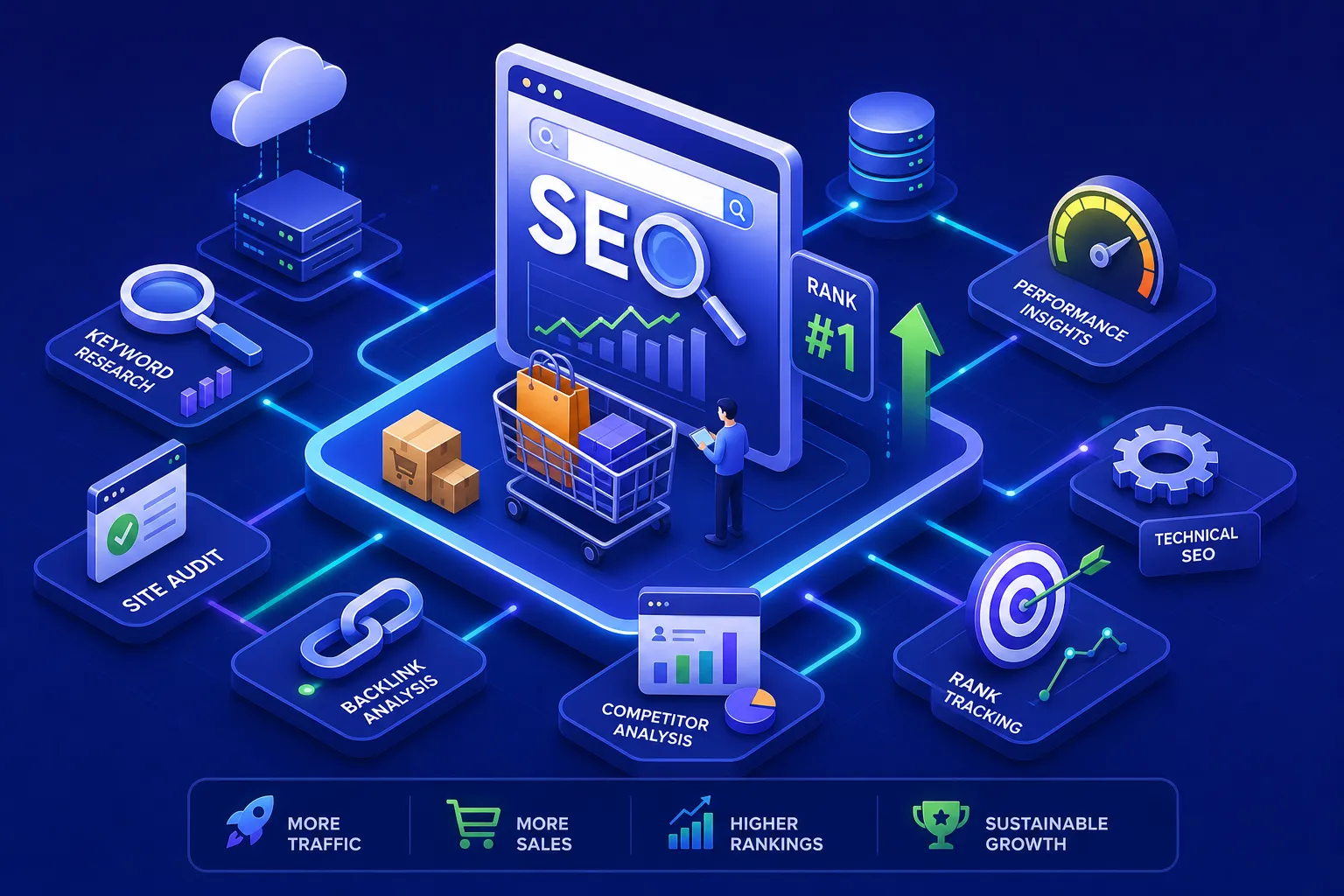
Many small store owners pour money into paid ads because organic rankings feel like a mystery. The actual problem, in most cases, isn’t the algorithm. It’s not having a clear picture of which tools to use, how to combine them, and what to fix first. Choosing the best tools for ecommerce SEO optimization starts with matching tool capability to your platform and catalog size, not with buying the most expensive subscription you can find. The right ecommerce SEO software stack doesn’t require an agency retainer or a $500/month budget.
This article breaks down the top ecommerce SEO tools by use case, platform compatibility across Shopify, WooCommerce, and BigCommerce, and realistic price ranges for stores at different growth stages. Whether you’re fixing crawl issues on a 5,000-SKU catalog or just trying to get your first product page to rank, you’ll walk away with a clear, actionable tool stack. Beginners who pair these tools with solid fundamentals tend to get results fastest. The free SEO guides at AISEO Round Table are built exactly for that kind of parallel learning.
What to look for in an ecommerce SEO tool before you commit
Features that actually matter for product pages
Generic SEO tools are built around blog posts and editorial content. Ecommerce stores need something different: bulk meta tag editing, structured data generation for product schema, internal linking support across large catalogs, and XML sitemap management that handles thousands of product URLs without breaking. Editing 300 product titles one by one is not a workflow. A template-based bulk editor that applies rules across your whole catalog is. Before evaluating any tool, confirm it handles these specific tasks rather than treating your store like a WordPress blog with a shopping cart bolted on.
Platform fit matters more than feature count
A tool with 50 features that doesn’t integrate cleanly with your platform creates more friction than a tool with 10 features that slots in perfectly. AIOSEO and Rank Math are built for the WooCommerce and WordPress ecosystem, with product-level schema controls that work directly inside the product editor. Booster SEO and Sherpas are Shopify-native apps designed to automate SEO tasks at the scale a Shopify store operates. BigCommerce users face a thinner landscape of dedicated plugins, which makes deliberate tool selection even more important. Generic tools that don’t understand your platform’s URL structure and navigation logic will miss platform-specific issues entirely.
Where free tools end and paid plans begin
A functional starter stack doesn’t require a large monthly investment. Rank Math and AIOSEO both offer free core versions for WooCommerce stores. Screaming Frog is free for up to 500 URLs. Google Search Console costs nothing and surfaces real search data. When you’re ready to add paid tools, Ahrefs starts at $29/month for early-stage research, KWFinder runs around $29/month as part of the Mangools suite, and Semrush has a limited free tier before its paid plans begin. A complete working stack can stay comfortably under $50/month for most stores under 1,000 SKUs.
Best tools for ecommerce SEO optimization: technical audits and crawling large catalogs
Screaming Frog for catalog-level crawl analysis
Screaming Frog remains a go-to desktop crawler for ecommerce stores that need a thorough technical audit without an enterprise price tag. The free version handles stores up to 500 URLs. The paid version, currently listed at around $259/year on Screaming Frog’s official site, though pricing can change, removes that cap entirely. A crawl surfaces broken links, duplicate meta descriptions across product variants, redirect chains, and missing structured data. These are the exact issues that quietly suppress rankings across large catalogs. For stores with thousands of SKUs, scheduled crawls catch regressions before they compound into bigger ranking problems. For a side-by-side look at desktop crawlers and cloud audits, see the Screaming Frog vs Semrush comparison.
Semrush Site Audit and Ahrefs Site Explorer for ongoing monitoring
Both tools run cloud-based site audits on a schedule, so you’re not relying on remembering to run a crawl manually. Semrush Site Audit categorizes issues by severity, errors, warnings, and notices, and tracks which issues you’ve resolved over time, making it easier to show progress and stay organized. Ahrefs Site Explorer combines technical data with backlink profiles, which is useful for understanding why certain product pages aren’t getting crawled or linked. The most actionable outputs for ecommerce are crawlability scores, indexation gaps, and internal linking reports that reveal pages receiving no inbound links from the rest of the store. For a broader roundup of recommended solutions, check this best SEO tools for ecommerce resource. Additionally, for guidance on making your keyword and linking strategy smarter, see SEO Intelligence: Unlocking Smarter Search Optimization, AISEO Round Table.
Fixing indexation problems that quietly tank product visibility
Faceted navigation, filter URLs like /shoes?color=blue&size=10, is one of the most common crawl budget killers in ecommerce. Each filter combination generates a separate URL with essentially the same content as the main category page, which means search engines spend crawl time on hundreds of low-value duplicate URLs instead of prioritizing your best product pages. The fix involves robots.txt rules to block certain parameter patterns, canonical tags pointing filtered URLs back to the main category page, and noindex directives on parameter-generated URLs that shouldn’t appear in search results. Ecommerce site audit tools like Screaming Frog and Semrush surface these problems directly. Resolving them can deliver faster ranking gains than publishing new content, particularly when a store has significant indexation bloat. For deeper technical guidance on handling filters and parameters, read this faceted navigation SEO guide.
Product page optimization and schema markup tools that actually work
Best tools for ecommerce SEO optimization, product page schema on WooCommerce
Both AIOSEO and Rank Math add ecommerce-specific schema markup automatically: product name, price, availability, and review ratings all get structured data without manual coding. Rank Math’s free version covers the core schema needs; the Pro tier adds WooCommerce breadcrumb schema, bulk editing across your product catalog, and custom schema templates for different product types. AIOSEO’s WooCommerce module handles product SEO settings directly from the product editor and uses smart tags to pull in live product data, like price and SKU, into meta descriptions automatically. Both plugins are well-documented, and most store owners can have structured data running within a session of following the setup guides.
Booster SEO and Sherpas for Shopify automation
Booster SEO’s AI AutoPilot scans your Shopify store and applies meta tag fixes automatically based on configurable rules, a practical solution for stores where manually editing hundreds of product pages isn’t viable. Check the Shopify App Store for current plan details, as Booster SEO’s pricing tiers are updated periodically. Sherpas takes automation further, rewriting image alt text, product titles, and meta descriptions at scale while adding JSON-LD structured data across thousands of products simultaneously. Both are Shopify App Store installs with tiered pricing based on store size, so a small store isn’t paying for enterprise-level infrastructure it doesn’t need. For Shopify merchants who want automation without technical setup, these two tools cover most of the on-page SEO work.
How schema markup generates rich snippets in search results
Structured data gives Google machine-readable details about your product: price, stock status, star ratings, and shipping information. When that data is present and valid, Google can display it directly in the search result, a price, a star rating, and an availability status that appear before the user even clicks. That’s a richer, more informative listing than a standard blue link, and it increases click-through rate without requiring any change in ranking position. For small stores competing against larger retailers, implementing product schema is widely considered one of the higher-ROI technical SEO tasks available, and setup is generally quick with a dedicated plugin handling the heavy lifting. For practical guidance on how rich snippets work with product listings, see this rich snippets for product listings write-up.
Keyword research and competitor analysis tools for online stores
Ahrefs for backlink depth and competitor product page gaps
Ahrefs is a strong tool for diagnosing why a competitor’s product pages outrank yours. The Content Gap feature shows keywords driving traffic to competitor stores that your site isn’t targeting, a direct shortlist of category and product page opportunities worth pursuing. The Lite plan at $129/month gives solo store owners full access to keyword data, backlink profiles, and site audits. The $29/month Starter plan covers limited research for stores still in early research mode. For competitive niches where understanding backlink profiles matters as much as on-page work, Ahrefs earns its place in the stack.
Semrush for all-in-one keyword tracking and store traffic estimates
Semrush bundles keyword research, position tracking, site audits, and competitor traffic estimates into a single subscription. For ecommerce specifically, the Keyword Magic Tool filters by search intent, commercial and transactional queries surface the product and category page targets worth prioritizing. The Organic Research report shows exactly which pages on a competitor’s store drive the most organic traffic, so you can reverse-engineer which content and product structures are performing before committing to building your own. That kind of competitive intelligence is hard to replicate with free tools alone. For more on building smarter competitive workflows, consult SEO Intelligence: Unlocking Smarter Search Optimization, AISEO Round Table.
Budget-friendly alternatives when $100+/month isn’t realistic yet
Not every store needs Ahrefs and Semrush running simultaneously. Google Search Console is free and already surfaces the actual search queries your store ranks for, the most important keyword data you have. KWFinder, part of the Mangools suite at around $29/month, delivers solid keyword difficulty scores and search volume data for niche product research without the steeper learning curve of enterprise tools. Pairing Search Console with a lightweight tool like KWFinder covers most keyword research needs for a store under 1,000 SKUs. The combination keeps costs well under $50/month while leaving room to add more tools as the business grows.
How to build a lean ecommerce SEO tool stack without blowing your budget
The starter stack for Shopify and WooCommerce beginners
For a Shopify store just starting out, a practical low-cost stack includes Booster SEO’s entry-level plan for automated meta tags, Google Search Console for keyword data, and Screaming Frog’s free version for crawl audits. For WooCommerce, the equivalent is Rank Math’s free plugin for schema and on-page SEO, Google Search Console, and Screaming Frog. These combinations handle the most impactful ecommerce SEO tasks without a significant monthly subscription. Many small stores generate meaningful organic traction from this lean foundation before ever paying for a tool. When evaluating the best tools for ecommerce SEO optimization at this stage, start with what solves your most pressing technical gaps rather than chasing full-featured platforms you haven’t outgrown your free options to need yet.
When to upgrade your tools as your store scales
The right time to add a paid tool is when a free tool creates a specific, recurring bottleneck, not because a feature list looks impressive. When your catalog exceeds 500 URLs, upgrade Screaming Frog to the paid version. When you need to understand why competitors rank above you and your current tools can’t answer that question, add Ahrefs Starter or KWFinder. When tracking rankings across multiple category pages becomes part of your regular workflow, Semrush Pro fills that gap cleanly. Upgrade based on a specific need you’ve already hit, not anxiety about missing features you haven’t needed yet.
Pairing tools with free education so you don’t need an agency
The tools handle execution; strategy is what makes the execution count. Store owners who understand how to read crawl data, interpret keyword difficulty scores, and structure product pages for search intent get far more from their tool spend than those who run audits without knowing what to do next. The free beginner SEO guides at How to Run a Technical SEO Audit: A Step-by-Step Guide, AISEO Round Table are built specifically for non-technical store owners and content creators who want to close that knowledge gap without hiring a consultant. Combine the right tools with solid fundamentals, and most small stores can compete organically without paying agency rates.
The practical path forward for your store
The best SEO software for an online store isn’t the most expensive option or the one with the longest feature list. It’s the one that matches your platform, fits your budget, and targets the specific problems holding your store back right now. Start with technical health: crawling, indexation, and faceted navigation cleanup. Move to product page optimization and schema markup. Then layer in keyword research and competitor analysis once the foundation is clean and stable. Implementing the best tools for ecommerce SEO optimization in this sequence gives you the clearest, fastest path from audit to ranking improvement. For a simple starting checklist you can follow this week, see the Technical SEO Checklist for Beginners, AISEO Round Table and prioritize the items that match your platform and catalog size. Also consider site performance as part of technical health, this site speed and Core Web Vitals guide is useful when you start performance tuning.
Small stores that commit to the right free or low-cost stack often start seeing organic traction sooner than they expect, though timelines vary based on niche competition, catalog size, and how quickly technical issues get resolved. Pick one section of this article, implement it this week, and build from there. The free beginner SEO resources at AISEO Round Table are designed for exactly this kind of step-by-step, no-agency implementation process, covering everything from reading your first crawl report to structuring category pages for transactional intent.
Your first Google ranking won’t come from ad spend. It’ll come from fixing what’s already broken.