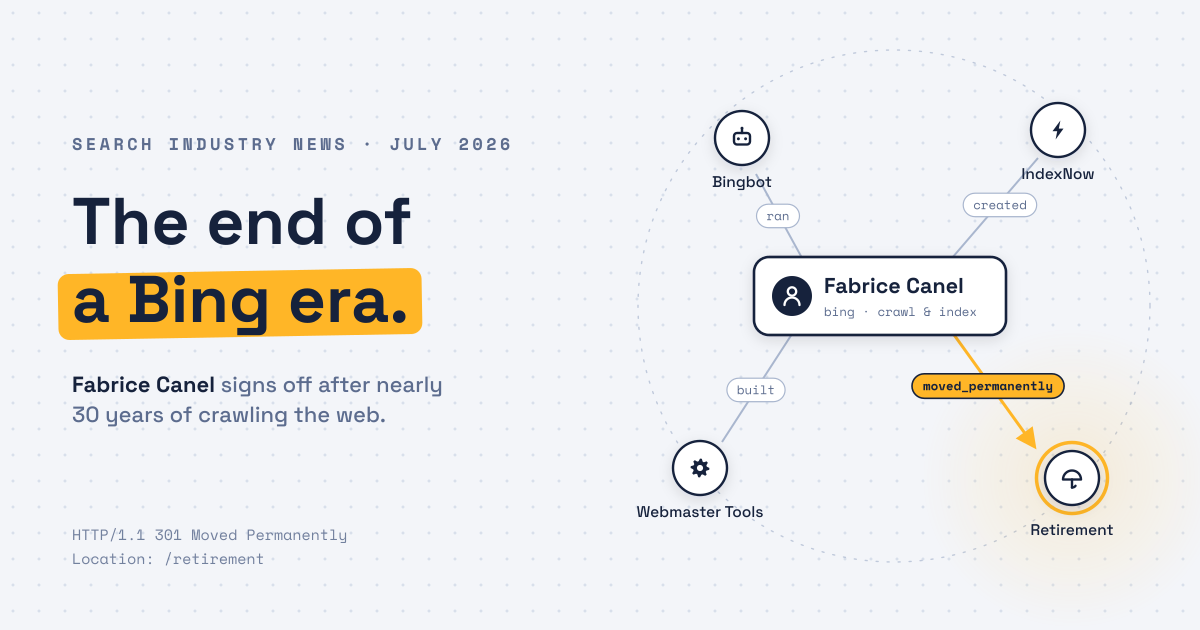
Every industry has a handful of people who quietly shape how everything works behind the scenes. In the world of search, Fabrice Canel was one of those people. On July 1, 2026, the Principal Product Manager who led Bing’s crawling and indexing team announced his retirement from Microsoft, closing a chapter that lasted nearly three decades.
For most internet users, the name may not ring a bell. But if you have ever submitted a sitemap, pinged a search engine about a new page, or checked your site’s performance in Bing Webmaster Tools, you have benefited from his work. His retirement is more than a personnel change. It marks the end of an era in which one of the most approachable figures in search technology served as the bridge between a major search engine and the millions of publishers trying to be found on it.
In this article, we will look at who Fabrice Canel is, what he built, why his departure matters, and what SEO professionals and site owners should do now that one of Bing’s most familiar voices has stepped away.
Who Is Fabrice Canel?
Fabrice Canel spent almost 30 years at Microsoft, an extraordinary run in an industry where careers at a single company rarely last a decade. Before Bing even existed as a brand, he was already working on search across Microsoft’s websites, covering everything from search engine technology to user experience in the earliest days of SEO.
In 2006, he joined the MSN Search Beta project, the effort that would eventually evolve into Bing. From that point on, he became the person responsible for one of the most fundamental jobs in all of search: deciding what gets crawled, discovered, selected, and processed into the Bing index. That covered the full pipeline, from URL discovery to content processing, across hundreds of billions of new and updated pages every day.
Beyond the engineering side, Canel became one of the most visible public faces of Bing. He spoke at major industry conferences such as SMX and Pubcon, wrote extensively about how search works, and consistently explained how publishers could perform better in Bing. In recent years, he also focused on how search is adapting to generative AI, including guidance on how duplicate content affects AI search visibility.
The Announcement: A Farewell Worthy of the Shire
Canel shared the news on LinkedIn and X with a farewell letter that instantly became a talking point in the SEO community. Rather than a dry corporate goodbye, he wrote a heartfelt message inspired by Bilbo Baggins’ famous send off in The Lord of the Rings, addressing engineers, marketers, webmasters, SEO champions, journalists, and even his friends at Google.
In the post he confirmed the decision plainly: “I am retiring from Microsoft, effective today July 1st.”
He explained that he chose to take advantage of Microsoft’s Voluntary Retirement Program after long conversations with family and friends. He also made a point of celebrating the people he trained and mentored over the past two years, expressing full confidence that his team is ready to carry the mission forward.
The tone of the message said a lot about the man. It was warm, playful, generous, and focused on others. That is exactly how most of the SEO industry will remember him. The reaction across the community was immediate, with tributes pouring in from search journalists, SEO veterans, and former colleagues. Our own weekly roundup covered the industry’s reaction in SEO This Week: an industry says goodbye to a legend.
What Fabrice Canel Actually Built at Bing
It is easy to describe someone as a legend. It is more useful to explain why. Canel’s fingerprints are on several systems and initiatives that publishers rely on every single day.
Crawling and Indexing at Massive Scale
Canel owned the end to end process that determined what content Bing could show its users. Crawling, URL discovery, content selection, and content processing all sat under his responsibility. This is the invisible plumbing of search. When it works, nobody notices. When it fails, entire businesses lose visibility overnight.
His team’s decisions influenced not just Bing.com but also the many partner products and experiences powered by the Bing index. In an era where AI assistants and chat experiences increasingly rely on search indexes for fresh information, the quality of that foundation matters more than ever.
IndexNow: Changing How Search Engines Discover Content
Perhaps his most lasting contribution is IndexNow, the open protocol that Microsoft Bing announced together with Yandex in 2021. The idea was simple but powerful. Instead of waiting for search engine crawlers to discover new or updated pages on their own, websites could proactively notify participating search engines the moment content changed.
This flipped the traditional model of discovery. Crawling is expensive, slow, and wasteful when bots repeatedly visit pages that have not changed. IndexNow made discovery faster and more efficient for both sides. Canel championed the protocol tirelessly, encouraging CMS platforms, CDNs, and SEO tools to adopt it. Today, IndexNow support is built into major platforms and plugins used by millions of websites.
In a search landscape that is shifting toward AI generated answers, the thinking behind IndexNow matters even more. Fresh, quickly discovered content is a prerequisite for showing up in AI experiences. If you want a deeper look at that shift, our guide on how to optimize for AI answers breaks it down step by step.
Bing Webmaster Tools and Open Communication
Canel was also instrumental in creating and improving Bing Webmaster Tools, the platform site owners use to monitor how Bing crawls and indexes their sites. Just as importantly, he treated communication with webmasters as a core part of the job, not an afterthought.
He answered questions at conferences, engaged with SEOs on social media, and published practical guidance on the Bing blog. Google has its own well known channels for business owners, such as its official Google Business Profile support documentation, but on the Bing side, Canel himself often was the channel. That level of personal accessibility from someone running core infrastructure at a major search engine is rare, and it earned him deep goodwill across the industry.
Why His Retirement Matters to the SEO Community
On a purely technical level, nothing changes overnight. Bing will keep crawling. IndexNow keeps running. Bing Webmaster Tools remains available. Canel himself noted that he spent the past two years training and mentoring the team that will continue the work.
The real impact is about communication and trust. For years, Canel was one of the most reliable human interfaces between Bing’s machinery and the people trying to understand it. When SEOs had questions about crawling behavior, indexing issues, or new initiatives, there was a familiar, friendly face to ask. His departure removes one of the most visible points of contact between Bing and the publisher community.
This matters at a particularly sensitive moment. Search is being reshaped by AI answers, citations, and conversational experiences. Publishers already feel uncertain about how visibility works in this new world, a tension we explored in our analysis of the recent AI Overviews click study. Losing a trusted explainer during a period of rapid change makes clear guidance harder to come by.
Who Takes Over at Bing Now?
As of this writing, Microsoft has not formally announced a successor to lead the crawling and indexing team or to take over webmaster communications. Canel’s farewell post did not name one either.
Industry observers expect that Krishna Madhavan, a colleague of Canel’s at Microsoft, may become the primary source of Bing updates for the SEO community going forward. Canel also emphasized that he deliberately prepared his team for this transition over the past two years, which suggests the underlying work is in steady hands even if the public communication style evolves.
The open question is not whether Bing will keep functioning. It will. The question is who will fill the role of accessible, trusted voice that Canel played so well, especially as AI reshapes what search even means.
What This Means for Your SEO Strategy Going Forward
A leadership change at Bing is a useful prompt to audit your own visibility strategy. Here are three practical takeaways.
Keep Your Technical Foundation Strong
Canel’s entire career was a reminder that discovery comes before ranking. If search engines cannot crawl and index your content efficiently, nothing else you do matters. Make sure your sitemaps are clean, your crawl budget is not wasted on junk URLs, and your important pages return healthy status codes. Implement IndexNow if your platform supports it, since faster discovery means fresher representation in both classic search and AI experiences. Our technical SEO checklist walks through the exact items to verify.
Prepare for AI Search, Not Just Blue Links
Canel spent his final years at Microsoft writing about how search is adapting to generative AI, and that is no coincidence. Visibility increasingly means being cited in AI generated answers, not just ranking in a list of links. That requires clear entity signals, structured data, and content written to answer real questions. If those concepts are new to you, start with our beginner friendly guides to entity SEO and generative engine optimization, then compare approaches in our AEO vs GEO strategy playbook.
Do Not Depend on Personalities
One quiet lesson from this news: your visibility strategy should never rest on a single spokesperson, a single conference talk, or a single blog post from a search engine representative. People retire. Communication channels change. What endures is a resilient operational system, meaning regular monitoring, fast fixes for crawl and index issues, consistent content freshness, and accurate business information maintained everywhere your brand appears, from your website to your Google Business Profile. Build the system, and personnel changes at any search engine become news rather than a crisis.
Lessons From a 30 Year Career in Search
Beyond the tactical takeaways, Canel’s career offers a few timeless lessons for anyone working in SEO or digital marketing.
First, solve real problems. IndexNow was not a marketing gimmick. It addressed a genuine inefficiency in how the web and search engines interact, which is why it achieved broad adoption.
Second, educate generously. Canel gave away knowledge for decades through articles, talks, and one on one conversations. That generosity built trust that no advertising budget could buy.
Third, prepare your succession. He spent two full years training the people who would replace him. In an industry obsessed with the next quarter, that kind of long term thinking stands out.
Finally, keep your sense of humor. A retirement letter written in the voice of Bilbo Baggins, complete with references to mithril and eagles, reminded everyone that even the most technical work in search is ultimately done by humans, for humans.
Conclusion
Fabrice Canel’s retirement from Microsoft on July 1, 2026 truly closes a Bing era. For nearly 30 years he shaped how one of the world’s major search engines discovered, selected, and processed the web, and he did it while remaining one of the most approachable, generous educators in the industry. IndexNow, Bing Webmaster Tools, and a generation of SEOs who understand crawling and indexing better because of his talks and writing are his legacy.
For site owners, the practical message is simple. The fundamentals Canel championed still apply, and they matter even more in the age of AI search. Keep your site technically healthy, make your content easy to discover quickly, structure it so machines and humans both understand it, and never build your strategy around any single person or channel. Do that, and your content will remain, in Canel’s own Tolkien inspired spirit, swift to be found and sure to endure.
For more breaking coverage of the search industry, follow our News section here at AISEO Round Table.