
For nearly a decade, SEO advice has followed one simple mantra: mobile first, always. Google switched to mobile first indexing, traffic charts tilted toward smartphones, and most teams quietly treated desktop as an afterthought.
That assumption just cracked.
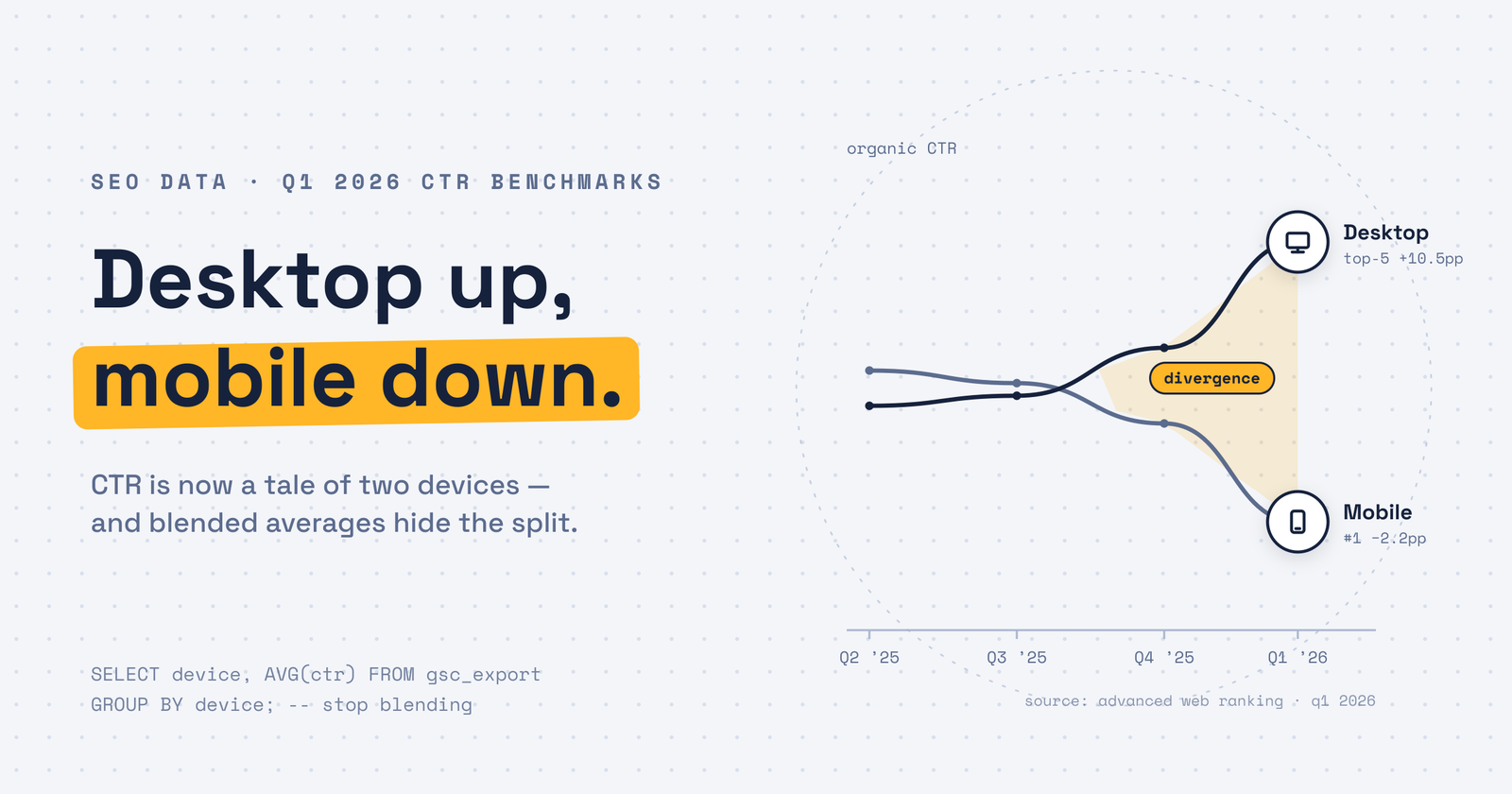
New benchmark data shows that desktop and mobile clickthrough rates are no longer moving together. They are splitting apart. Clicks are growing on desktop while declining on mobile, and the gap is wide enough that treating both devices as one audience is now a genuine measurement mistake.
This article breaks down what the data shows, why the divergence is happening, and exactly how to adjust your SEO strategy so your traffic reports reflect reality instead of averages.
What the New Benchmark Data Actually Shows
The clearest evidence comes from Advanced Web Ranking’s Q1 2026 CTR benchmarks, which were also covered by Search Engine Journal. The report tracks organic clickthrough rates across Google positions, industries, and query types, and the quarter over quarter movement tells a striking story.
Desktop CTR Is Climbing Across Positions
On desktop, clickthrough rates rose across the top of the results page. Taken together, the first five desktop positions gained more than ten percentage points of CTR compared with the previous quarter. The improvement was not limited to one niche either. The upward trend appeared across more than twenty industries, every major search intent type, and keywords of all lengths, from single word queries to longtail phrases.
Some verticals saw especially large jumps. Family and parenting queries recorded the biggest single position gain, with first place desktop results picking up roughly seven percentage points of additional CTR on average. Real estate, technology, personal finance, and automotive also posted meaningful desktop gains.
What makes this remarkable is the context. For the past two years, the dominant narrative in search has been shrinking organic clicks as AI Overviews expanded. Desktop moving in the opposite direction runs against everything the industry expected.
Mobile CTR Is Slipping at the Top
Mobile tells the opposite story. The most significant movement happened exactly where it hurts most: position one. First place mobile results lost around 2.2 percentage points of CTR during the same quarter.
That may sound small next to the desktop gains, but position one has always carried the largest share of clicks. When the top spot bleeds clicks on the device that drives more than half of global web traffic, the aggregate impact on real websites is substantial.
Google itself acknowledges that performance naturally varies by surface and device, which is why its own documentation encourages businesses to review performance metrics in their profiles and reports rather than assume uniform behavior across platforms.
Why Desktop and Mobile Are Diverging
The split is not random noise. It is the predictable outcome of three forces colliding: SERP design, screen size, and changing user habits.
AI Overviews Dominate the Mobile Viewport
On a phone, an AI Overview can consume the entire first screen. The user asks a question, reads the generated answer, and never scrolls to the organic results sitting below the fold. Even a perfect position one ranking can become invisible in practice.
On desktop, the situation is different. A wide screen leaves room for organic listings to remain visible beside or immediately below AI generated content. Users can scan the AI answer and the traditional results at the same time, and many still click through to verify, compare, or go deeper.
Interestingly, research covered in this AI Overviews study on lost clicks found that the clicks disappearing to AI answers were not low quality traffic after all, which makes protecting the clicks you still receive even more important.
Different Screens, Different Search Behavior
User intent also differs by device. Mobile searches skew toward quick answers, local lookups, and momentary curiosity. Those are exactly the queries AI Overviews and featured snippets satisfy without a click.
Desktop searches skew toward work, research, comparison, and purchase decisions. Someone comparing project management software or researching a mortgage on a laptop wants to open tabs, read full pages, and evaluate options. Those sessions produce clicks, and they produce valuable ones. Industry benchmarks consistently show desktop converting at roughly double the rate of mobile, with desktop conversion averaging around 3.5 to 4 percent against roughly 1.8 to 2.5 percent on mobile.
Mobile Is Becoming a Top of Funnel Surface
Mobile still commands the majority of global traffic, with smartphones accounting for just over 52 percent of website visits in early 2026 according to Statista figures. Nobody should abandon mobile.
What has changed is mobile’s job description. It is shifting from a click and convert channel toward a discovery and impression channel. People encounter brands, read AI summaries that cite sources, and form first impressions on their phones. Then they complete the serious research or purchase on desktop. Traffic share and click value are drifting apart by device, and strategy has to follow.
Why Blended CTR Reporting Is Now a Trap
Here is the uncomfortable part for anyone running SEO reports: a blended CTR line can look completely flat while the underlying story is dramatic.
Imagine your site gains clicks on desktop and loses a similar number on mobile in the same month. Your combined CTR barely moves. Leadership sees a calm chart. Meanwhile, you are quietly losing visibility on the device where most of your audience first discovers you, and gaining share on the device that actually converts. Both trends deserve action, and the blended number hides both.
In previous years, the gap between desktop and mobile CTR was narrow enough that one could stand in for the other. That era is over. Single device benchmarks and blended estimates now systematically overstate mobile performance and understate desktop performance.
What This Means for Your SEO Strategy
The divergence is best treated as a measurement and prioritization problem rather than a crisis. Here is a practical response plan.
Segment Everything by Device
Open Google Search Console and split every meaningful report by device. Compare desktop and mobile CTR at the same positions for the same queries. Identify pages where the gap is widest, because those pages reveal where AI Overviews or SERP features are absorbing your mobile clicks. Pair this analysis with solid keyword research so you understand which queries trigger AI answers on mobile and which still deliver clean organic clicks.
Set Different Goals for Desktop and Mobile
Stop grading both devices on the same scorecard. On mobile, prioritize SERP visibility, brand impressions, and presence inside AI generated answers. Being the cited source in an AI Overview is the new mobile position one. Guides on how to optimize for AI answers and how to build an AEO vs GEO strategy cover this in depth.
On desktop, prioritize high intent clicks and conversion. Sharpen your title tags and meta descriptions for comparison and decision stage queries, because desktop users are actively clicking again and rewarding compelling snippets.
Rethink Content and SERP Feature Priorities
Content parity does not mean identical experiences. Mobile pages should deliver fast, direct answers with clear brand signals, since impressions may be all you get. Desktop pages can support deeper comparison tables, detailed research, and stronger conversion paths. Strengthening entity SEO also helps both Google and AI systems recognize and cite your brand, which protects mobile visibility even when clicks decline.
Technical fundamentals still matter on both devices, so keep your crawlability, speed, and structured data in shape using a reliable technical SEO checklist.
Update Your Reporting Dashboards
Replace the single blended CTR line with device level CTR, SERP feature ownership, and visibility metrics. Report mobile impressions and AI citation presence alongside desktop clicks and conversions. When performance reads like reality, budget decisions improve automatically. This is especially important after major algorithm shifts, and if you are still stabilizing after recent volatility, this guide on how to recover from a Google core update pairs well with device level analysis.
Common Myths About the Device Split
Myth one: mobile is dead. Not even close. Mobile still delivers the majority of traffic and remains the primary discovery surface for most audiences. Its role has changed, not its importance. Underinvesting in mobile means going invisible exactly where first impressions form.
Myth two: ranking number one solves everything. On mobile, position one can now mean zero clicks if an AI Overview fully answers the query above your listing. On desktop, position three on a high intent query can outperform its historical value because users are clicking and comparing more actively.
Myth three: this is a Google algorithm change. The benchmark data reflects observed user behavior in a tracked dataset, not a confirmed switch inside Google. Neither Advanced Web Ranking nor other analysts have assigned a single definitive cause. The practical takeaway remains the same either way: measure by device or fly blind.
Conclusion
The desktop and mobile CTR divergence of 2026 is one of the most consequential shifts in search behavior since AI Overviews launched. Desktop clicks are rising across positions and industries while mobile clicks erode at the very top of the results page. The forces behind the split, from AI dominated mobile viewports to device specific user intent, are structural rather than temporary.
The winning response is not panic and it is not a pivot away from mobile. It is precision. Segment your data by device, assign each device a role that matches how people actually use it, chase AI visibility on mobile, chase high intent clicks on desktop, and retire blended CTR from your dashboards. Teams that measure the split accurately will make better decisions than teams optimizing to an average that no longer describes anyone.