
One AI, Two Completely Different Search Engines
Most marketers treat ChatGPT as a single system. You track your brand mentions, monitor your citations, and assume the answers people see are roughly the same for everyone asking the same question. A new study from Semrush, conducted in partnership with growth strategist Kevin Indig, just proved that assumption wrong in a big way.
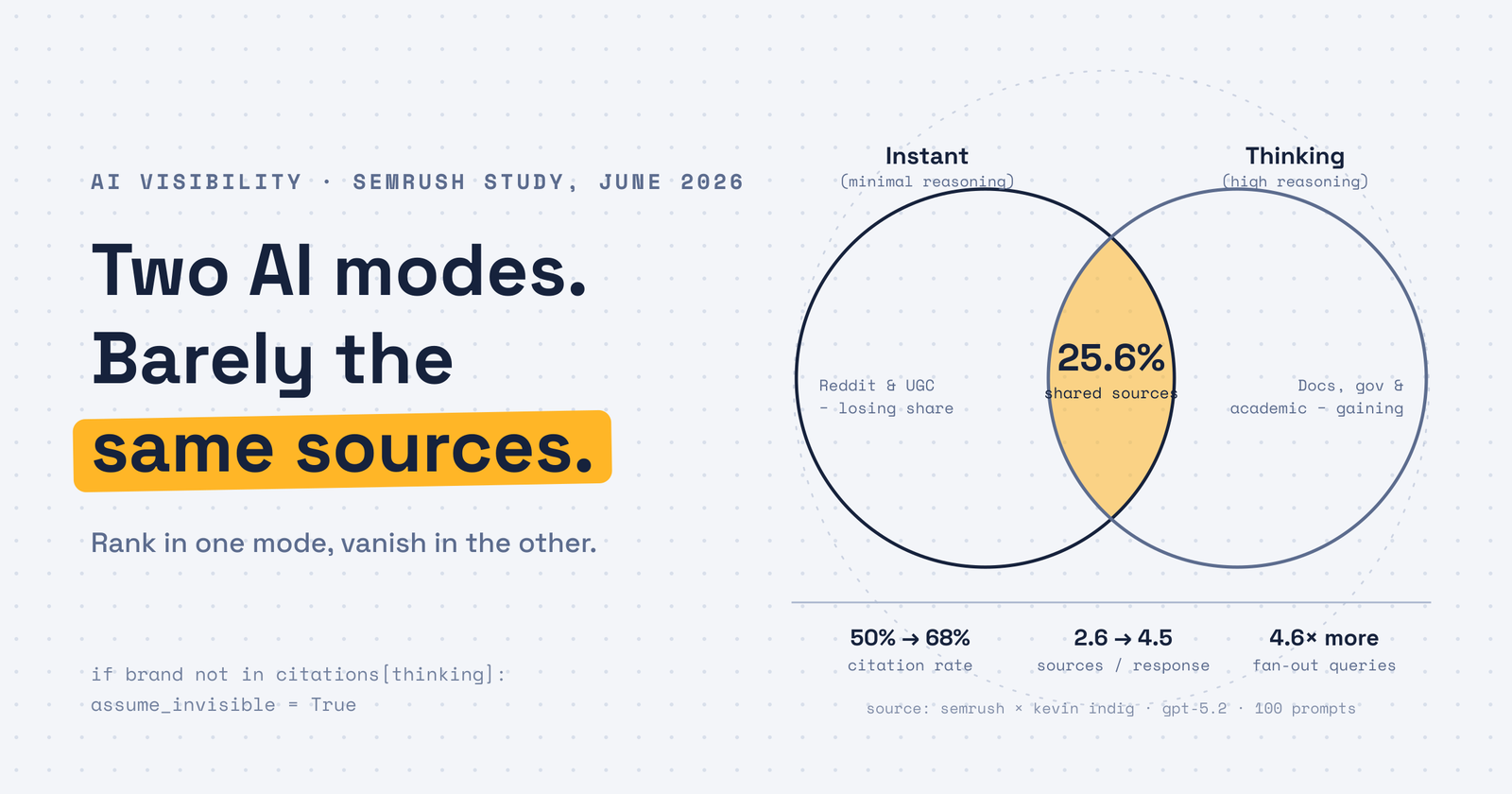
The research found that when ChatGPT switches from minimal reasoning to high reasoning, only 25.6 percent of cited domains stay the same. In plain terms, nearly three out of four sources change entirely based on how hard the AI thinks before answering. Your brand might dominate Instant mode answers and vanish completely the moment a user taps Thinking mode on the exact same prompt.
This is one of the most practically important findings in AI search research to date, and it has direct consequences for anyone working on AI answer optimization. Let us break down what the study measured, what it found, and what you should do about it.
What the Semrush and Kevin Indig Study Actually Measured
The methodology behind this research was straightforward and rigorous. Semrush partnered with Kevin Indig, the growth advisor behind The Growth Memo who previously led SEO and growth at Shopify, G2, and Atlassian. Together they analyzed data from the Semrush AI Visibility Toolkit.
Here is how the test worked:
- 100 prompts were selected across 20 buyer journeys
- Prompts covered four verticals: B2B SaaS, finance, consumer tech, and health and lifestyle
- Each prompt ran twice through GPT 5.2, once with minimal reasoning and once with high reasoning, producing 200 total responses
- The analysis tracked citation rates, cited domains, and the fan out queries ChatGPT generated behind the scenes
In the ChatGPT interface, minimal reasoning corresponds to Instant mode, the fast default experience most people use. High reasoning corresponds to Thinking mode, where the model deliberates longer, searches more, and verifies before it answers. The full report is available on the Semrush blog, and Search Engine Land covered the findings as well.
The Headline Finding: Only 25.6% Source Overlap
The single most important number in the study is 25.6 percent. That is the share of cited domains that appeared in both reasoning modes for the same prompts. Everything else changed.
Think about what that means for a moment. If your brand earned a citation in a standard ChatGPT answer, there is no guarantee whatsoever that you appear when the user activates Thinking mode on the identical question. The Semrush team described high reasoning ChatGPT as essentially a different search engine, and the data backs that description up.
Kevin Indig coined a term for this gap: reasoning lift. It describes how brand visibility rises or falls depending on the reasoning level applied to a query. Just as SEOs once learned to think about mobile and desktop as separate surfaces, AI visibility now demands thinking about reasoning modes as separate surfaces too. This matters enormously for anyone building a generative engine optimization strategy, because a plan built on one mode alone measures only a fraction of reality.
Why Reasoning Level Changes Which Sites Get Cited
Why would the same model cite different sources just because it thinks longer? The answer lies in how reasoning modes gather information.
In minimal reasoning, ChatGPT works quickly. It runs a handful of searches, grabs the most accessible sources, and assembles an answer. Speed is the priority, so familiar, high visibility sources like forums and review aggregators do well.
In high reasoning, the model decomposes the question into many sub queries, sometimes dozens for a single prompt. It cross checks claims, seeks authoritative confirmation, and leans toward sources that can survive verification. That process naturally favors official documentation, academic material, and government pages over casual user opinions.
The result is two distinct citation ecosystems living inside one product. Understanding this split is now as fundamental as understanding how AI systems interpret entities in the first place.
The Numbers That Should Change Your Strategy
Citation Rates Jump From 50% to 68%
In minimal reasoning, only half of responses included citations at all. In high reasoning, that figure climbed to 68 percent. Thinking mode does not just cite different sources. It cites sources more often, which means more opportunities to appear, but also more competition for each slot.
Sources Per Answer Nearly Double
Cited answers in minimal reasoning averaged 2.6 sources. In high reasoning, that rose to 4.5 sources per response. More citation slots per answer sounds like good news, but remember that those slots are being filled from a largely different pool of domains.
Web Searches Explode From 245 to 1,130
Across the full test set, high reasoning ran 1,130 web searches compared to just 245 for minimal reasoning. That is roughly 4.6 times more sub queries. Comparison style prompts averaged around 24 sub queries in high reasoning versus about 5.5 in minimal mode. Every one of those sub queries is a chance for your content to be found, or missed. If your pages only answer the surface level question and not the deeper follow ups, high reasoning will route around you.
Winners and Losers When AI Thinks Harder
Reddit and UGC Sites Lose Ground
One of the most striking shifts involves user generated content. Reddit citation share fell from 15 percent in minimal reasoning to 7 percent in high reasoning. UGC and review sites as a broader group dropped from 14.3 percent to 6 percent. The entire industry playbook of chasing Reddit visibility for AI citations turns out to apply mainly to fast, low reasoning answers.
Government, Academic, and Documentation Pages Win
On the other side of the ledger, government and academic sources rose from 1.9 percent to 8.8 percent of citations when high reasoning was active. Official documentation and support pages also gained ground. When the model verifies harder, it reaches for institutional trust signals. This is the clearest possible argument for investing in thorough documentation, structured product information, transparent pricing pages, and third party references from credible institutions.
The Industry Divide: Finance Gains, Consumer Tech Stays Flat
The reasoning shift does not hit every vertical equally. Citation rates for finance content jumped by 28 percentage points when reasoning increased, the largest swing in the study. Consumer tech barely moved at all.
The likely explanation is stakes. Finance queries carry real risk, so the model verifies aggressively and cites heavily when it deliberates. Consumer tech questions are lower stakes, so extra reasoning changes less. If you operate in finance, health, or another high trust category, Thinking mode is effectively your primary battleground, and institutional credibility is your entry ticket.
What Reasoning Lift Means for Buyer Journeys
One of the more surprising findings involves top of funnel content. Under high reasoning, brands cited at the Problem stage of a buyer journey were more likely to persist all the way through to the Selection stage. Under minimal reasoning, that persistence effectively never happened.
That gives early stage educational content a payoff it had been losing in traditional search. If a deliberating AI meets your brand while a user is still defining their problem, it may carry your brand through comparison and into the final recommendation. This changes how you should think about AEO versus GEO strategy, because funnel stage coverage now compounds inside a single reasoning session.
How to Optimize for Both Reasoning Modes
Based on the study, here is a practical action plan:
- Track both modes separately. Run your priority prompts in Instant mode and Thinking mode, and record where you appear and where you drop out. One mode tells you a quarter of the story at best.
- Build sub query depth. High reasoning fires many narrow follow up searches. Create content that answers pricing questions, integration questions, comparison questions, and edge cases individually rather than burying everything in one mega page. Our guide on optimizing your site for ChatGPT and Perplexity answers covers this structure in detail.
- Invest in institutional trust signals. Earn references from academic, governmental, standards based, and established industry sources. These are exactly the citation types that gain share when reasoning increases.
- Strengthen official documentation. Support pages, technical docs, and structured product data punch above their weight in Thinking mode.
- Keep UGC efforts in perspective. Reddit and review site visibility still matters for fast answers, but do not let it be your entire strategy. It loses roughly half its citation share the moment reasoning switches on.
- Cover the full buyer journey. Because high reasoning carries early stage brand exposure through to selection, top of funnel educational content deserves renewed investment.
Why This Fits a Bigger Pattern of Search Volatility
The reasoning mode split is not happening in isolation. Search visibility has become volatile across the board, from AI Overviews reshaping which clicks survive to OpenAI introducing ads into ChatGPT, and even to local signals wobbling as businesses report Google reviews disappearing from their profiles. The common thread is that visibility you assumed was stable can shift for reasons entirely outside your content quality.
The correct response is not panic. It is measurement. Brands that audit their presence across multiple surfaces, reasoning modes included, will spot gaps early. Brands that track a single mode and call it AI visibility will report averaged numbers that reflect neither system accurately.
Conclusion
The Semrush and Kevin Indig study delivers a message the industry cannot ignore: ChatGPT with high reasoning is functionally a different search engine from ChatGPT with minimal reasoning. Only 25.6 percent of cited domains overlap between modes. Citation rates, source counts, search volume, source types, and even brand persistence through the buyer journey all change when the model thinks harder.
For marketers and SEOs, the takeaway is clear. Stop treating AI visibility as a single scoreboard. Split your tracking by reasoning mode, build content deep enough to survive dozens of sub queries, earn institutional trust signals, and cover the buyer journey from problem to selection. The brands that adapt to both surfaces now will own the citations that matter as reasoning heavy AI answers become the default for high intent questions.
FAQs
What did the Semrush and Kevin Indig study find about AI reasoning modes? The study found that only 25.6 percent of cited domains overlapped between ChatGPT minimal reasoning and high reasoning modes across 100 identical prompts. Nearly three in four sources changed when the model switched from Instant style answers to Thinking style answers.
How was the study conducted? Semrush and Kevin Indig ran 100 prompts across 20 buyer journeys in B2B SaaS, finance, consumer tech, and health and lifestyle. Each prompt ran twice through GPT 5.2, once in each reasoning mode, producing 200 responses analyzed through the Semrush AI Visibility Toolkit.
Does high reasoning mode cite more sources? Yes. Citation rates rose from 50 percent of responses in minimal reasoning to 68 percent in high reasoning, and the average number of citations per cited answer grew from 2.6 to 4.5. High reasoning also ran 1,130 web searches compared to 245 in minimal reasoning.
Which types of websites benefit from high reasoning mode? Government and academic sources grew from 1.9 percent to 8.8 percent of citations, and official documentation and support pages also gained share. Reddit fell from 15 percent to 7 percent, and user generated content and review sites dropped from 14.3 percent to 6 percent.
What is reasoning lift? Reasoning lift is Kevin Indig’s term for the change in brand visibility that occurs when an AI model applies a different reasoning level to the same query. It captures the idea that reasoning modes behave like separate search surfaces with their own citation patterns.
How should I optimize my website for both reasoning modes? Track your prompts in both modes separately, create content deep enough to answer the many sub queries high reasoning generates, invest in institutional trust signals and official documentation, and maintain full buyer journey coverage so early stage citations can persist through to selection.
Which industries are most affected by the reasoning mode split? Finance saw the largest change, with citation rates jumping 28 percentage points under high reasoning. Consumer tech barely changed. High trust categories like finance and health are the most sensitive to reasoning level.