
The Study That Challenges the AI Overviews Panic
For nearly two years, the SEO industry has argued about one question. When Google shows an AI Overview at the top of the results page, what actually happens to the traffic that websites lose?
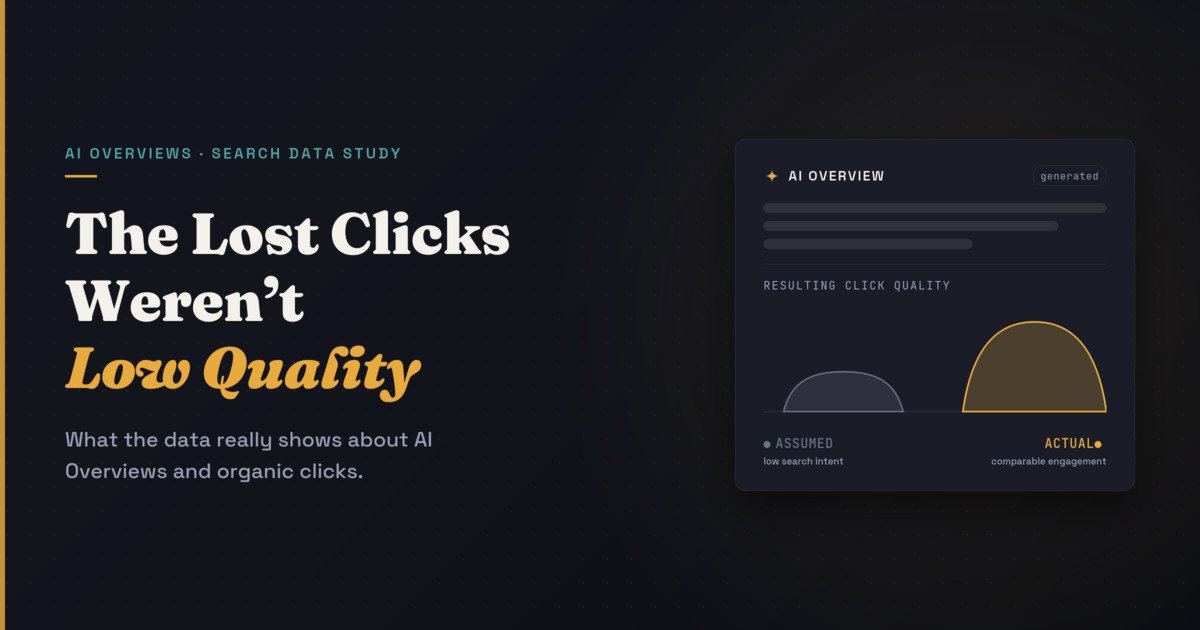
Google’s answer has been consistent and reassuring. The company claims that the clicks disappearing from your analytics dashboard were mostly low value visits anyway. People who would have clicked, skimmed for a few seconds, and bounced straight back to the results page. In other words, AI Overviews were supposedly filtering out junk traffic while the clicks that remained became more valuable.
An updated randomized field experiment now puts real data behind that debate, and the results cut in a genuinely surprising direction. The researchers found no measurable difference in bounce rates, time on site, or returns to search between clicks that happened with AI summaries present and clicks that happened without them.
That single finding reshapes how publishers, marketers, and SEOs should think about the ongoing shift in search. This article breaks down what the experiment measured, why the results contradict Google’s public messaging, and what you should actually do about it.
What the Updated AI Overviews Experiment Actually Measured
The research comes from a randomized field experiment conducted by academics Saharsh Agarwal and Ananya Sen, with an updated version of their working paper published on SSRN. Unlike correlational studies that simply compare traffic before and after AI Overviews rolled out, this was a controlled test. Some search sessions displayed AI Overviews and others had them removed, which allowed the researchers to isolate the effect of the summaries themselves.
The original version of the paper focused on click volume. The updated version adds something the industry has been waiting for: a click quality comparison. For queries where an AI Overview would have appeared, the authors measured three engagement signals on the destination websites.
- How often users hit the back button and returned to the search results page
- How often a visit ended within ten seconds with no interaction
- Total time spent on the destination site
These three metrics map almost perfectly onto what Google itself has described when discussing traffic quality. That makes the findings especially difficult to dismiss.
The Headline Numbers: A 39.8 Percent Drop in Organic Clicks
Before getting to the quality question, the volume finding deserves attention on its own. The experiment showed that organic clicks fell by roughly 39.8 percent when AI Overviews were displayed.
That number aligns with what many site owners have reported anecdotally since the feature launched. It also matches earlier data showing how aggressively AI generated summaries overlap with organic results. As covered in Google’s AI Overviews are shaking up the SEO world, AI summaries were already overlapping more than half of organic search results by late 2025, and the footprint has grown since.
A near 40 percent reduction in clicks is enormous. But the industry has largely accepted that the volume loss is real. The open question was always about what kind of clicks were being lost. That is where this study becomes genuinely contrarian.
The Contrarian Finding: Click Quality Did Not Change
Here is the core result. Across all three engagement measures, the researchers found no statistically significant difference between the group that saw AI Overviews and the group that did not.
Bounce Rates Stayed the Same
Roughly 18 percent of visits ended within ten seconds without any interaction in both conditions. If AI Overviews were absorbing the low intent searchers, the group without summaries should have shown noticeably worse quick exit numbers. It did not.
Returns to Search Were Identical
About four in ten same tab clicks eventually led users back to the search results page, and that figure held steady whether or not an AI Overview had been present. Pogo sticking behavior, one of the clearest signals of an unsatisfying click, was unchanged.
Time on Site Showed No Measurable Difference
Total time spent on destination sites was statistically indistinguishable between the two groups. Visitors who clicked through in a world without AI Overviews engaged just as deeply as visitors who clicked through with the summaries on screen.
The logic of the test is elegant. If AI Overviews truly absorbed mostly shallow, low value visits, then the extra clicks appearing in the no Overview group should have looked worse on average. They should have bounced more, returned to search more often, and spent less time on the page. None of that happened. The extra clicks websites receive when AI Overviews are removed appear to be of the same quality as the clicks that survive when the summaries are shown.
Why This Finding Contradicts Google’s Official Story
Google VP of Search Liz Reid has publicly stated that AI Overviews reduce what she called bounce clicks, meaning visits where a searcher lands on a page, immediately realizes it does not answer their question, and heads back to Google. The implication was that publishers losing traffic were mostly losing visits that never mattered.
The problem is that Google has never released data supporting that claim. This experiment approaches the same question from the opposite direction with an actual randomized design, and the data points the other way. The lost clicks were just as engaged as the clicks that remained.
This matters because Google’s messaging has shaped how many businesses responded to their traffic declines. Site owners were encouraged to view shrinking numbers as a quality upgrade rather than a genuine loss. If the surviving clicks are not actually better, that reframing falls apart, and the near 40 percent volume decline has to be treated as a real business impact rather than a statistical cleanup.
It is worth noting that engagement quality in search is not a trivial topic for Google either. User interaction signals feed into how the company evaluates results, and business owners are encouraged to monitor engagement through official tools, as outlined in Google’s own performance reporting documentation.
What “Bounce Clicks” Were Supposed to Explain
The bounce clicks narrative served a useful purpose. It explained why traffic was falling while allowing Google to argue that nothing valuable was being taken from publishers. A bounce click, in Google’s framing, is a wasted visit for everyone involved. The user wastes time, the publisher gets a meaningless pageview, and the ad ecosystem records an impression nobody wanted.
If AI Overviews eliminated only those visits, the tradeoff would arguably benefit the entire web. Users would get faster answers, and publishers would get cleaner analytics with more committed visitors.
The updated experiment undermines that framing directly. When the summaries were removed, the additional traffic that flowed to websites did not consist of impatient fact checkers. Those visitors read, stayed, and engaged at the same rates as everyone else. The visits AI Overviews absorb are, on average, normal visits. They carry real attention, real ad impressions, and real conversion potential.
What This Means for Publishers and Site Owners
The Clicks You Lost Were Real Clicks
The most practical takeaway is also the most uncomfortable one. If your informational content has lost significant traffic to AI Overviews, that traffic was not disposable. It represented genuine readers with genuine engagement. Any strategy built on the assumption that AI Overviews merely trimmed the fat needs to be revisited.
This also changes how you should interpret your analytics. A stable bounce rate alongside falling sessions is not evidence that Google filtered your audience down to the serious visitors. According to this data, it simply means fewer people arrived, and the ones who did behaved like they always have.
Traffic Quality Is Not Your Consolation Prize
Many recovery playbooks published over the last year leaned on the idea that surviving clicks convert better, so revenue would hold up even as sessions fell. That may still be true for specific sites and specific query types, but it can no longer be treated as a general law of the AI Overviews era. Measure your own conversion data rather than assuming the quality upgrade happened.
If your site took a hit during recent algorithm turbulence on top of AI Overview losses, it helps to separate the two problems. The guide on how to recover from a Google core update walks through diagnosing ranking driven losses, which require a very different response than SERP feature driven losses.
How to Respond Strategically in 2026
Accepting that the lost clicks were valuable does not mean accepting defeat. It means redirecting effort toward the places where visibility still compounds.
Optimize for AI Answers, Not Just Rankings
If summaries are going to sit above your listings, the next best position is inside them. Getting cited within AI generated answers preserves brand visibility and captures the clicks that do still happen. A practical starting point is this guide on how to optimize for AI answers, which covers structuring content so that AI systems can extract, attribute, and cite it.
The broader discipline around this is often split into answer engine optimization and generative engine optimization. If those terms are new to you, the breakdown of AEO vs GEO strategy explains how the two approaches differ and where each one fits. For a ground level introduction, see Generative Engine Optimization explained for beginners.
Build Entity Level Authority
AI systems do not just match keywords. They resolve entities, meaning they need to understand who you are, what you do, and why you are credible before they will cite you. Strengthening your entity footprint through consistent naming, schema markup, and authoritative references is one of the highest leverage moves available right now. The primer on entity SEO for beginners covers exactly how to make both Google and AI models recognize your brand as a distinct, trustworthy source.
Solid fundamentals still matter underneath all of this. Reviewing the Google SEO ranking factors that actually matter in 2026 ensures the technical and content foundation is strong enough for any AI visibility work to pay off.
Diversify Beyond Google Search
The researchers behind the experiment expect AI Overviews to appear on a growing share of queries over time, which means the total traffic impact will likely increase rather than stabilize. That makes channel diversification a survival requirement, not a nice to have.
Conversational platforms are becoming discovery channels in their own right, and they cite sources differently than Google does. The guide on optimizing your site for ChatGPT and Perplexity answers explains how to earn citations in those environments. Alongside that, email lists, communities, and direct relationships with your audience insulate you from any single platform’s decisions.
The Bigger Picture: AI Overviews Will Only Expand
Perhaps the most sobering line in the updated paper is the authors’ forward looking expectation. They anticipate that AI Overviews will trigger on an increasing percentage of queries, expanding the overall traffic impact across the web.
Combine that with the two core findings, a roughly 39.8 percent click reduction and no quality difference in the clicks that remain, and the strategic picture becomes clear. The open web is not losing junk traffic to AI summaries. It is losing ordinary, valuable traffic, and the volume of that loss is set to grow.
For SEOs, this is clarifying rather than paralyzing. The debate about whether the losses are real is effectively settled by this data. The remaining question is execution: how quickly can you shift from ranking centric strategies to visibility strategies that work inside AI generated answers, across multiple platforms, and through owned channels.
Conclusion
The updated AI Overviews experiment delivers one of the most important data points the search industry has seen in years. AI Overviews cut organic clicks by nearly 40 percent, and the clicks that disappear are statistically identical in quality to the clicks that remain. Bounce rates, returns to search, and time on site all held steady with or without the summaries.
That finding directly challenges the idea that AI Overviews merely filter out low value bounce clicks. The lost visits were real readers with real attention. Publishers should stop treating traffic declines as a quality upgrade and start treating them as a structural shift that demands a structural response: optimizing for AI citations, building entity authority, and diversifying discovery channels before AI Overviews expand even further.
The panic around AI Overviews was never really about whether change was coming. It was about whether the change would be fair. This data suggests the losses are real, measurable, and evenly distributed across click quality. The sites that thrive next will be the ones that plan for that reality instead of waiting for reassurance.
FAQs
1. What did the updated AI Overviews experiment find? The randomized field experiment found that AI Overviews reduce organic clicks by roughly 39.8 percent, and that there is no measurable difference in bounce rates, time on site, or returns to search between clicks that occur with AI summaries and clicks that occur without them.
2. Who conducted the AI Overviews study? The study was conducted by researchers Saharsh Agarwal and Ananya Sen. The updated version of their working paper, which added the click quality analysis, was published on SSRN.
3. Does this study contradict Google’s claims about AI Overviews? Yes, in an important way. Google VP of Search Liz Reid has said AI Overviews reduce low value bounce clicks, but Google has not released supporting data. This experiment found the lost clicks were just as engaged as the surviving ones, which conflicts with that explanation.
4. Does this mean AI Overviews do not hurt websites? No. The study confirms a large click volume loss of nearly 40 percent. What it disproves is the idea that the lost clicks were low quality. The traffic being lost is normal, engaged traffic, which arguably makes the impact more serious, not less.
5. Will AI Overviews appear on more searches in the future? The study authors expect AI Overviews to trigger on a growing share of queries over time, which would increase the total traffic impact across websites.
6. How can I keep my site visible if AI Overviews keep expanding? Focus on earning citations inside AI generated answers, strengthen your entity signals so AI systems recognize your brand, keep your technical and content fundamentals strong, and diversify into channels like ChatGPT, Perplexity, email, and communities so no single platform controls your traffic.
7. Should I still track bounce rate and time on site? Yes. Engagement metrics remain useful diagnostics for content quality and search intent alignment. Just avoid interpreting a stable bounce rate during a traffic decline as proof that Google filtered out low value visitors, because this data shows that assumption does not hold.